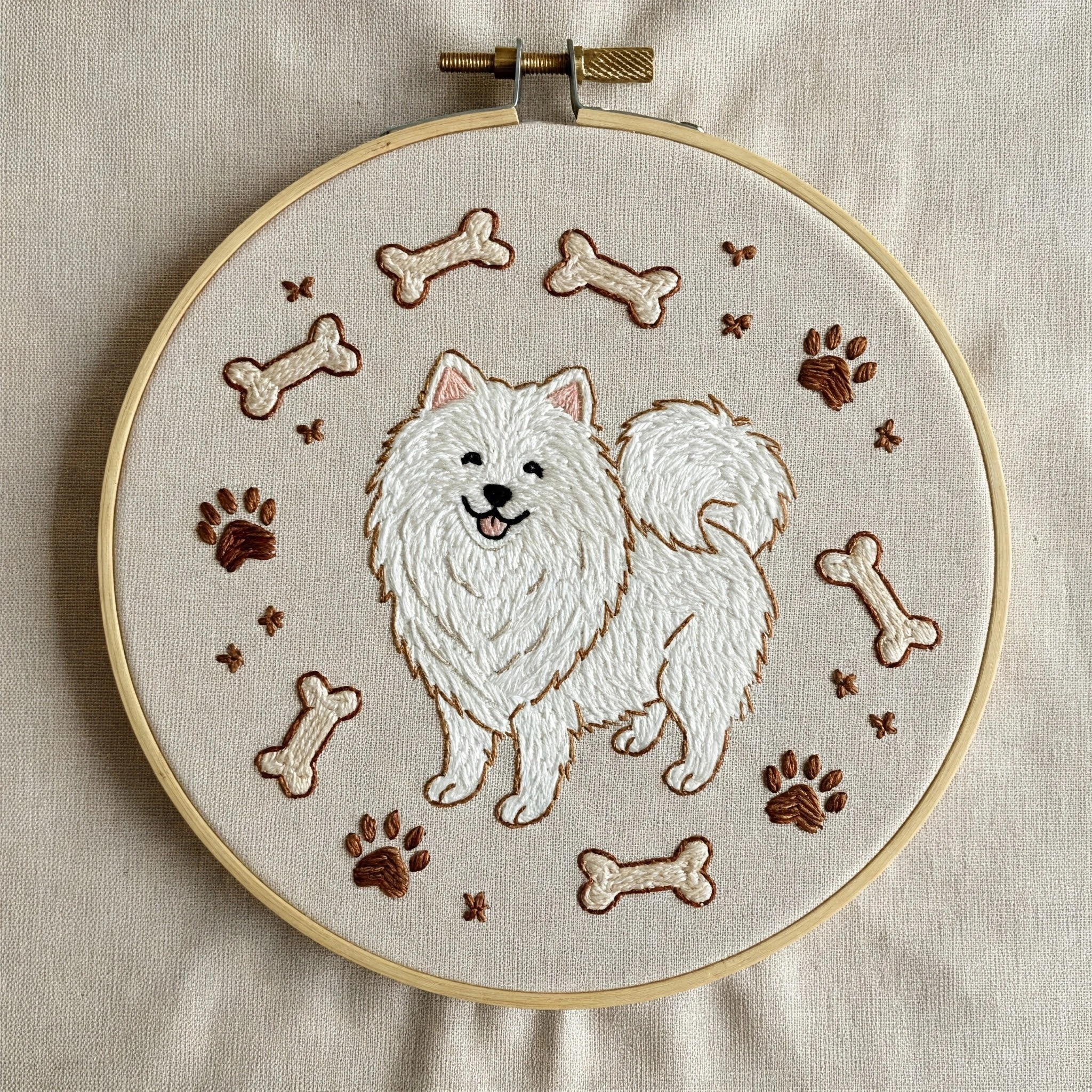

Design #468 · Realistic 3D Golden Retriever Puppy
DMC Palette & Stitching Guide
A soft, dimensional puppy portrait worked on natural linen with creamy white-to-honey fur, warm brown outlining, dark facial features, pink inner ears and tongue, plus playful bones, paw prints, butterflies, and tiny flowers. Colors are visually estimated from the hoop preview and matched to practical DMC floss shades.
Likely DMC Color Palette
The preview reads as a high-relief cream puppy with golden-brown contour stitching and small chocolate accent motifs. Use the pale shades for the raised fur mass, the honey and brown tones for contour and depth, and black only for the polished facial details.
Brightest fur highlights on face, chest, tail tip, and bone centers.
Main cream puppy fur and raised thread layers that should look soft, not stark.
Warm transition shade in cheeks, chest, legs, tail base, and bone shadows.
Subtle golden retriever warmth under ears, belly, paws, and lower tail.
Honey shading where the fluffy fur turns away from the light.
Outer puppy outline, leg separations, underside shadows, and bone outlines.
Warm fur flicks, paw pads, butterflies, and medium contour details.
Paw print fill, bone edging, flower centers, and darker outline strokes.
Deep paw pad base, butterfly bodies, strongest fur creases, and lower shadows.
Eyes, nose, mouth line, and tiny final contrast stitches.
Inner ears and tongue base; use sparingly so the face stays natural.
Tongue shadow and the deepest corner of each pink ear.
Optional linen-shadow stitches around cream bones and paws.
Natural hoop-toned grounding stitches and subtle background specks.
Optional sunlit golden glints on puppy ears and top of tail.
Blend with 3865 when white looks too bright against natural linen.
Stitching Suggestions
Build the puppy in soft layers: map the outline first, fill low areas with split or long-and-short stitch, then add raised surface texture last. Keep the background motifs flatter so the puppy remains the dimensional focal point.
| Element | Stitch Type | Practical Notes |
|---|---|---|
| Puppy face | Long and short stitch, split stitch | Radiate stitches away from the nose, eyes, and cheeks. Use 3865 as the base, B5200 on the brow and muzzle, and 712/739 under the chin. |
| Fluffy body | Layered straight stitch, turkey work, couching | Follow the visible fur direction: downward on the chest, curved around the shoulders, and swept upward on the tail. Trim turkey work cautiously for a plush 3D effect. |
| Tail plume | Turkey work, loose long stitches, feather stitch | Use the longest pile on the outer curl and shorter stitches inside the spiral. Mix B5200 + 3865, then add a few 712 shadow strokes near the base. |
| Legs & paws | Short satin stitch, split backstitch | Keep stitches shorter around toes to avoid bulky feet. Add 437 on the underside and one-strand 433 between toe separations. |
| Ears & tongue | Satin stitch, tiny straight stitches | Use one strand of 754 for soft pink fill, add 353 only in the inner crease and tongue base, then soften edges with cream stitches. |
| Eyes, nose & smile | Satin stitch, padded satin, backstitch | Pad the nose with two small under-stitches before satin stitching in 310. Leave or add a tiny B5200 highlight to keep the face lively. |
| Bone treats | Split stitch outline, satin stitch, stem stitch | Fill bone centers with 3865/712 and outline with 437 or 433. Curve stitches around the rounded ends so each bone looks puffy. |
| Paw prints | Satin stitch, fishbone stitch, backstitch | Use 433 for the main pads and 898 at the lower edge. Stitch each toe oval separately for a clean raised footprint. |
| Butterflies & tiny flowers | Detached chain, lazy daisy, French knots | Use 434/433 for wings and 898 for bodies. Keep these accents small and flat so they do not compete with the puppy fur. |
| Final outline | One-strand backstitch or split stitch | Outline after the fur is finished. Break the line into tiny irregular fur strokes instead of a continuous heavy border. |
Thread Count, Blending & Dimension
Base fill
Use 2 strands for most long-and-short fill on cotton or linen. For dense fur areas, stitch a neat base layer first so raised stitches have something to grip.
Fur highlights
Use 1 strand of B5200 over 3865 for bright wisps on the forehead, chest, tail edge, and top of paws. Do not overblend; visible direction creates realism.
Warm golden blend
Thread one needle with 3865 + 712 for creamy shadows, and another with 712 + 739 for honey-colored depth under the ears and belly.
Dark accents
Reserve 310 for the face only. Use 898 or 433 for most dark brown details so the puppy keeps a warm, natural look.
Raised 3D areas
For turkey work, knot securely, work loops slightly longer than needed, then trim gradually. Brush with a clean toothbrush to fluff before final shaping.
Flat background balance
Use 2 strands for bones and paw prints, but keep butterflies and flowers at 1 strand. This preserves depth hierarchy: puppy first, accents second.
Outlining, Shading & Texture Plan
- Trace the puppy with a light, broken 437 split stitch before filling so the silhouette stays round but not cartoon-heavy.
- Shade under the chin, belly, inner legs, and tail base with short 739 or 437 strokes tucked beneath cream fur.
- Use 433/898 for paw prints and bone outlines to echo the warm brown sample stitching.
- Add the nose, eyes, smile, tongue, and ear pinks near the end so they remain crisp and clean.
- For a realistic 3D look, vary stitch length constantly; perfectly even fur can look stiff.
- After finishing, steam from the back only and avoid pressing the raised fur directly.
Beginner-Friendly Working Order
Start with bones and paw prints to warm up, then stitch the puppy outline, base fur, face, tail texture, and final details. Use shorter thread lengths, about 14–16 inches, because pale floss shows fuzz and wear quickly. Keep hands clean while working with B5200 and 3865, and test any washable transfer marks on scrap linen before stitching the cream fur.
Fur