
Dandelion Wish
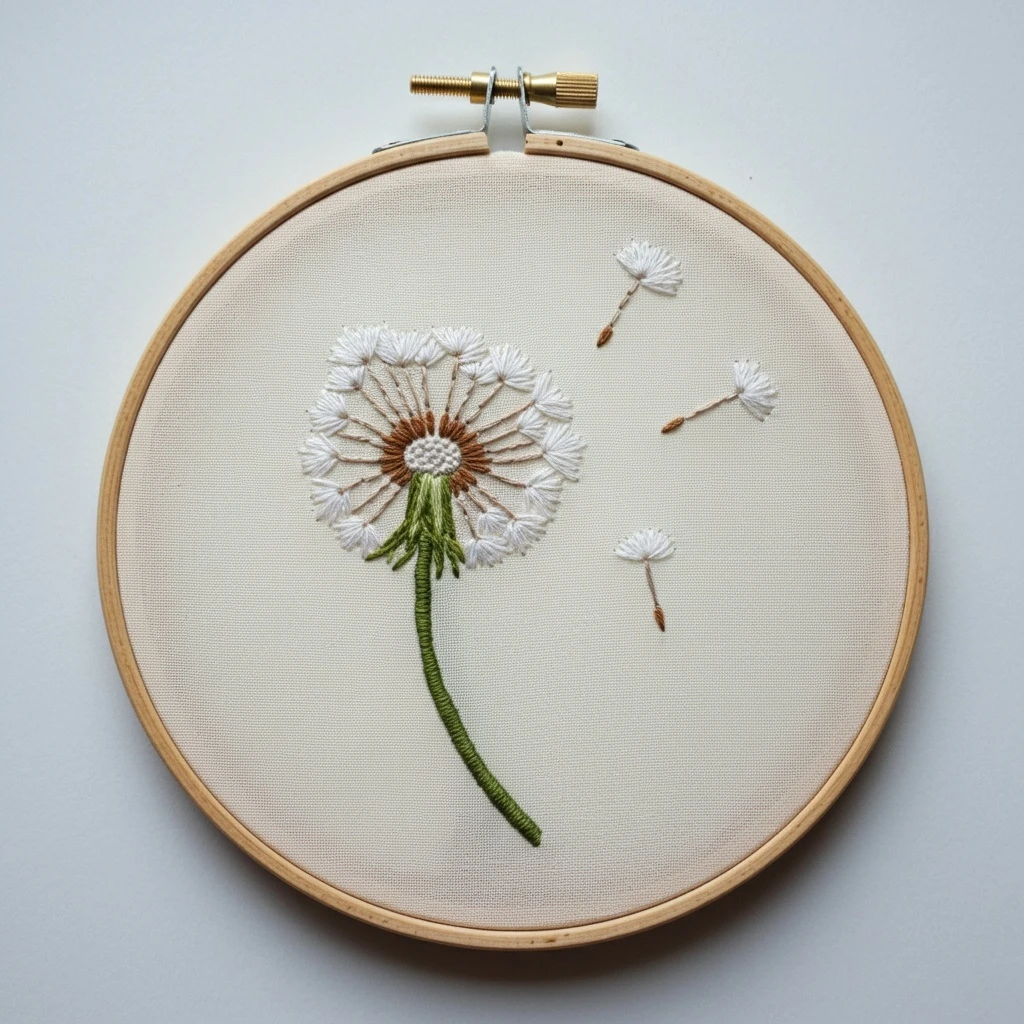
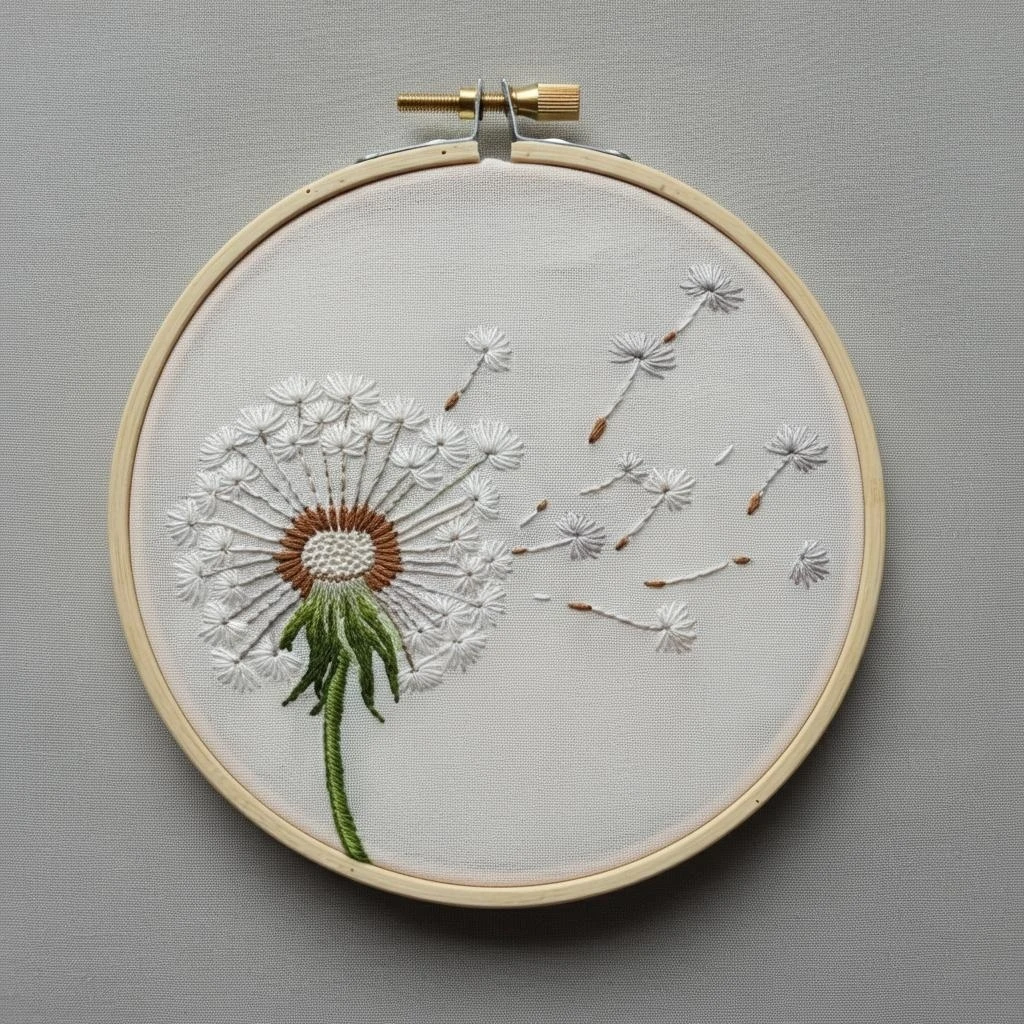
A soft botanical palette for a dandelion clock: airy white seed parachutes, warm brown seed bases, a textured olive stem, and a calm natural linen ground.
Polished DMC palette
Use these as practical, stitchable matches for the design. The palette keeps the dandelion delicate while preserving enough contrast on beige or oatmeal linen.
Main highlights for seed fluff tips and the brightest areas of the dandelion clock.
Softer white for inner fluff, so the parachutes do not look flat or stark.
Fine spokes, subtle seed stems, and low-contrast interior structure.
Warm seed bases and the small flying seed tips; use sparingly for natural accents.
Darker crescent around the flower center and tiny shadow strokes at seed anchors.
Cool shadow inside white fluff when stitching on cream fabric; adds separation.
Fresh highlights on the stem ribs and the upper bracts beneath the flower head.
Main stem color; good for wrapped or stem-stitch lines with a leafy dandelion look.
Lower stem shadow, underside of bracts, and tiny definition where the stem curves.
Stitch map
The design is most successful when the dandelion is kept light: long airy strokes, tiny knots, and controlled thread counts instead of dense satin filling.
| Design area | Recommended stitch | Thread count & colors | Practical notes |
|---|---|---|---|
| Large seed-fluff fans | Straight stitch, fly stitch, or long-and-short feathered spokes | 1 strand B5200 blended visually with 3865; add a few 762 shadows | Start every spoke near the seed center and radiate outward. Keep stitch lengths varied so the head feels soft, not mechanical. |
| Fine seed spokes | Back stitch or split back stitch | 1 strand 842; optional 1 strand 3865 over the outer half | Use 842 for the barely-there beige lines visible in the reference. Do not use dark brown for all spokes or the flower will look too heavy. |
| Central seed head | French knots, colonial knots, or tight seed stitch | 2 strands 3865 for light knots; 1 strand 975 and 433 around the lower crescent | Cluster knots irregularly. Place darker knots mostly below and around the edge to echo the warm brown ring in the image. |
| Green bracts beneath flower | Fishbone stitch, detached chain, or short straight stitches | 2 strands 734 and 732; touch of 730 at the base | Angle each bract downward from the center. Alternate light and medium greens for lively texture. |
| Curved stem | Stem stitch, whipped back stitch, or outline stitch | 2 strands 732; whip with 734 on the light side and add 730 on the shadow side | Follow the curve in small increments. For a thicker stem, work two close rows of stem stitch rather than one bulky strand bundle. |
| Floating wishes | Straight stitch fan plus tiny seed-stitch base | 1 strand B5200/3865 for fluff, 1 strand 842 for stalk, 1 strand 433 for seed tip | Keep the flying seeds finer than the main flower. Their lightness creates the drifting motion. |
Thread-count, blending & shading guidance
Delicate default
For a 5–6 inch hoop, use 1 strand for seed fluff and spokes, 2 strands for the stem, and 2 strands only for the center knots. This preserves the airy negative space.
Visible contrast on linen
If your fabric is close to cream, stitch outer fluff with B5200 and reserve 3865 for inner layers. Add occasional 762 shadow strokes at the underside of overlapping fluff.
Soft blended stem
Thread the needle with one strand 732 plus one strand 734 for the upper stem. Switch to one strand 732 plus one strand 730 near the lower bend for depth.
Warm seed detail
Use 433 for golden-brown seed tips and 975 only for the darkest center accents. Too much 975 can overpower the quiet white dandelion clock.
Best fabric pairing: natural linen, oatmeal cotton, or warm ivory fabric. If using white fabric, replace some B5200 with 3865 and 762 so the parachutes remain visible.
Beginner-friendly stitching order
Trace lightly
Mark the circular seed head, main stem curve, and floating seeds with a fine erasable line. Avoid thick transfer marks under white stitches.
Anchor the greens
Stitch the stem first so the design has structure. Add bracts next, changing direction with each leaf-like stroke.
Build the center
Work the white knots in the center, then add the brown crescent and tiny warm seed bases around it.
Add spokes
Use 1 strand beige for radial guide lines. Keep tension gentle so long stitches do not pucker the fabric.
Float the fluff
Fan B5200 and 3865 straight stitches outward from each spoke end. Vary the spacing to mimic natural dandelion parachutes.
Finish cleanly
Add the loose flying seeds last. Steam from the back over a towel, then trim any visible white tails behind open areas.
Texture suggestions
Raised center
- Wrap French knots twice with 2 strands for a plump center.
- Mix knot sizes: single-wrap knots at the edge, double-wrap knots in the center.
- Scatter a few 975 knots along the lower edge only.
Feathery parachutes
- Use a sharp needle for clean long stitches.
- Let some spokes stop short to create transparent gaps.
- Add one tiny couching stitch if a long white spoke feels loose.
Outlined definition
- Outline the stem with 730 on the shaded left/lower side only.
- Do not outline every white fluff fan; outline only a few inner seed stems with 842.
- Use tiny 433 straight stitches for seed tips to add readable detail.
Neat back tips
- Because white stitches are open, park thread tails under the stem or center where coverage is denser.
- Keep jumps behind floating seeds very short, or end and restart.
- Use a hoop with firm tension to prevent long stitches from sagging.