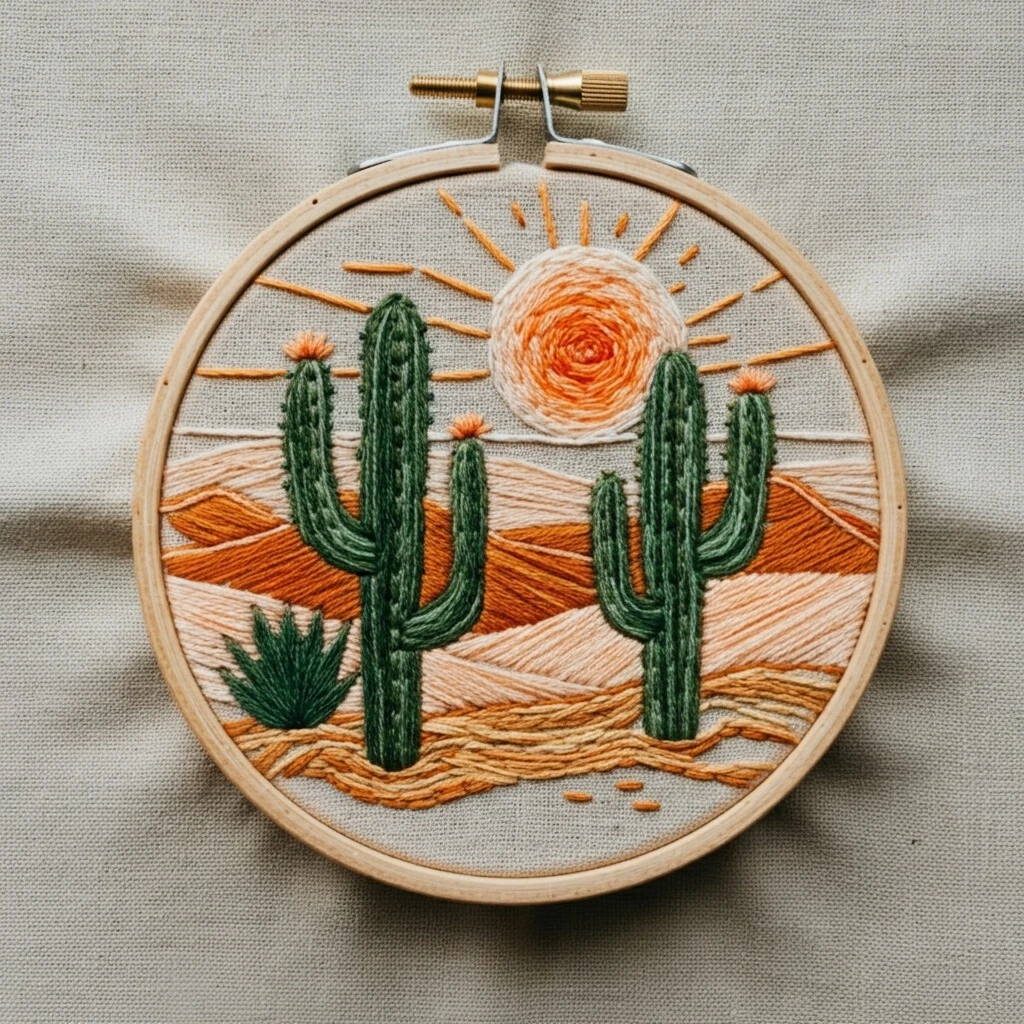

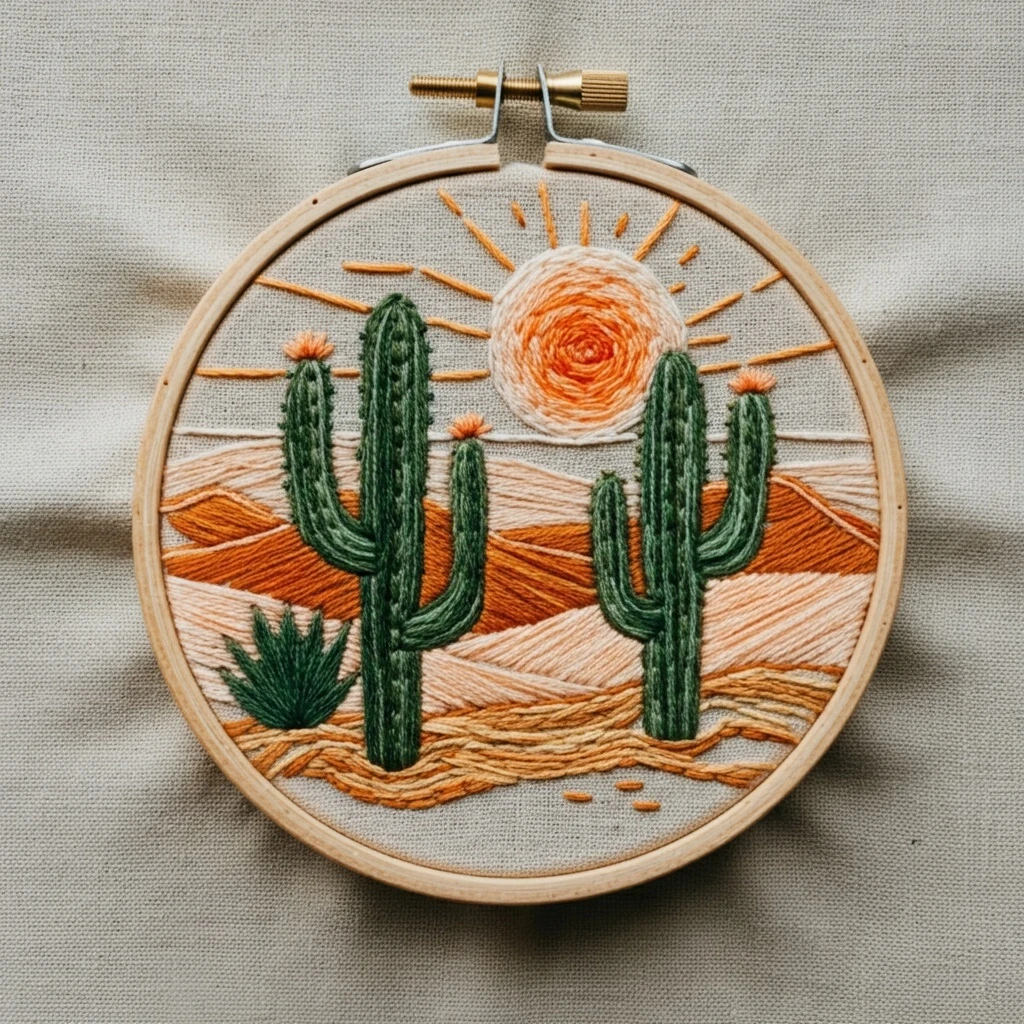
Desert Sunset
A warm hoop-art landscape with glowing sunset bands, dusky desert earth, soft sky notes, and small cactus silhouettes. The palette should feel sun-baked but refined: terracotta, ochre, copper, shaded brown, muted cactus green, and a gentle blue haze for contrast.
Color reading from the design
The reference image reads as a circular desert scene with pale blue upper sky, a peach-gold horizon glow, orange and coral sunset transitions, red-brown mesas, dark sandy foreground, and small green cactus accents. Keep the strongest darks for silhouettes and outline accents so the sunset remains luminous.
Suggested DMC floss palette
These DMC choices are selected for a desert-sunset embroidery interpretation rather than a strict chart conversion. Use the notes to decide where each shade belongs.
Stitch plan
Thread-count guidance
- Sky fills: 1-2 strands for smooth blends; 1 strand gives the most painterly sunset.
- Hills and dunes: 2 strands for coverage, switching to 1 strand near edges for cleaner curves.
- Cactus details: 1 strand for outlines and ribs; 2 strands only for thicker cactus bodies.
- Foreground texture: 1 strand seed stitches so the bottom area stays airy and not bulky.
- Outer linework: 1 strand of DMC 3371 or 918 for definition without a cartoon-heavy border.
Blending and shading ideas
Texture suggestions
To avoid flat blocks of color, vary stitch direction between the sky, hills, and foreground. Smooth horizontal stitches suit the sunset, while diagonal stitches help hills recede. Tiny seed stitches near the lower edge create sandy grit and give the composition a handcrafted finish.
Outlining details
- Outline distant hills in DMC 921 for warmth instead of black-brown.
- Use DMC 3371 only where you want true silhouette contrast.
- Split stitch gives smoother curves than back stitch around circular sunset bands.
- For a softer modern hoop look, outline only the foreground and cactus, not every sky band.
Beginner-friendly practical tips
- Transfer the largest horizon and hill shapes first, then add plant details after the main fills are complete.
- Keep thread lengths around 35-45 cm to reduce fraying in warm-toned floss.
- Use a hoop tight enough that the fabric sounds slightly drum-like when tapped.
- Stitch light colors before dark browns and greens to avoid lint transfer.
- When filling curves, rotate the hoop rather than forcing your wrist into awkward angles.
- Step back after each color band; sunset embroidery looks best when values are balanced from a distance.
- If using dark fabric, add a pale underlayer with one strand of 3865 beneath the brightest yellow-orange highlights.
- Press from the back on a towel when finished so the raised stitches stay dimensional.