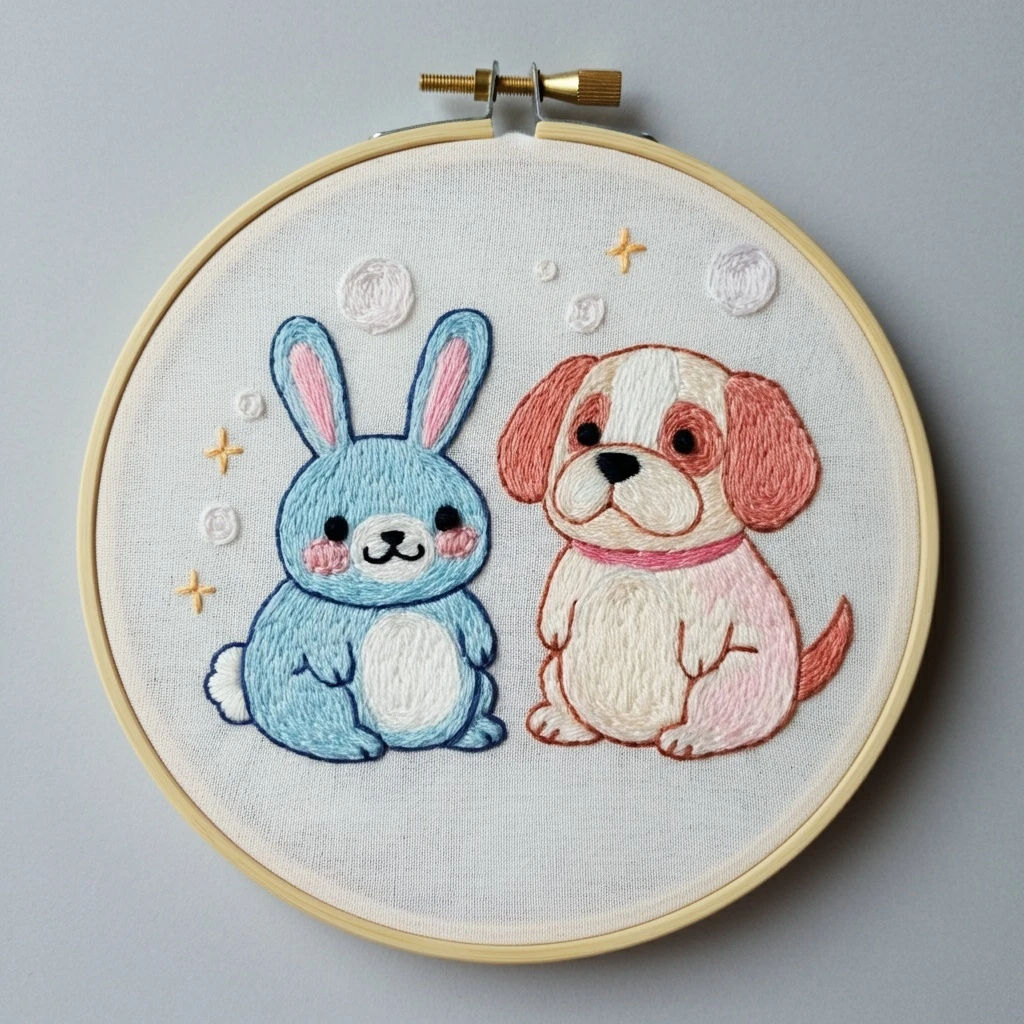

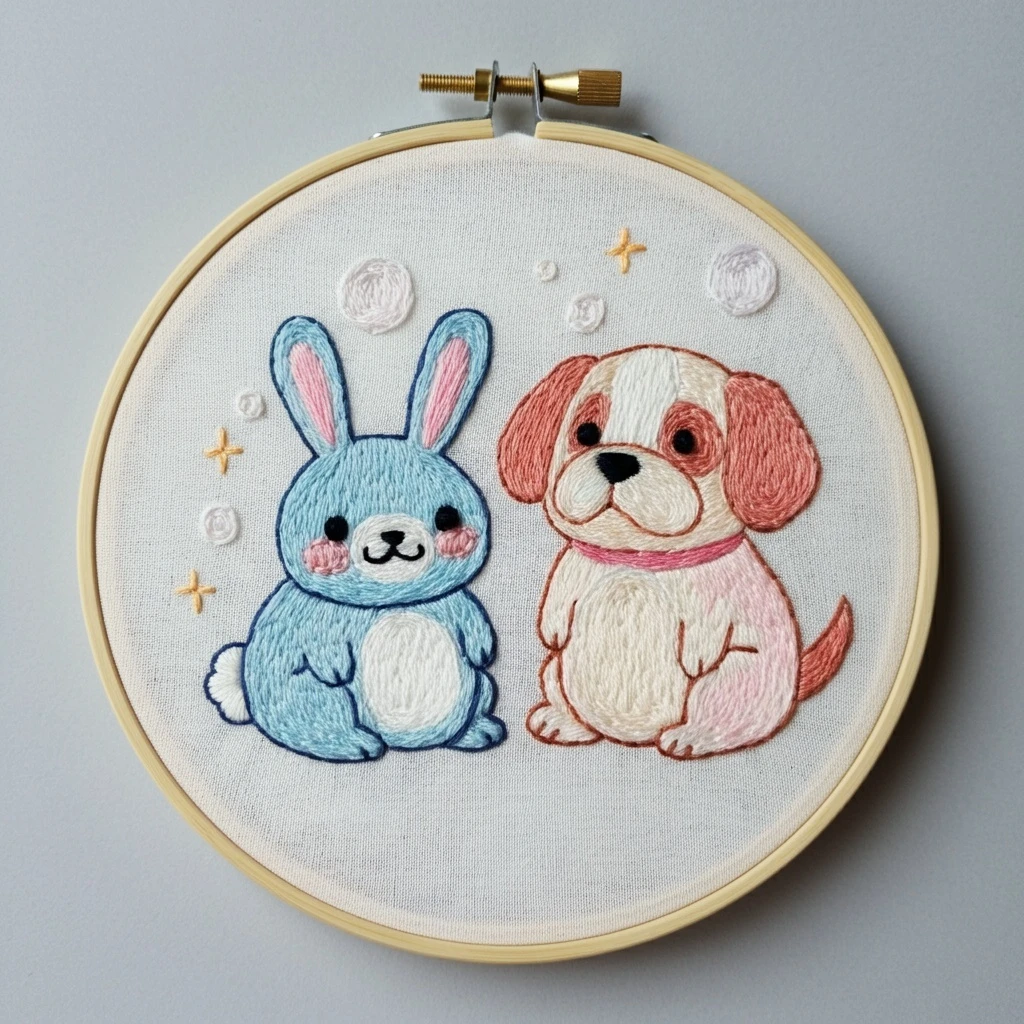
Beginner Friendly Embroidered Bunny And Puppy Hoop Art
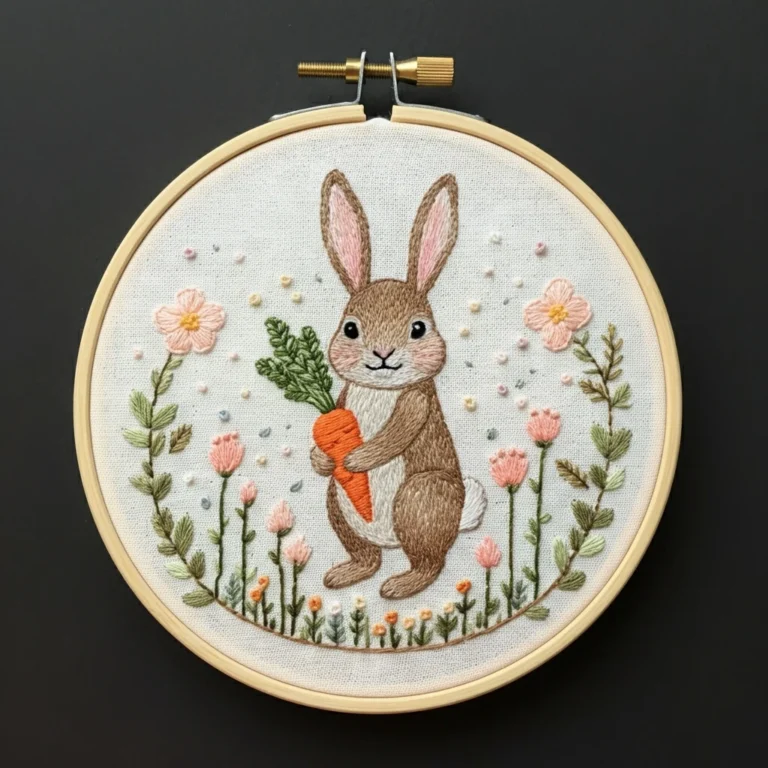
A soft, sweet beginner hoop built around two gentle animal characters, rounded floral sprigs, warm earth outlines, and tiny decorative details. Use simple stitches, controlled strand counts, and a calm pastel palette to keep the design charming without becoming fussy.
Color story from the design
The reference artwork suggests a cozy nursery-style hoop: a pale bunny, a warm puppy, delicate greenery, small blossoms, and fine brown outlines. The palette should feel light and readable on fabric, with gentle creams and tans for the animals, fresh greens for stems and leaves, and cheerful pink, yellow, and blue accents for the surrounding flowers.
For best visibility, work on natural linen, ivory cotton, or a pale oatmeal ground. Avoid stark white fabric if using very pale animal highlights; an off-white base makes the bunny and puppy faces easier to see.
Suggested DMC floss palette
Stitch map by design area
| Area | Recommended stitches | Practical notes |
|---|---|---|
| Bunny body | Back stitch outline, satin stitch patches, split stitch curves | Keep fills small and directional; use 842 with 3865 highlights and 841 shadows. |
| Puppy body | Long-short stitch, stem stitch, tiny straight stitches | Blend 3864 and 435 for warm fur; reserve 898 for facial dots only. |
| Faces | French knots, single straight stitches, couching if needed | Use one strand for eyes, noses, smiles, whiskers, and eyelashes so expressions stay delicate. |
| Flowers | Lazy daisy, woven wheel, satin stitch centers, French knots | Use 2 strands for petals, 3 strands for plump flower centers. |
| Leaves & stems | Stem stitch, fishbone stitch, detached chain | Alternate 772 and 3347 to create lively but simple greenery. |
Blending and shading guidance
Soft animal fur
For the bunny, pair one strand of DMC 842 with one strand of 3865 where the fur needs to look creamy and light. For shadowed sides, blend one strand 842 with one strand 841. For the puppy, blend 3864 with 435 for golden-brown areas, then place a few single-strand 898 stitches only in the deepest points.
Pastel blossoms
Use DMC 818 at petal tips and 761 near the flower centers. A few DMC 726 French knots brighten the floral cluster without adding complicated color changes.
Cool balance
Small touches of 747 or 3761 keep the hoop from becoming too beige. Add them sparingly in blue blossoms, tiny buds, or cool reflected highlights near white fur.
Texture suggestions
- Fluffy tails: Use small seed stitches in 3865 and 842, scattered rather than lined up.
- Floppy puppy ears: Work long-short stitches following the curve of the ear so the surface reads as soft fur.
- Round cheeks: Add two or three tiny straight stitches in 3779 or 818; do not overfill the blush.
- Leaf movement: Use fishbone stitch for larger leaves and single detached-chain stitches for tiny leaves.
- Flower depth: Mix lazy daisy petals with French-knot centers for dimension without advanced stitches.
Outlining details
Use DMC 898 very selectively. Heavy dark outlines can make beginner animal designs look harsh, so outline most body curves with 841 for the bunny and 3864 or 435 for the puppy. Save 898 for eyes, nose tips, mouth curves, and the smallest anchor points.
For smoother curves, keep back stitches short around faces and paws. On longer body curves, split stitch gives a soft, rope-like edge that looks polished even when the fabric tension is not perfect.
Beginner-friendly stitching order
Trace the design lightly and hoop the fabric drum-tight. Add a backing fabric if your ground cloth is thin.
Work animal outlines first with 1-2 strands. Keep facial features for later so they stay clean.
Use satin stitch for small patches and long-short stitch for curved body shapes. Follow the animal form instead of stitching all in one direction.
Build the garden around the animals. This lets flowers overlap naturally and hides tiny outline joins.
Use one strand for eyes, noses, smiles, whiskers, paw marks, and final blush. These details define the character, so stitch slowly.
Practical tips for a polished hoop
- Cut floss lengths around 14-16 inches to prevent fuzzy pale threads, especially on bunny highlights.
- Use a needle small enough to pass through previous stitches cleanly; a size 7 or 8 embroidery needle is comfortable for 2 strands.
- Keep satin stitches short. For wide areas, split the shape into smaller sections or use long-short stitch instead.
- Turn the hoop as you work around faces and ears; short stitches look smoother when your hand follows the curve.
- Press finished work from the back on a towel so French knots and petal stitches stay raised.
- Before framing, check the animal faces from arm's length. Add only one or two extra stitches if an expression needs balancing.