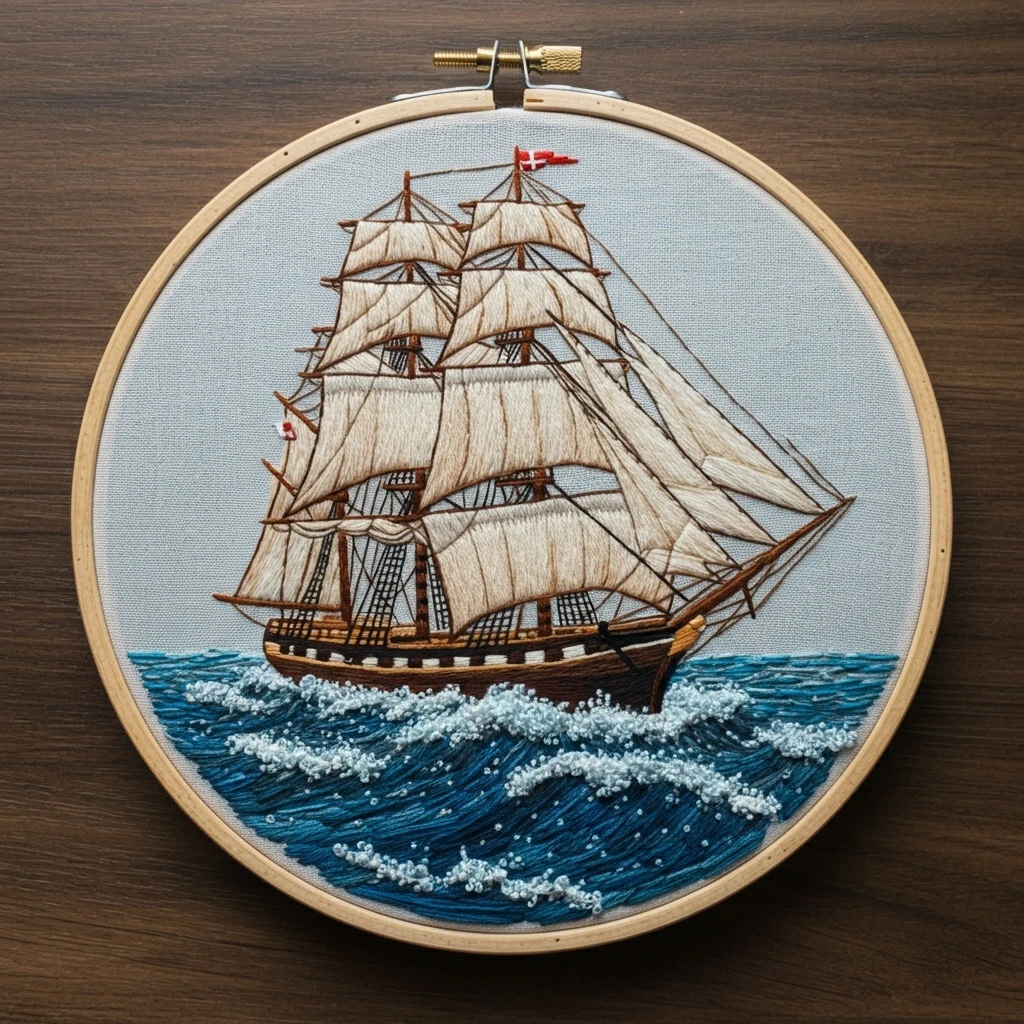

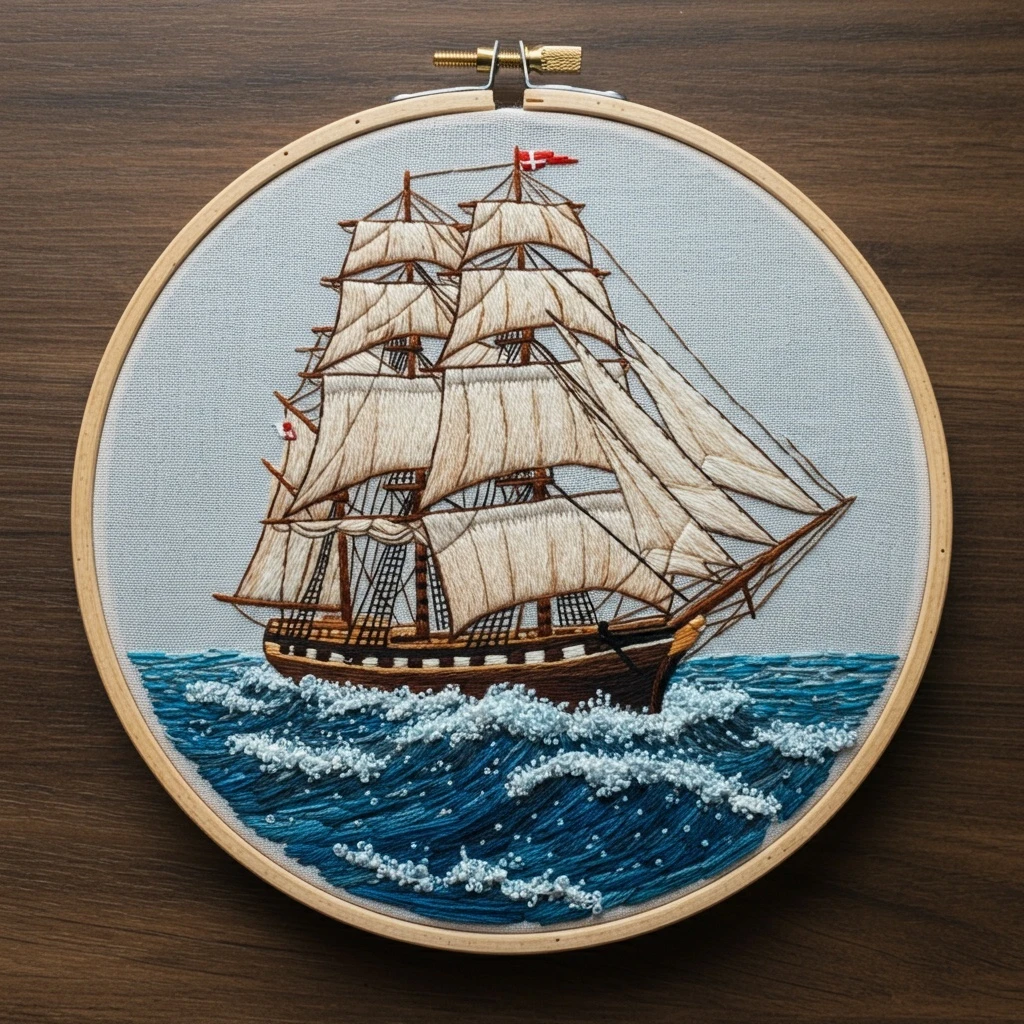
Embroidered Tall Ship On The High Seas
A polished floss palette and practical stitch plan for a dramatic hoop scene with cream canvas sails, warm brown rigging, a dark wooden hull, teal-blue rolling water, and frothy white sea spray.
Color story observed from the design
The reference has a classic nautical balance: weathered ivory sails edged in warm brown, a deep chocolate hull with small pale window details, reddish flags, pale blue background fabric, and a highly textured band of blue-green water. The most important embroidery effect is contrast: smooth, slightly aged sails against energetic waves and raised foam.
Stitch map and thread-count guidance
| Area | Suggested stitches | Strands | Practical notes |
|---|---|---|---|
| Sails | Long-and-short stitch, split stitch seam lines, tiny straight-stitch grain | 1–2 | Fill each sail panel following its curve. Blend DMC 712 with 642 sparingly near lower folds so the sails stay luminous rather than muddy. |
| Masts, spars & rigging | Stem stitch, back stitch, couching for long ropes | 1 for rigging, 2 for masts | Use DMC 801 for visible ropes and DMC 938 only where lines overlap or disappear behind sails. Keep rigging taut by stitching from anchor point to anchor point. |
| Hull | Satin stitch, split stitch outline, short straight stitches for planking | 2–3 | Work the hull dark first, then add DMC 975 rail highlights and small B5200 cabin marks last so they stay clean. |
| High seas | Directional satin stitch, split stitch rows, whipped back stitch for crests | 2–4 | Use 3768 in troughs, 3810 as the main band, and 3846 on upper curves. Vary stitch length so the water feels restless. |
| Foam & spray | French knots, colonial knots, detached chain, seed stitch | 2–3 | Cluster knots densely near the bow wake and wave tops, then scatter outward with fewer knots for natural spray. |
| Flags | Satin stitch, back stitch outline | 1–2 | Because the flags are tiny, stitch red areas after the rigging and avoid carrying red thread across pale sails. |
Blending, shading, and texture plan
Weathered sails
Thread-paint the sails with mostly DMC 712. Add thin, irregular strokes of 3863 and 642 from the top attachment points downward, imitating the vertical creases visible in the reference. Avoid perfectly parallel lines; slight waviness makes the canvas look wind-filled.
Dark hull contrast
Anchor the composition with DMC 938 along the lower hull and stern. Place DMC 801 above it and reserve DMC 975 for warm trim. A single strand of B5200 or 712 makes the tiny porthole/window marks pop.
Active ocean
Work the sea in sweeping horizontal arcs rather than straight rows. Blend 3810 with 3846 in the needle for brighter ridges, then use 3768 under the bow and wave troughs to create depth.
Optional blending combinations
- Sail midtone: one strand DMC 712 + one strand DMC 3863 for warm canvas folds.
- Cool sail shadow: one strand DMC 712 + one strand DMC 415 where sails overlap.
- Wave highlight: one strand DMC 3846 + one strand B5200 for sparkling crests before adding knots.
- Rope detail: one strand DMC 801 for normal rigging; switch to DMC 938 for the bow lines and deepest crossing points.
Outlining and finishing details
Use a light hand with outlines around the sails. The design depends on many fine rigging lines, so heavy black outlining can flatten the ship. Choose DMC 801 for most outlines, then deepen only the hull base, mast bases, and bow with DMC 938.
Rigging control
For long diagonal lines, make one long laid thread and couch it down every 6–10 mm with tiny matching stitches. This gives cleaner rigging than many short back stitches.
Foam placement
Place the largest French knots where waves break against the hull and along the front crest. Use smaller seed stitches farther away so the foam fades naturally.
Hoop presentation
Mount on pale blue fabric to avoid stitching the sky. Keep the sea boundary slightly uneven and rounded to echo the hoop shape and the stitched sample.
Step-by-step stitching order
- Transfer the ship lightly; mark only key sail edges, mast lines, hull curve, and the top wave crests.
- Fill the large sail panels with 1–2 strands of DMC 712, keeping stitch direction angled with the sail shape.
- Add sail shading with 3863 and 642, then outline sail seams with one strand of 801.
- Stitch masts and spars with 2 strands of 801, adding 975 highlights on sunlit wooden rails.
- Work the hull in 938 and 801, then place pale porthole/window details last.
- Couch or back stitch the rigging in one strand so lines remain fine and elegant.
- Build the ocean with 3768, 3810, and 3846 in sweeping rows, leaving space for foam.
- Add B5200 foam with French knots, seed stitches, and detached chains; finish with the red flags.