
DMC palette & stitching notes
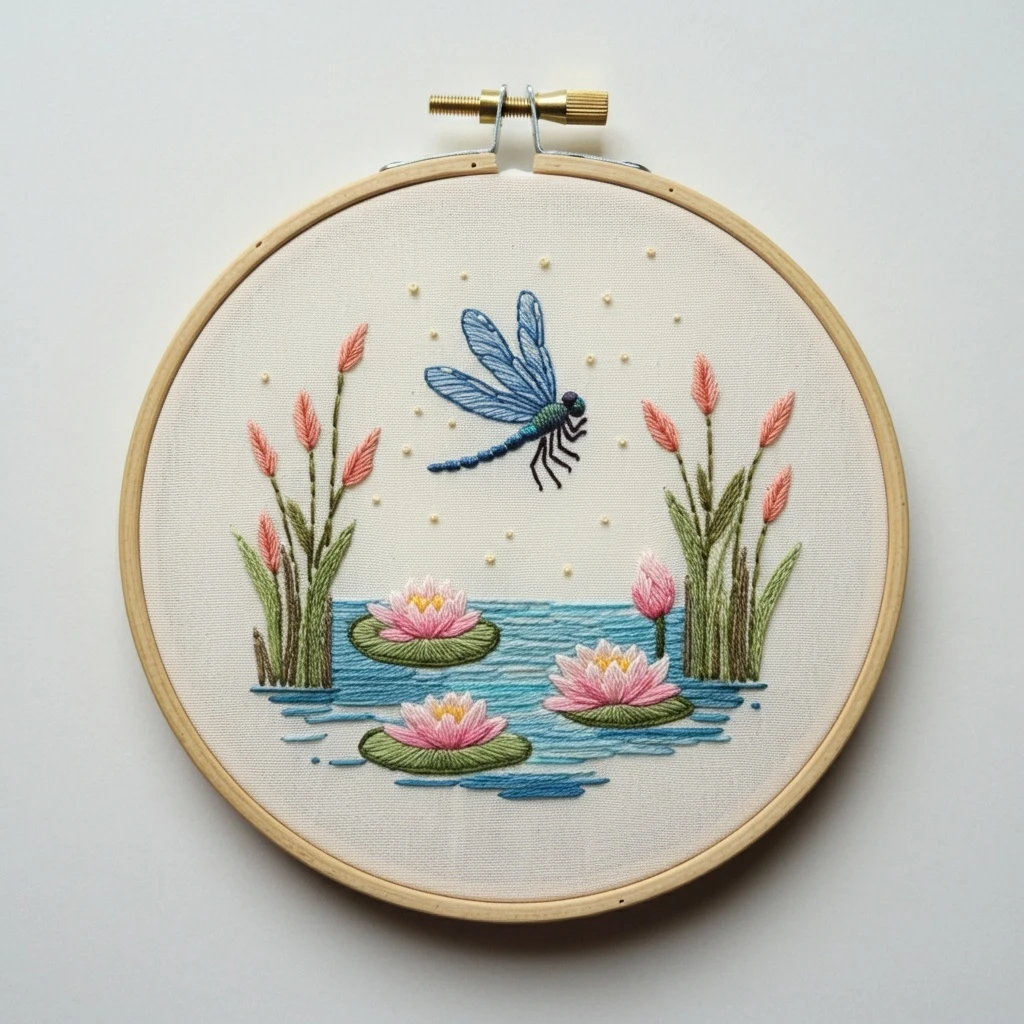
Tranquil Dragonfly Pond
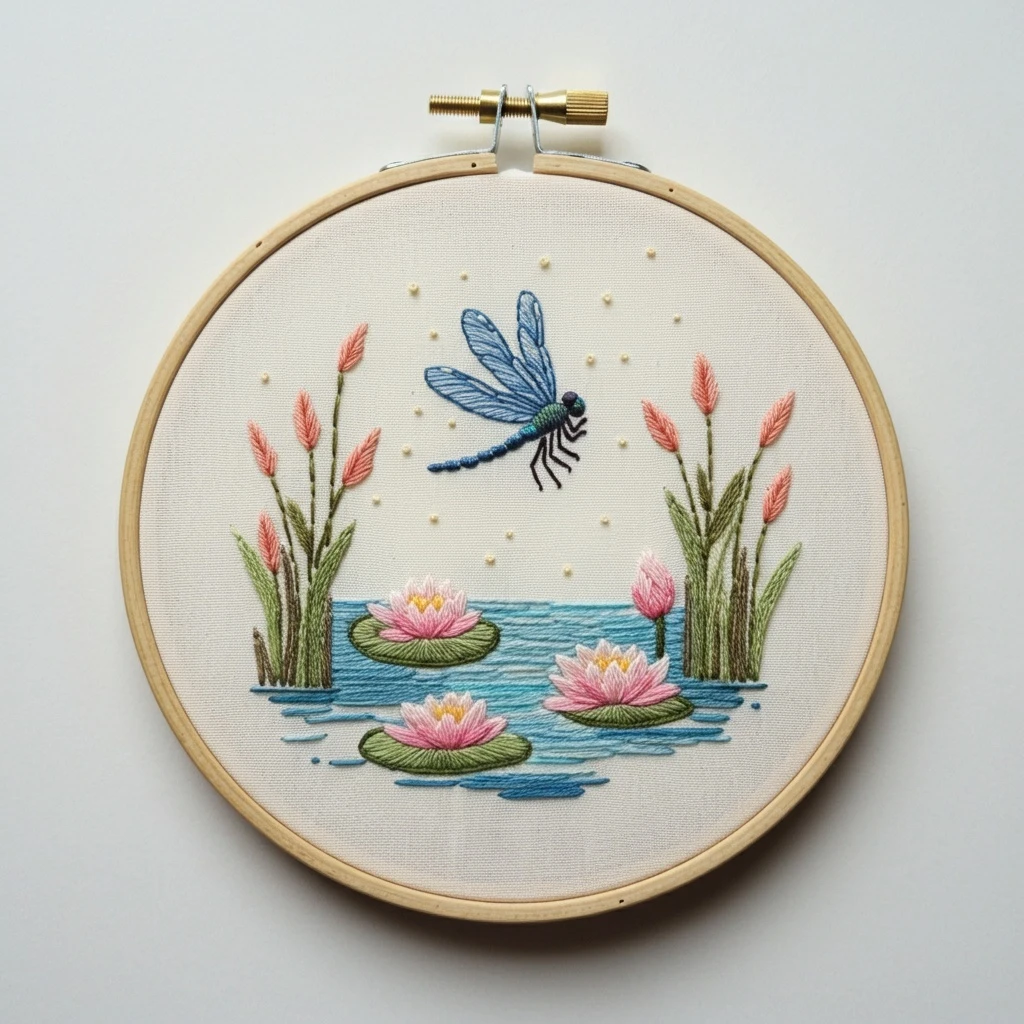
Colors estimated from the visible embroidery hoop preview and matched to close DMC embroidery floss shades. This design centers on calm blue pond ripples, pink water lilies, rounded lily pads, reed clusters, a blue-green dragonfly, and tiny floating light specks.
Likely DMC Color Palette
The preview reads as a soft natural palette: aqua pond water, deeper blue wing/body outlines, olive reeds and lily pads, warm pink blooms, cream highlights, pale yellow accents, and a few dark definition stitches.
Main pond water and open ripple lines. Work mostly horizontal stitches so the water feels calm and flat.
approx. 18% coverageLight water glints, upper ripple highlights, and soft reflections around lily pads.
approx. 10% coverageDragonfly body shadow, wing veins, darker lower ripples, and tiny blue accent dots.
approx. 9% coverageTransparent dragonfly wing fill and pale blue wing shimmer. Keep stitches airy rather than dense.
approx. 7% coverageReed shadows, lower stems, and dark lily pad undersides. Good for grounding plant clusters.
approx. 12% coverageMain reed blades, lily pad fill, and mid-tone leaf strokes. Blend with darker green at bases.
approx. 13% coverageLeaf tips, top edges of lily pads, and a few raised highlights on reeds.
approx. 7% coverageMain pink water-lily petals and cattail-like pink reed heads. Use directional stitches from base to tip.
approx. 11% coveragePetal tips, inner lily highlights, and soft transitions on the smaller pink buds.
approx. 6% coverageWater-lily centers, pale petal highlights, and small glowing dots in the air.
approx. 5% coverageTiny yellow flower centers and warm specks around the dragonfly.
approx. 4% coverageDragonfly eyes, legs, and the smallest contrast points. Use sparingly with one strand.
approx. 3% coverageStitching Suggestions
| Element | Best stitch type | Practical notes |
|---|---|---|
| Pond water | Backstitch, whipped backstitch, or split stitch | Use horizontal, slightly uneven lines. Alternate DMC 3845 and 3846, then add a few DMC 312 lines near the lower edge for depth. |
| Water ripples around pads | Single-strand backstitch | Leave small gaps between ripple lines so the fabric becomes the light reflection. Do not overfill the pond. |
| Lily pads | Fishbone stitch or long-and-short stitch | Start from the center notch and fan outward. Use 3012 as the main fill, 3011 near the lower edge, and 3013 along the top curve. |
| Water lilies | Satin stitch, straight stitch, or long-and-short stitch | Stitch each petal from base to tip. Put 962 near the petal bases and 963 or 3865 at the tips for layered blossom shading. |
| Flower centers | French knots or tiny straight stitches | Use one wrap for small knots in 725, with a few 3865 stitches around them to keep the centers bright. |
| Reeds and grasses | Stem stitch, split stitch, and straight stitch | Vary stitch lengths and green shades. Place dark 3011 at the base, 3012 through the main blades, and 3013 on selected tips. |
| Pink reed heads | Fishbone stitch or stacked straight stitches | Use 962 for the outer ridges and 963 along the center ridge. Angle stitches upward for a soft feathery bud texture. |
| Dragonfly body | Stem stitch, padded satin stitch, or chain stitch | Build the body in small segments with DMC 312 and a touch of 3845/3013 for blue-green shimmer. Keep the tail narrow. |
| Dragonfly wings | Single-strand outline stitch plus straight-stitch veins | Outline with DMC 312 or one strand of 3753. Add veins lightly, then leave open fabric between them for a translucent wing effect. |
| Tiny floating dots | French knots or colonial knots | Scatter knots in 3865 and 725. Keep them irregular in size and spacing so they look like light, pollen, or firefly-like sparkle. |
Thread Count, Blending & Shading Guidance
Everyday strand plan
Use 2 strands for most water, lily pads, flowers, and reeds. Switch to 1 strand for dragonfly wing veins, legs, fine reed tips, and delicate ripple accents.
Soft water blending
Blend one strand of 3845 with one strand of 3846 for a middle-value aqua. Blend 3845 with 312 only for the darker foreground ripples.
Petal shading
Use 962 at the base of each water-lily petal, feather 963 toward the tip, and reserve 3865 for tiny highlights on the uppermost petals.
Leaf dimension
Darken the underside and center crease of lily pads with 3011. Fill the main pad with 3012 and add 3013 on the light-facing upper rim.
Dragonfly sparkle
For a subtle iridescent look, blend one strand of 3753 with one strand of 3846 on wing edges or use just one strand so the fabric shows through.
Outlining control
Use 310 only on the dragonfly eyes and legs. For outlines elsewhere, choose dark blue or dark green instead of black for a gentler stitched illustration.
Where to Start
Beginner-Friendly Practical Tips
- Use a washable or heat-erasable guide line for the pond horizon and major lily pad ovals before stitching.
- Keep water lines relaxed and imperfect; overly straight rows can make the pond look stiff.
- For satin-stitched petals, make shorter stitches rather than spanning very wide shapes. This prevents snagging and keeps petals smooth.
- Turn the hoop while working dragonfly wings so your hand can follow the wing curve naturally.
- When stitching reeds, vary the height and angle of each blade. A few crossing stems make the clumps look more natural.
- Save dark outlines for the end. It is easier to correct shapes first, then sharpen the design with fine one-strand definition.
- Press from the back on a towel after finishing so the French knots and raised flower details stay dimensional.