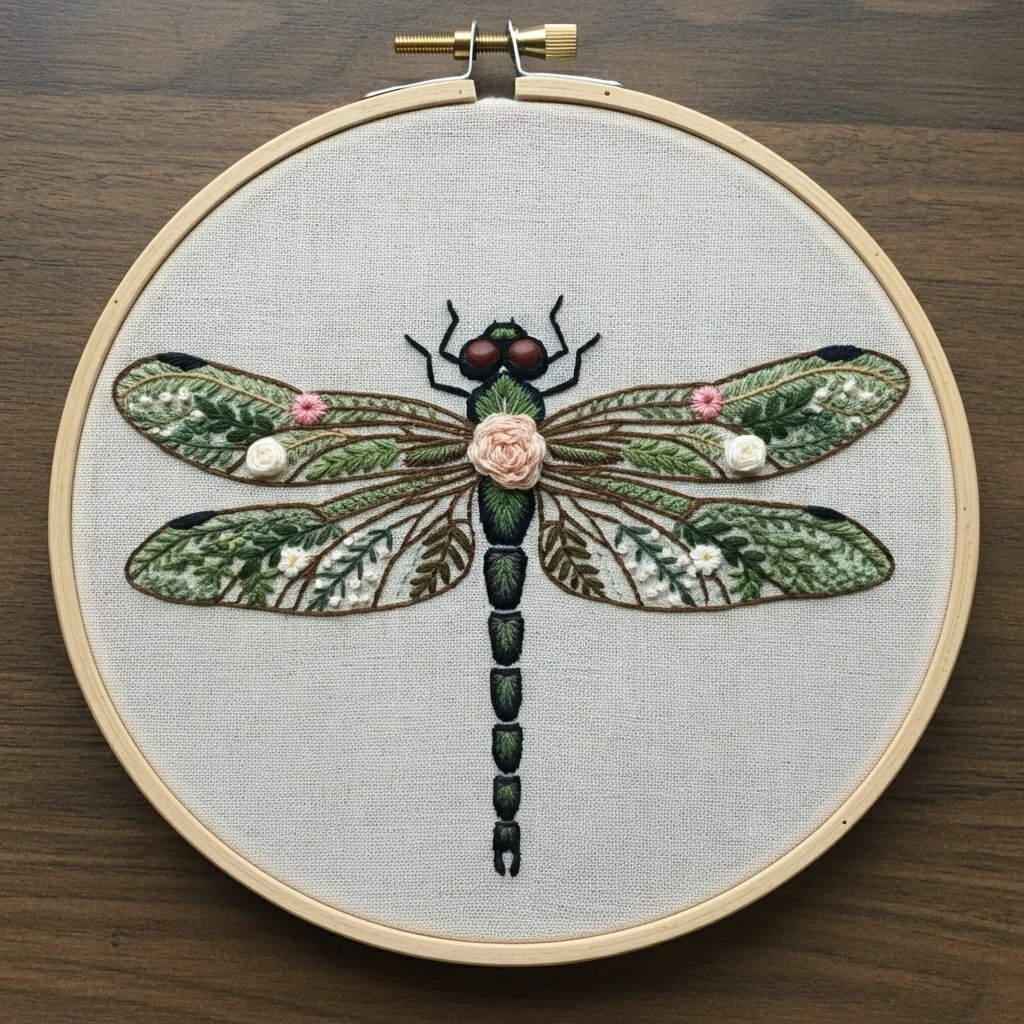

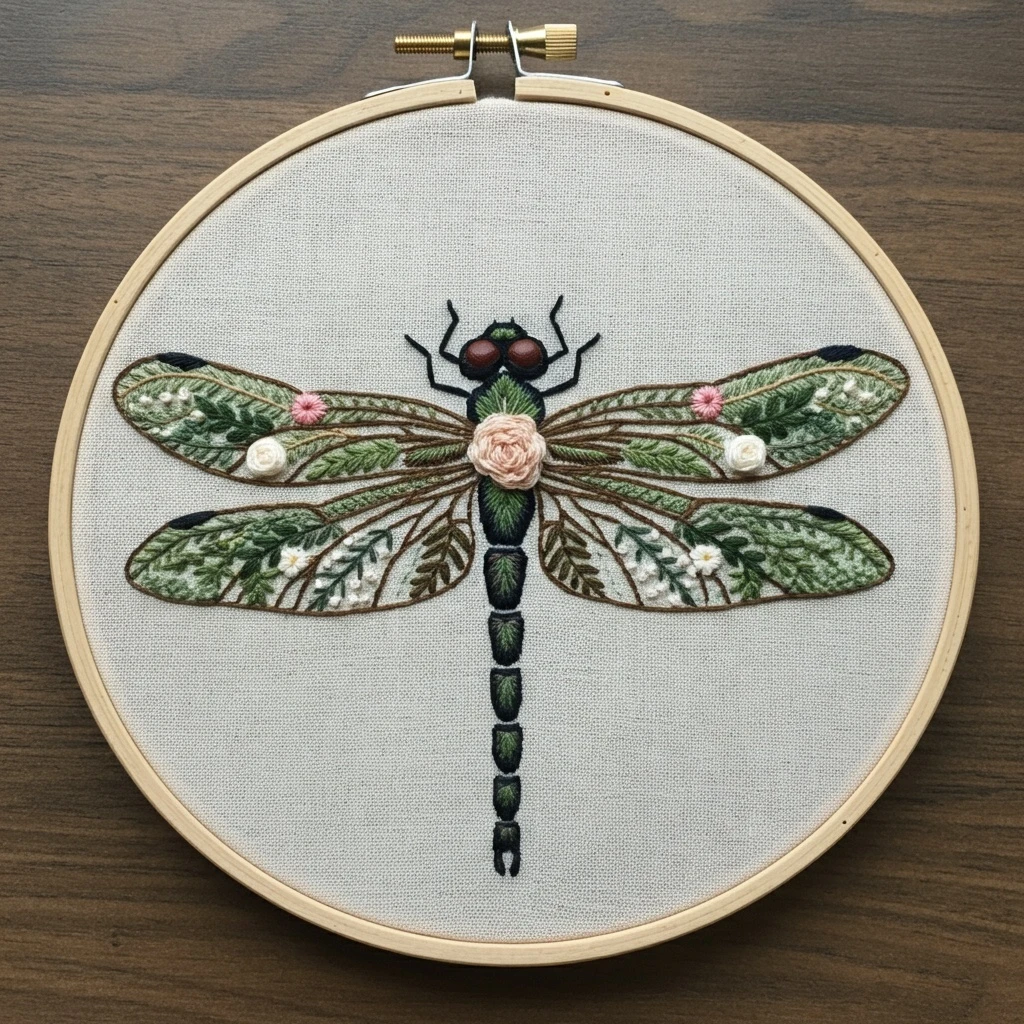
DMC palette & stitching guide
Nature Inspired Dragonfly
A polished embroidery planning page for a graceful dragonfly design with translucent aqua wings, botanical greens, soft meadow accents, and small natural details. Use this as a practical floss-picking and stitch-planning companion before you begin transferring the pattern.
Color story from the artwork
The design reads as a fresh garden-and-pond dragonfly: clear blue-green wings, a darker teal body, muted leaves, small golden flower centers, and soft lavender/pink accents. The most important visual effect is contrast between the airy transparent wings and the crisp dark body line, so reserve your brightest pale blues for highlights and keep outlines fine.
Recommended stitch plan
Long & short satin
Use 1 strand for translucent fills. Start with DMC 3761, feather in 747 near the top edges, then add 597 only where the wing overlaps or curves downward.
Split stitch or backstitch
Work wing veins with 1 strand. Use 597 for soft veins and 3846 for the few veins closest to the body so the structure stays delicate, not heavy.
Padded satin
Pad the thorax lightly with 2 short foundation stitches, then cover with satin in 3809. Add narrow 3846 or 747 highlight lines along one side.
Fishbone stitch
Fishbone stitch gives leaves a natural center vein. Use 3052 for the main fill, 3051 on the sunny side, and 934 as a fine base shadow.
Stem stitch
Work curving stems with 2 strands of 934 or 3052. Keep your tension relaxed so botanical arcs stay smooth around the wing shapes.
French knots & lazy daisies
Use 3821 or 3854 for knot centers. Add tiny detached chain petals in 340 or 3865 for meadow-flower details without crowding the dragonfly.
Thread-count guidance
For a 5–6 inch hoop
- 1 strand: wing fills, veins, facial details, light glints.
- 2 strands: stems, leaf fills, medium outlines, flower petals.
- 3 strands: only for bolder outer botanical curves or heavier decorative dots.
For a 7–8 inch hoop
- Use 2 strands for most wing fills, but keep veins at 1 strand.
- Increase leaf and stem stitches to 3 strands only where the pattern needs a strong frame.
- Use 1 strand of 3865 for final sparkle so highlights stay crisp.
Blending and shading ideas
Iridescent wing blend
Thread the needle with one strand 3761 and one strand 747 for the palest wing areas. For shadowed tips, use one strand 3761 plus one strand 597.
Teal body shine
Place dark 3809 first, then add a skinny 3846 satin line down the upper curve. A single stitch of 3865 at the head creates a glassy insect glint.
Natural greenery
Alternate 3052 and 3051 in fishbone leaves. Add one or two 934 stitches at leaf bases so the foliage frames the wings without becoming flat.
Outlining, texture, and finishing details
Keep the dragonfly elegant by outlining selectively. A full heavy outline can flatten the transparent-wing effect, so use darker thread only at the body, head, and outermost wing turns.
Outline approach
- Use 1 strand DMC 3809 for the body and head contour.
- Use 1 strand DMC 597 for wing outlines, switching to 747 where the edge should disappear into the fabric.
- For botanical outlines, use 3052 on lighter leaves and 934 only in the deepest curves.
Texture accents
- Add small seed stitches in 3821 around flowers for pollen-like sparkle.
- Use couching with 3846 if you want a very smooth central body stripe.
- Place French knots sparingly; too many raised dots may compete with the wing veining.
Beginner-friendly working order
Transfer lightly
Use a fine washable pen or light box. Mark only the main wing outlines and body; add tiny flower dots by eye later so the fabric does not become cluttered.
Stitch the background botanicals
Complete stems and leaves first, especially any lines that sit visually behind the wings. This prevents green stitches from crossing over pale wing work.
Fill the wings
Work from light to medium: 747, 3761, then 597. Use long, angled stitches following each wing’s curve and avoid pulling too tightly.
Add the body last
The body should sit cleanly on top of the wing base. Padded satin gives it the raised, jewel-like look that makes the dragonfly feel alive.
Finish with details
Backstitch veins, add knots and flower centers, then place final 3865 highlights. Step back often; a few bright stitches are more effective than many.
Practical tips for a clean result
- Needle choice: a size 7 or 8 embroidery needle works well for 1–2 strand details; switch to size 5 or 6 for padded satin areas.
- Fabric: pale linen, natural cotton, or soft sage fabric will suit the nature palette. On darker fabric, increase highlights with 747 and 3865.
- Tension: wing stitches should rest on the fabric, not sink into it. If the fabric puckers, reduce strand count and loosen the hoop slightly while stitching.
- Thread length: use 14–16 inch lengths for silky wing fills to reduce fuzzing and keep the turquoise colors fresh.
- Finishing: press from the back on a towel so French knots and padded satin remain dimensional.