
Embroidered Summer Meadow Landscape
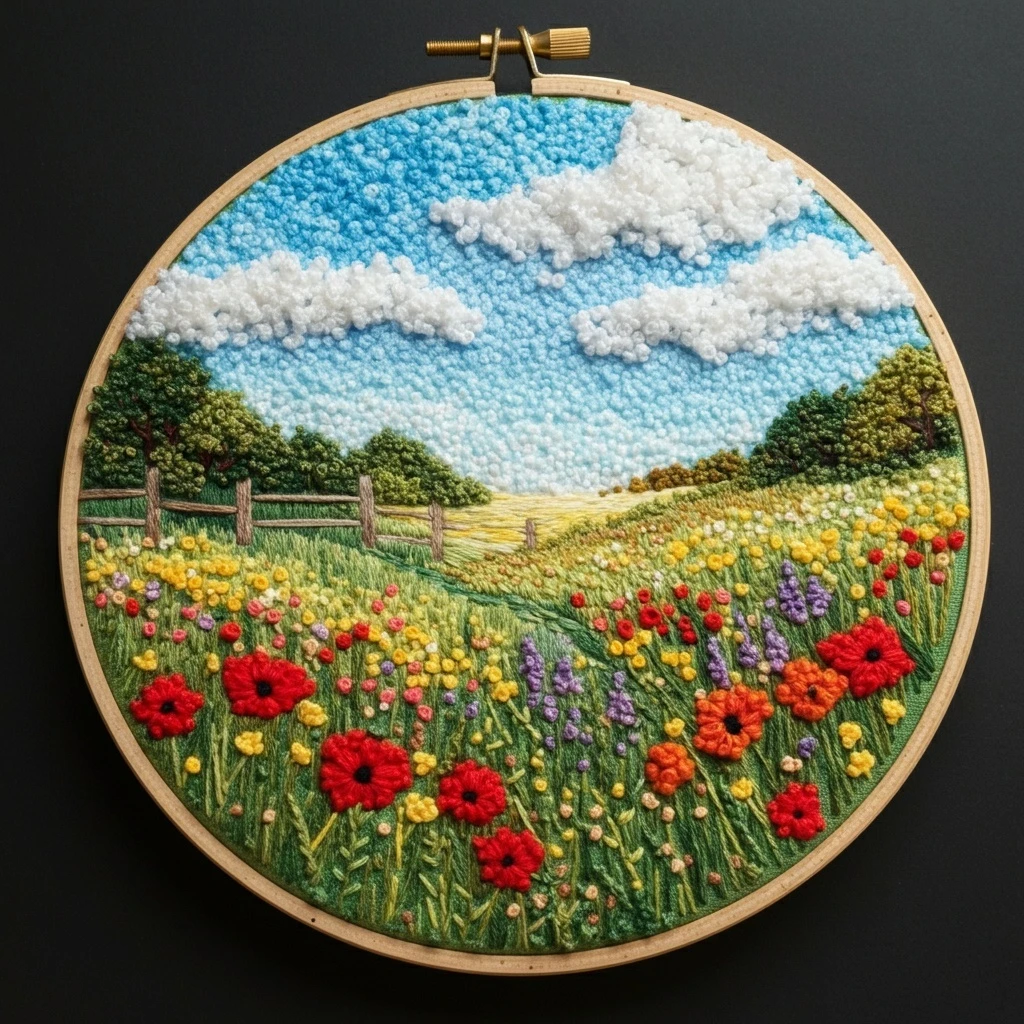
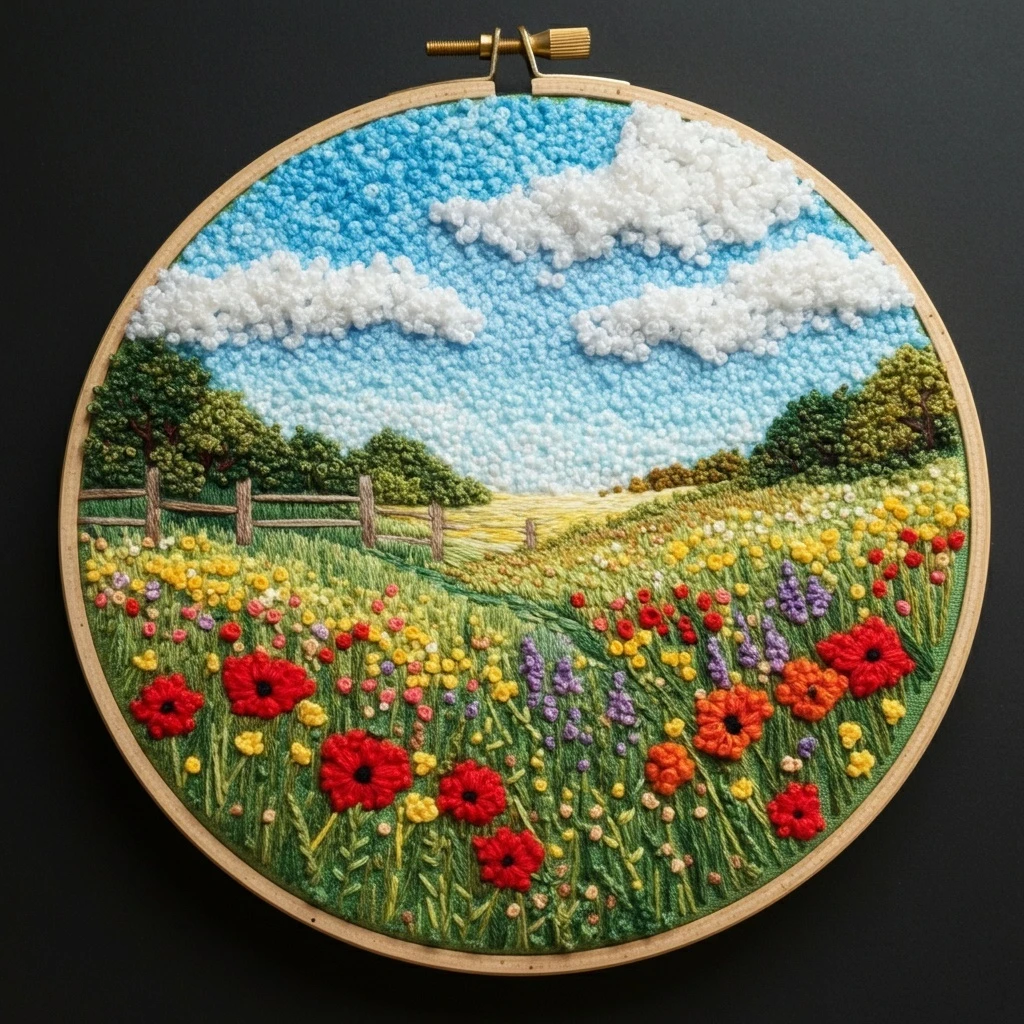
A bright hoop-art landscape with a textured blue sky, fluffy white cloud banks, distant rolling fields, a rustic fence, layered green grasses, and a lively foreground of poppies, yellow meadow blooms, purple flower spikes, and orange blossoms.
Color read: cool aqua sky and soft white clouds above warm hay-yellow paths, deep meadow greens, red poppies, orange marigold-like blooms, violet accents, and weathered tan fence posts.
Color matches and where to use them
This design benefits from a broad but practical palette: three sky tones, two cloud whites, several greens for depth, warm yellows for sunlit meadow areas, and saturated flower accents for the foreground focal points.
Stitches by design area
| Area | Recommended stitches |
|---|---|
| Sky | French knots, seed stitch, or tiny split stitches in 3845/3846/747. Keep knots smaller near the horizon. |
| Clouds | Colonial knots, French knots, turkey-work tips trimmed low, or dense detached chain clusters in B5200 with 762 shadows. |
| Distant field | Long-and-short stitch, horizontal satin dashes, and fine running stitch in 3820, 3012, and pale greens. |
| Fence | Stem stitch for rails, straight stitch for grain, one strand of 3371 under posts for shade. |
| Trees | Layered French knots and small lazy daisies over stem-stitched trunks; dark greens inside, lighter greens along sunlit edges. |
| Foreground grass | Varied straight stitches, fly stitch, couching, and occasional feather stitch using multiple green lengths. |
| Flowers | Woven wheels, detached chain petals, satin petals, French-knot clusters, and tiny straight-stitch stems. |
Strand guidance
Soft summer gradients
For the sky, thread one strand of 3846 with one strand of 747 near the cloud edges, then return to two strands of 3846 higher up. For the meadow path, blend 3820 with 3012 so the sunlit yellow does not look flat.
Keep outlines natural
Use broken outlines rather than continuous dark borders. A few 3371 accents under flower centers, fence rails, and tree trunks are enough; too much dark thread can flatten the soft landscape effect.
Foreground dimension
Let the foreground be the most dimensional part. Build red poppies with padded satin or woven wheels, then add black-brown centers. Add scattered yellow French knots after the grass so they sit on top like blooms.
Practical workflow for a clean hoop
Where to place light and dark
Keep the upper-left and upper cloud edges bright with B5200. Place 762 underneath larger cloud clusters for soft shadow. Use 895 at the base of trees and the lower hoop edge, then introduce 699 and 732 on top to create leafy dimension. In the path, reserve the brightest 3820 for the center and use 3012 along the sides so it recedes into grass.
Beginner-friendly polish
Use a sharp needle for dense knots and a slightly larger eye for thicker cloud strands. Rotate the hoop often so long grass stitches stay relaxed. If a flower looks too heavy, add two or three green straight stitches over its edge to tuck it back into the meadow. Steam from the back only, resting the front on a fluffy towel to protect raised knots.