
DMC palette & embroidery notes
Meadow Flowers Beginner
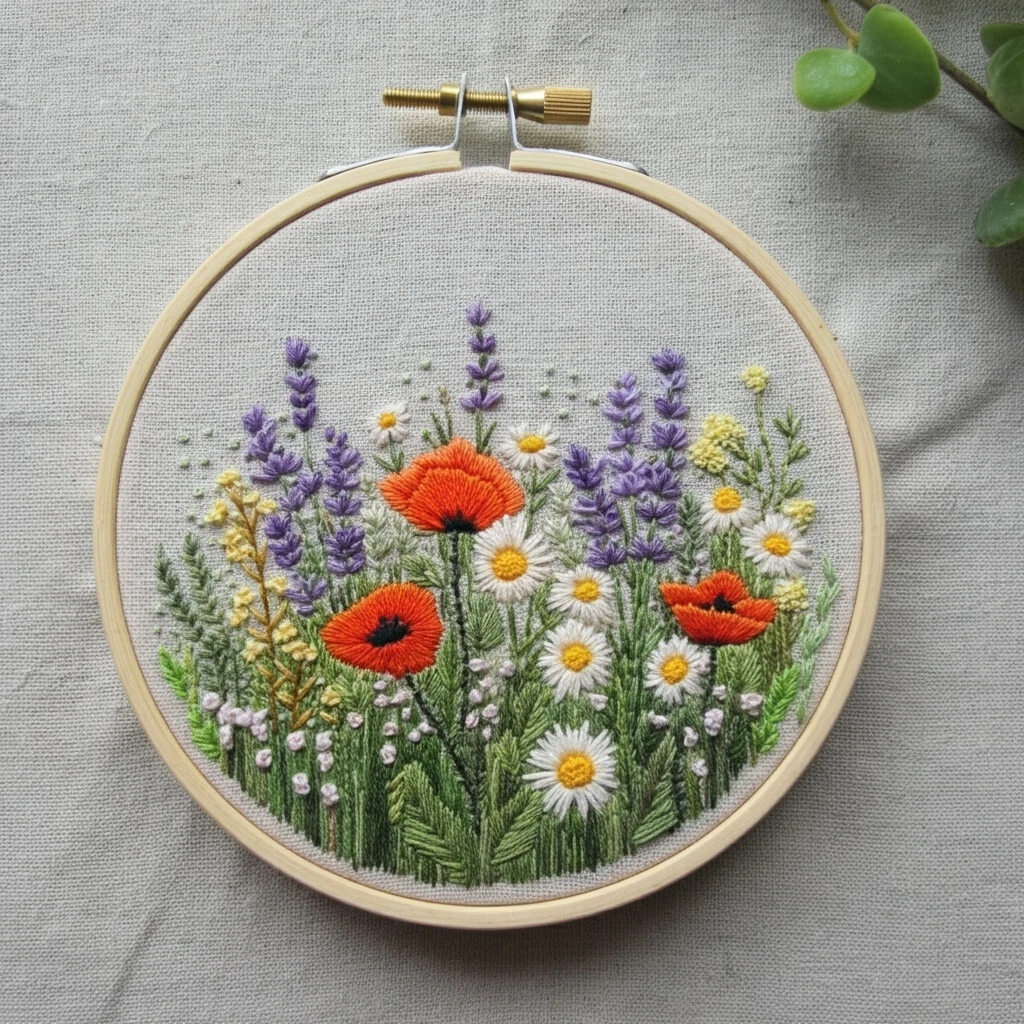
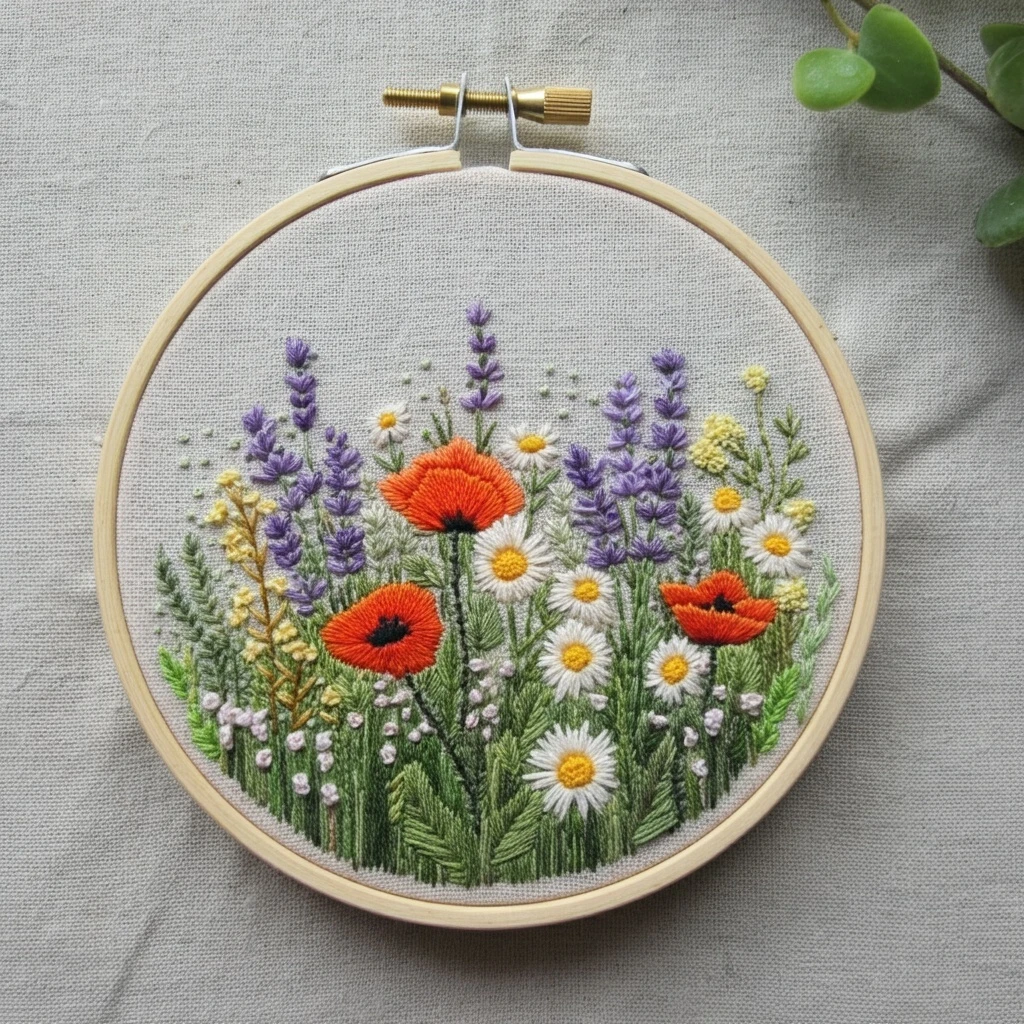
A cheerful beginner meadow with red-orange poppies, white daisies, purple lavender spikes, tiny pale buds, yellow filler flowers, and layered grassy greens on natural linen.
Color story from the reference
The design is built around a natural meadow balance: warm scarlet poppies catch the eye, white daisy petals soften the composition, golden centers repeat through the field, and purple lavender gives height. The greens should not be one flat color; use at least three values so the stems, ferny leaves, and background grasses stay airy.
Stitch plan by design area
| Area | Recommended stitches | Thread count & practical notes |
|---|---|---|
| Poppies | Long and short stitch, satin stitch, tiny straight stitches, French knots | Use 2 strands for petal fill. Start with DMC 817 at the base, blend into 900, then add 740 highlights as a final top layer. Work petals from the center outward so the stitches radiate naturally. |
| Daisies | Detached chain, straight stitch, satin stitch, French knots | Use 2 strands of B5200 for petals and 2 strands of 742 for raised centers. Keep petal stitches slightly uneven for a hand-picked meadow look. |
| Lavender spikes | Lazy daisy, fishbone-style pairs, seed stitch | Use 2 strands of 552 for shadow blossoms and 1 strand of 209 over selected tips. Place petals in small opposing pairs along a thin green stem. |
| Grasses and stems | Stem stitch, split stitch, straight stitch, fly stitch | Use 1 strand for distant fine grasses and 2 strands for stronger foreground stems. Mix 3362, 3346, and 3348 randomly to avoid a striped look. |
| Tiny buds and filler flowers | French knots, colonial knots, small detached chains | Use 1–2 wraps for tiny dots; 2 strands gives visible beginner-friendly texture. Add pale lavender and straw-yellow knots after the main stems are finished. |
| Lower meadow base | Vertical straight stitch, couching, seed stitch | Use 2 strands of dark and mid greens. Vary stitch height so the bottom edge feels grassy rather than perfectly even. |
Blending, shading & texture guidance
Poppy dimension
For the red-orange flowers, do not fill each petal with a single color. Lay the darkest coral-red close to the center, place burnt orange through the middle, then add a few tangerine stitches only on lifted petal rims. This creates depth without complicated thread painting.
Meadow depth
Stitch the green background first with fine 1-strand straight stitches, then add the bolder flowers on top. This layering helps the meadow feel full while keeping the beginner pattern clean and manageable.
Beginner-friendly working order
1. Anchor the stems
Work the longest green stems first in 1–2 strands. Keep them slightly curved; meadow flowers look more natural when they lean a little.
2. Add large flowers
Stitch poppies and daisies next. Complete one flower at a time so the direction of each petal stays consistent and easy to follow.
3. Fill with texture
Finish with lavender petals, yellow sprigs, pale buds, and small seed stitches. These details hide tiny spacing mistakes and make the design feel abundant.
Outlining and finishing details
- Outlines: Use minimal outlining. A few 1-strand split stitches in DMC 817 at poppy bases and DMC 3362 on selected stems are enough.
- Thread tension: Keep satin and long-and-short stitches smooth but not tight; puckering is more visible on natural linen.
- Needle choice: A size 7 or 8 embroidery needle works well for 2 strands; switch to size 9 for fine 1-strand grasses.
- Hoop care: Re-tighten fabric before dense poppy areas. Remove the hoop between stitching sessions to avoid permanent marks.
- Final polish: Steam lightly from the back through a towel, then trim stray fibers with small scissors rather than pulling them.