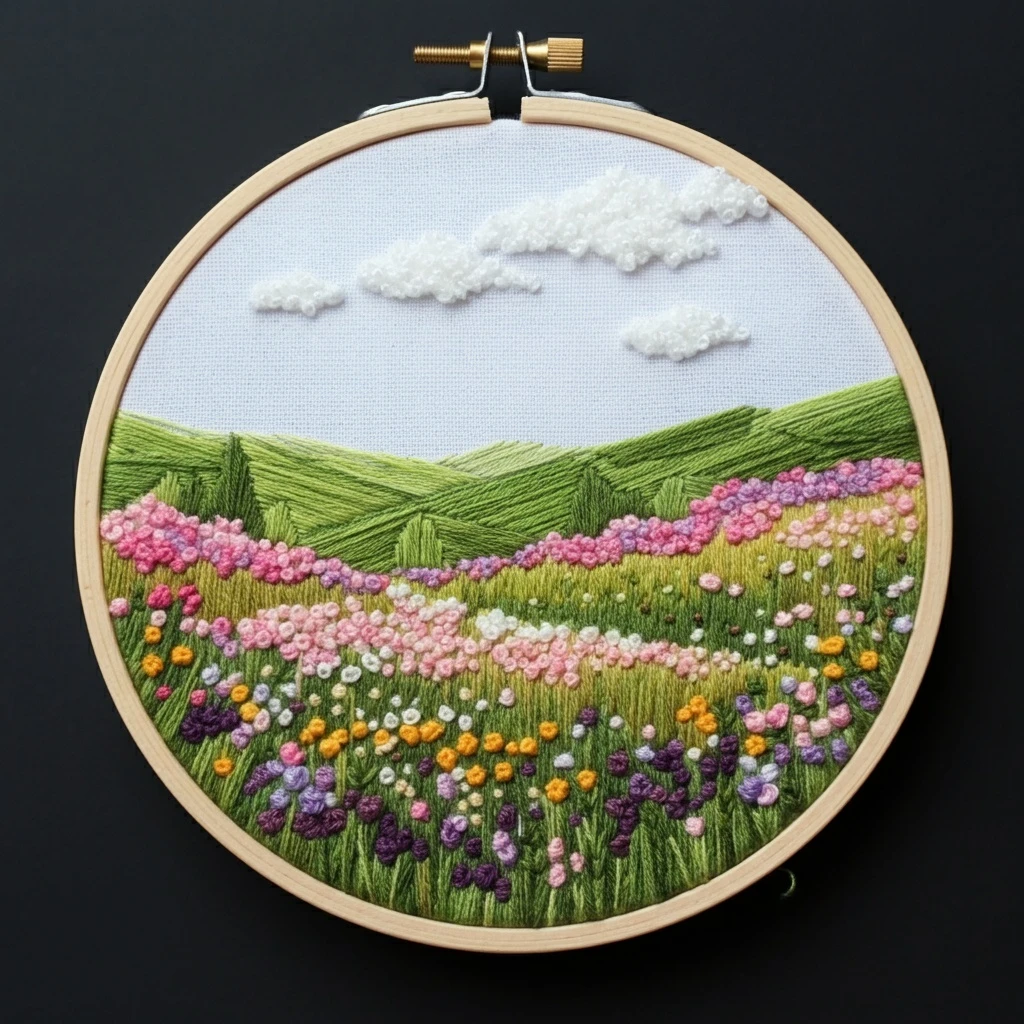

Embroidered Hillside Meadow Landscape
A soft round-hoop landscape with layered green hills, tufted clouds, long meadow grasses, and drifts of pink, white, yellow, lavender, and deep purple wildflowers. Use the guide below to keep the scene airy in the sky, directional in the hills, and richly textured in the foreground.
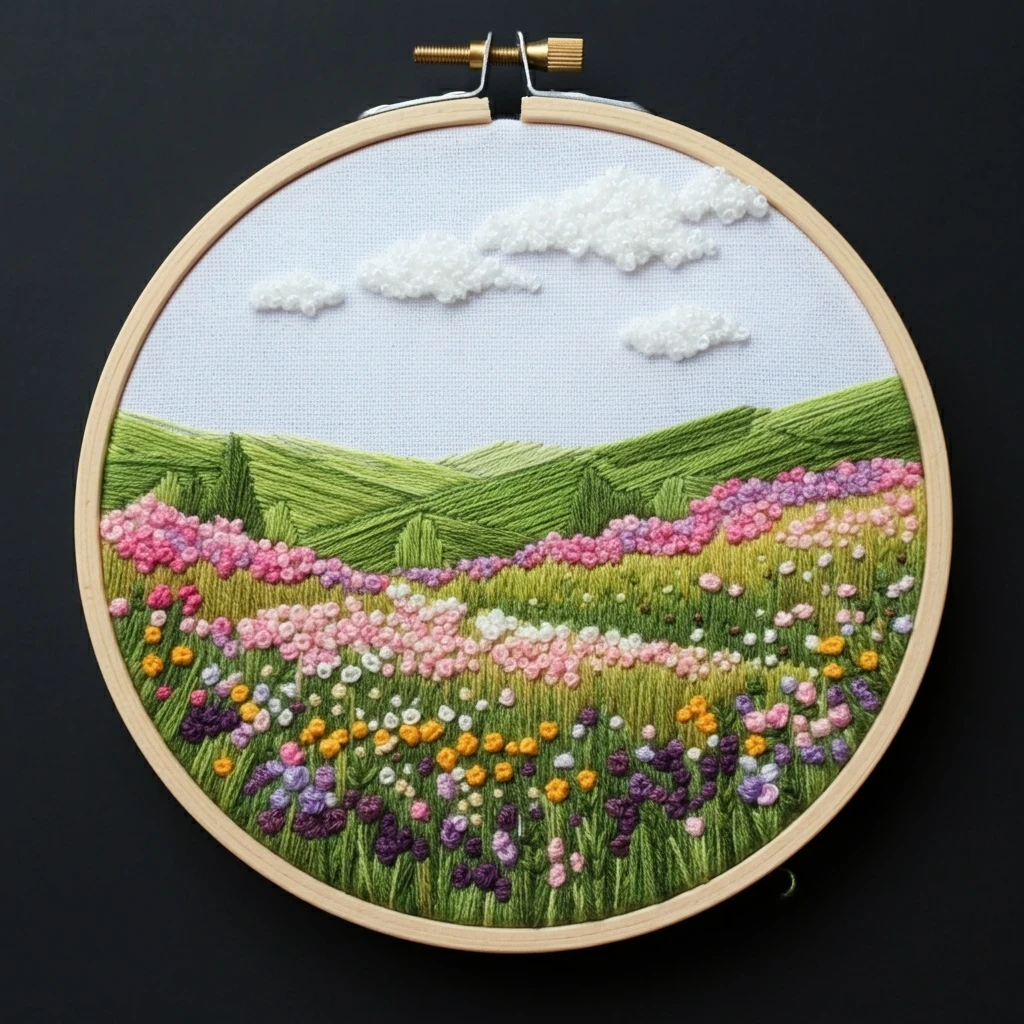
Color reading from the design
The image is built around cool spring greens and a pale blue-gray sky, then lifted with candy-pink flower bands and small accents of golden yellow, lilac, white, and plum. The most important color relationship is value: dark greens should sit at the lower meadow and hill shadows, while light yellow-greens catch the crests of the slopes.
washed sky, bright white cloud texture, distant pale hills
directional green hill stitches meeting in valleys and ridges
dense knotted blossoms over vertical meadow grass
Suggested DMC floss palette
These DMC colors are chosen to match the visible design: fresh greens for the hills and grass, clean whites for the clouds, pinks for the flower ribbon, violets for foreground contrast, and warm yellows for scattered meadow blooms.
Use as optional sky tinting stitches or tiny shadow stitches around clouds; keep very sparse.
Cloud highlights, white meadow flowers, and the brightest French-knot clusters.
Sunlit distant hill tops and soft transitions where slopes fade into the sky.
Bright hill streaks and fresh meadow highlights; blend with 470 for smoother shading.
Main hillside fill, especially the middle ridges and open meadow body.
Mid-tone grass, lower slope shadow, and stalks behind the flower bands.
Darker ridge lines, valley seams, and vertical foreground grass texture.
Deepest greens under flower clusters and at the base of the meadow.
Pale pink blossom knots and soft foreground flower highlights.
Main pink flower band; excellent for medium French knots and woven roses.
Saturated pink accents along the upper meadow wave and denser blossom patches.
Deep rose-purple knots that stop the pink areas from looking flat.
Light lavender blossoms in the lower meadow and mixed flower sprigs.
Mid-purple flower heads; alternate with 210 for natural variation.
Dark foreground flower clusters and small shadow dots under blossoms.
Tiny yellow wildflowers; use sparingly so they sparkle rather than dominate.
Warm centers and orange-yellow flower knots in the lower foreground.
Creamy cloud shadow, muted white flower knots, and blended highlights with Blanc.
Stitch map by design area
| Area | Stitches | Strands & notes |
|---|---|---|
| Sky | Mostly leave fabric open; add a few single straight stitches in 3756 only if the fabric needs cooling. | 1 strand, widely spaced. Avoid filling the whole sky so the clouds feel raised. |
| Clouds | French knots, colonial knots, tiny seed stitches, and a few short padded satin stitches. | 2-3 strands for knots; 1 strand 746 tucked under lower edges for soft shadow. |
| Distant hills | Long and short stitch, split stitch guide lines, and directional satin stitch following the slope. | 1-2 strands. Keep stitches long, smooth, and angled toward the valley points. |
| Mid hills | Layered straight stitch with alternating greens; occasional stem stitch on ridge seams. | 2 strands. Blend one strand 470 + one strand 472 for sunlit areas. |
| Meadow grass | Vertical straight stitches, fly stitch, stem stitch, and scattered seed stitch. | 2-3 strands in the middle ground; 3-4 strands at the front for stronger texture. |
| Flower bands | French knots, colonial knots, woven roses, lazy daisy petals, and small detached chain stitches. | 2 strands for small flowers, 3 strands for larger foreground clusters, 4 strands only for bold knots. |
| Outlines & separations | Split stitch or stem stitch along hill borders, hidden under later fill stitches. | 1 strand in darker green. Keep outlines broken, not heavy, to preserve the soft landscape feel. |
Blending & shading
- Hill gradients: work from dark lower edges to light crests. Try 469 → 3345 → 3346 → 470 → 472 → 772.
- Thread blending: combine one strand of 470 with one strand of 472 for a natural mid-light green; combine 3345 + 3346 for deep grass without harsh lines.
- Flower variation: mix 151, 3716, and 604 randomly in each pink band. Real meadows look better when blossoms are not perfectly uniform.
- Cloud softness: place 746 knots at the underside first, then cover the top with Blanc/B5200 so the shadow feels tucked in.
Texture suggestions
- Raised clouds: add a base of small seed stitches before French knots if you want extra puff.
- Wildflower depth: put darker purple knots behind lighter lavender knots in the lower foreground.
- Grass movement: vary stitch length from 4 mm to 18 mm and slightly change the angle every few stitches.
- Foreground richness: stitch some grass over flower stems and some stems over grass; this creates a woven, meadow-like surface.
Suggested stitching order
Beginner-friendly practical tips
Thread-count guide
- 1 strand: fine hill outlines, distant slopes, subtle sky marks.
- 2 strands: most hill fill, small flowers, delicate grass.
- 3 strands: mid-foreground grass and fuller flower knots.
- 4-6 strands: only for bold foreground knots or padded cloud texture.
Neatness & control
- Use a sharp crewel needle for woven fabric and a larger needle for heavy knot areas.
- Keep the fabric drum-tight in the hoop so long hill stitches do not pucker.
- Make knots in uneven groups of 3, 5, or 7; perfectly even rows look less natural.
- Step back often. Landscapes should read clearly from a distance before close-up details are added.
Outlining details
For the hillside seams, use a fine split stitch in 3345 or 469, then stitch the hill fill over the edge so only a soft shadow remains. For flower stems, use stem stitch in 3346 or 469 and let the blossoms cover the stem tips. Avoid black outlines; this design depends on soft color shifts rather than graphic borders.