
Vibrant Underwater
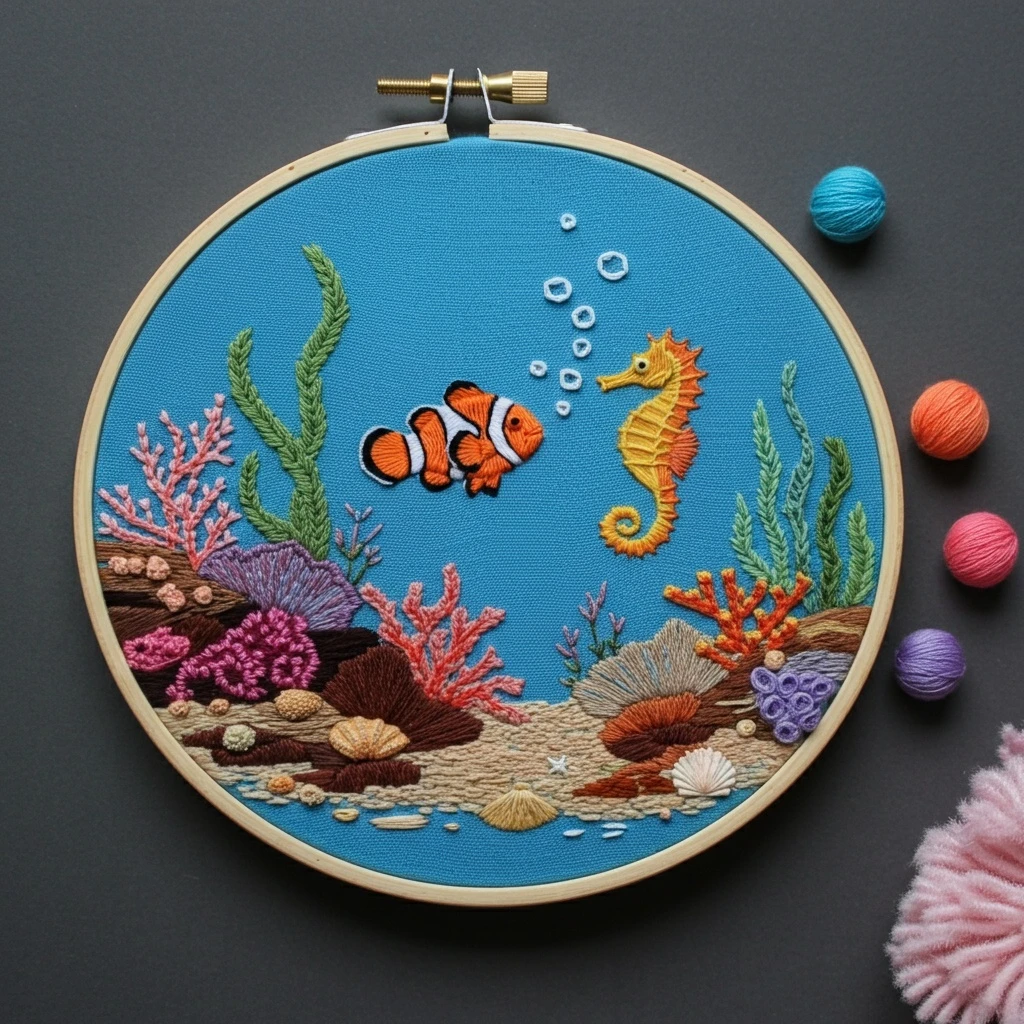
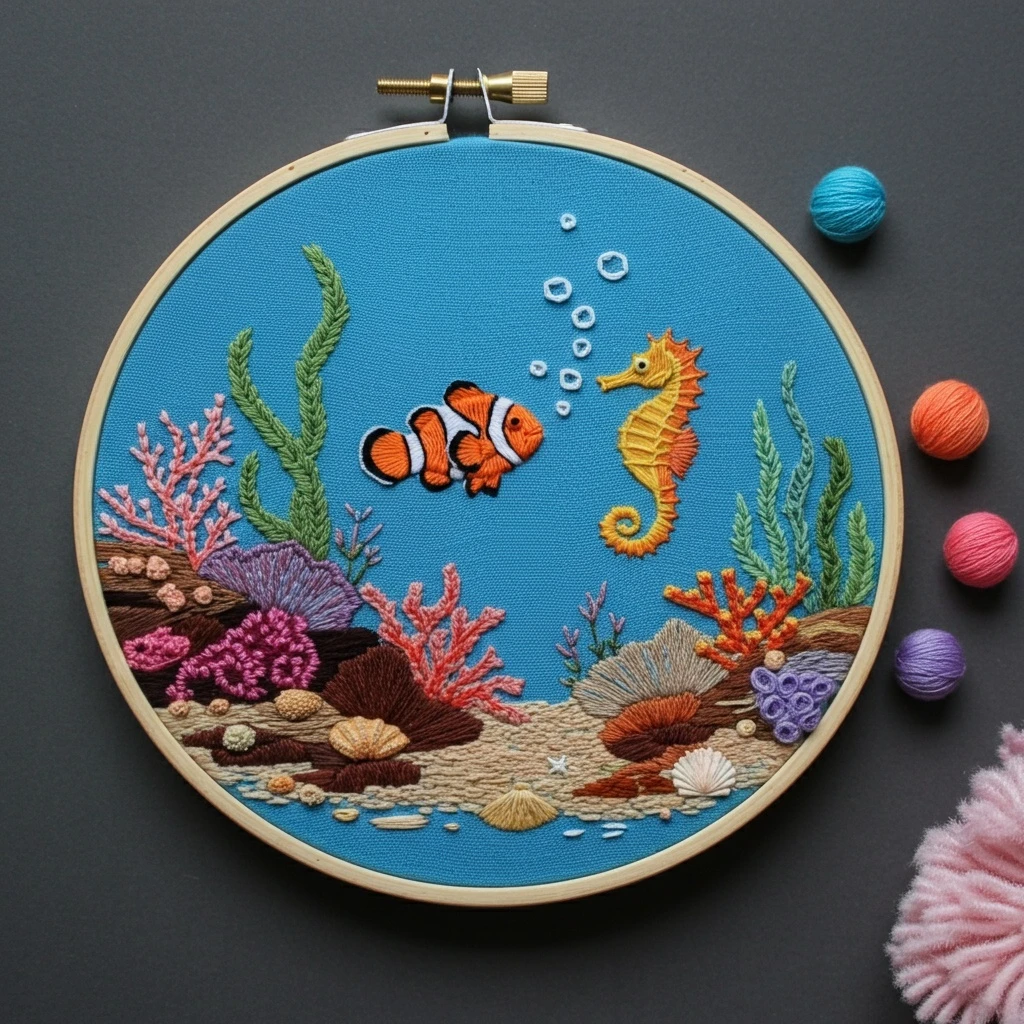
A bright reef scene with turquoise water, clownfish stripes, a golden seahorse, coral branches, seaweed fronds, textured sand, shells, pebbles, and small bubble accents. The stitching plan keeps the ocean background smooth while letting coral, fish, and seabed textures sit proudly on top.
Likely DMC Color Palette
Colors are matched to close DMC floss shades from the visible hoop preview. Percentages are practical visual estimates, not exact thread usage.
Stitching Suggestions
The design works best when the smooth ocean is treated as quiet negative space, with dimensional texture concentrated in the fish, corals, shells, and foreground seabed.
| Element | Stitch type | Practical notes |
|---|---|---|
| Clownfish body | Long and short stitch or satin stitch | Use 2 strands. Angle stitches from the spine toward the belly so the orange sections feel rounded. Add black split-stitch outlines after the fills are complete, then place white bands cleanly on top. |
| Seahorse | Split stitch outline plus padded satin | Work the silhouette in golden straw first, then add one-strand darker orange ribs across the belly and tail. Keep the curled tail stitched in short curved segments for control. |
| Tall seaweed | Fishbone stitch, stem stitch, and detached chain | Use dark green down the center and lighter green on the outside edges. A one-strand stem stitch spine helps the fronds curve naturally. |
| Branching coral | Whipped backstitch, coral stitch, or couching | Use 2 strands for thicker branches and 1 strand for tips. Place lighter pink or orange on the top-facing side, with darker tones tucked at branch bases. |
| Fan coral | Straight stitch fans and long-and-short shading | Radiate stitches from the base of each fan. Mix violet, antique violet, brown, or cream by alternating thread colors every few stitches. |
| Sand and seabed | Seed stitch, running stitch, and irregular straight stitches | Use 1 strand for scattered grains and 2 strands for short ridges. Vary stitch length so the bottom looks organic rather than striped. |
| Shells and pebbles | Satin stitch, split stitch, French knots | Use pale straw or winter white for shell tops, then add one-strand brown ridge lines. Pebbles can be small satin ovals or single French knots. |
| Bubbles and sparkle | Backstitch rings, tiny satin dots, French knots | Use 1 strand of white or pale turquoise. Leave a tiny gap in each bubble outline to make it look reflective instead of heavy. |
Thread Count, Blending & Shading Guidance
Thread-count plan
- 1 strand: bubble rings, fish eyes, seaweed tips, fine shell ridges, tiny coral twigs.
- 2 strands: most fish fills, seahorse body, coral branches, medium seaweed, shell fills.
- 3 strands: only for raised coral clusters or foreground knots where extra texture is wanted.
Blending ideas
- Blend one strand 740 with one strand 720 for clownfish side shadows.
- Blend 3852 + 3821 for the seahorse belly and shell highlights.
- Blend 905 + 3347 in seaweed bases, then switch to 3347 + 907 at the tips.
Outlining details
- Use black sparingly around the clownfish so the stripes pop without becoming bulky.
- Outline seahorse ridges with 1 strand of 720 or 434, not heavy black.
- Use split stitch for smooth shapes and whipped backstitch for raised coral branches.
Texture Suggestions
Reef texture
Cluster French knots in magenta, purple, cream, and coral orange. Mix one-wrap and two-wrap knots so the reef has different heights and does not look too uniform.
Water movement
Keep the blue field mostly open. Add only a few pale turquoise running stitches near the seabed or around bubbles if you want subtle motion.
Shell ridges
Fill shells with short satin stitches, then add single-strand backstitch lines from hinge to edge. Slightly darker ridge lines create dimension without needing heavy shading.
Beginner-Friendly Stitch Order
Helpful Notes
Hoop handling
Because this design has many raised knots and textured areas, finish the flat satin and long-and-short sections before adding bulky reef details.
Needle control
For tight curves such as the seahorse tail and clownfish bands, shorten each stitch rather than forcing one long stitch around a curve.
Clean finish
Trim traveling threads behind white bubbles and pale shells. Dark thread carried behind light stitches can shadow through the fabric.