
DMC palette & hand embroidery notes
Floral Mandala
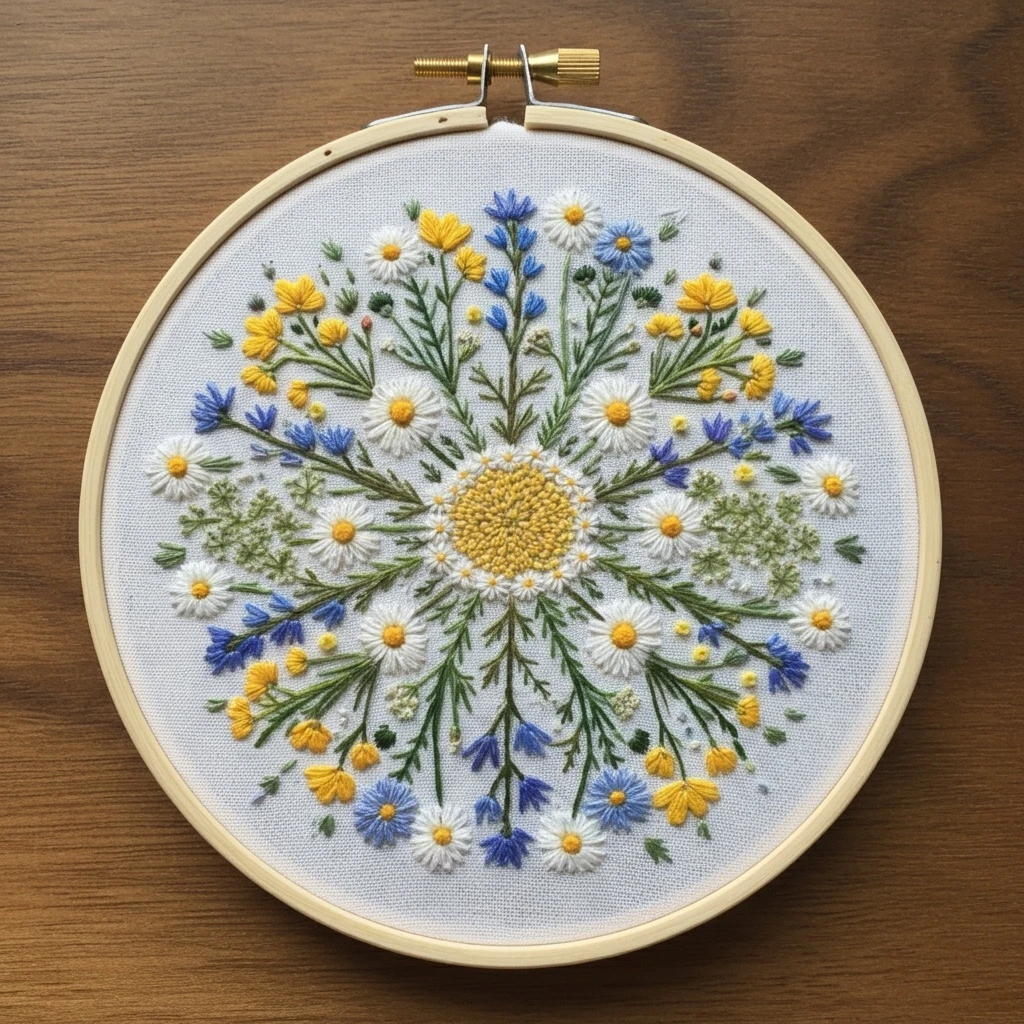
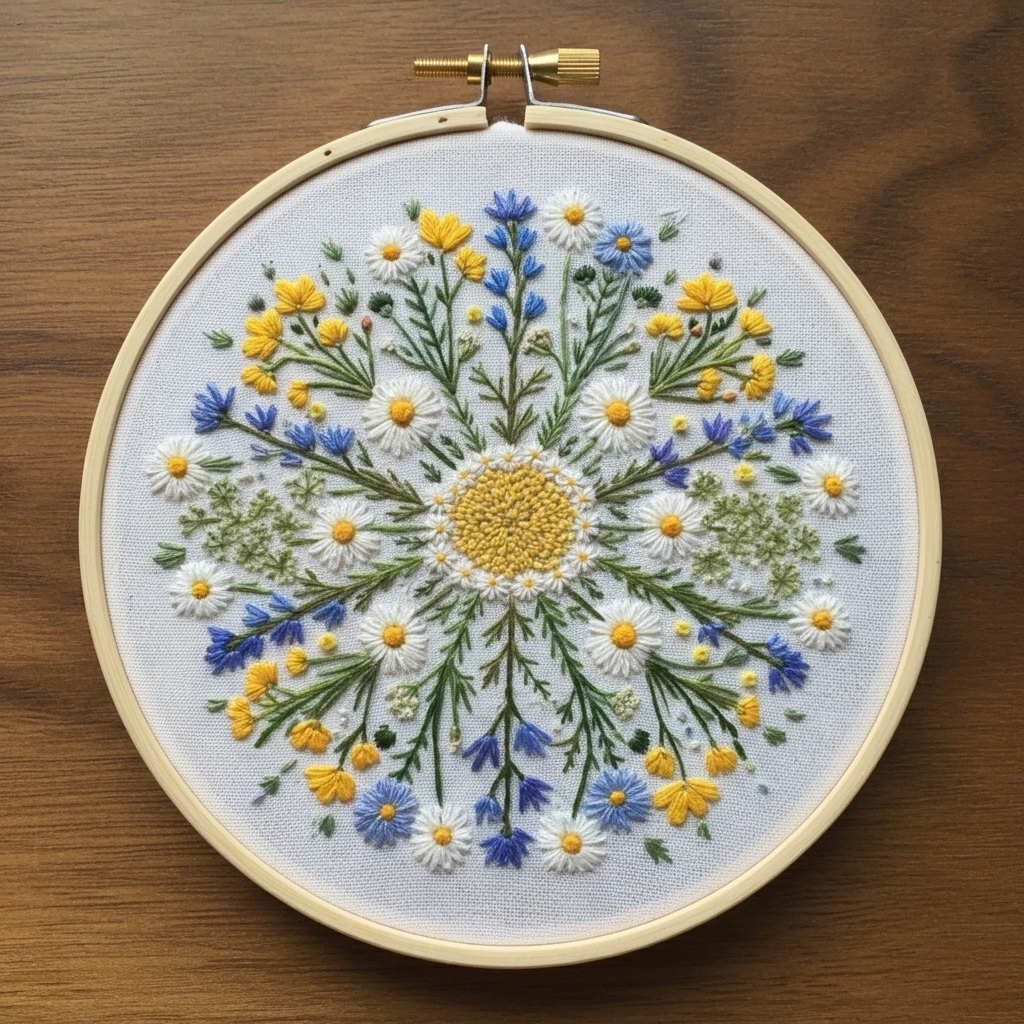
A balanced wildflower mandala stitched in sunny yellows, creamy daisies, cornflower blues, and layered meadow greens. The circular layout radiates from a textured golden center, so the palette and stitch plan focus on symmetry, soft botanical movement, and small dimensional details.
Design read
The reference artwork shows a round hoop composition on pale linen with a raised yellow center, white daisy petals, blue petal clusters, butter-yellow blossoms, fine green stems, ferny sprigs, and tiny scattered buds. Keep the center dense and tactile, then use lighter strand counts as the stems and flowers radiate outward.
Suggested DMC color palette
These DMC choices match the visible colors: warm golden yellows, creamy whites, medium and dark blues, olive and fern greens, plus muted gray-greens for airy filler sprigs. Use the darker colors sparingly so the mandala remains light and botanical.
Main raised center, yellow daisy centers, and golden pollen knots.
Bright butter-yellow flower petals and center highlights.
Soft tips on yellow petals and tiny light seed dots.
White daisy petals, small star flowers, and clean bright accents.
Petal shadows on white flowers and subtle linen-toned shading.
Deep blue petals, lower petal shadows, and darker blue bud tips.
Medium blue petals and the main tone for cornflower-like clusters.
Blue flower highlights and softened outer petal stitches.
Primary stems, central leaf shadows, and deep fern strokes.
Olive leaves, secondary stems, and shaded filler foliage.
Fine leaf highlights, tiny side leaves, and airy outer sprigs.
Muted seed clusters, pale green blossoms, and soft background texture.
Stitch plan by area
| Area | Recommended stitches | Strands |
|---|---|---|
| Golden center | Dense French knots, colonial knots, or seed stitch packed inside a round guide. Mix two yellows for sparkle. | 2 |
| White daisies | Lazy daisy or detached chain petals around French-knot centers. Add a few straight stitches between petals for fullness. | 2 for petals, 2 for centers |
| Blue flowers | Satin stitch, fishbone stitch, or small straight stitches radiating from each stem tip. | 2–3 |
| Yellow blossoms | Detached chain petals with tiny straight-stitch centers; use shorter stitches near the middle of each bloom. | 2–3 |
| Stems and spokes | Stem stitch for graceful curves; back stitch for very fine straight stems. | 1–2 |
| Fern and filler foliage | Fly stitch, fishbone leaves, and single straight stitches placed in pairs along the stem. | 1 |
Thread-count guidance
A mandala can look crowded if every element is stitched with heavy thread. Build depth by varying strand counts.
- 1 strand: fine green stems, tiny leaf veins, outer scattered sprigs, and delicate gray-green filler.
- 2 strands: most daisy petals, blue petals, yellow knots, and medium leaves.
- 3 strands: bold yellow flowers or blue petals that need to stand forward; keep these limited.
- 4 strands: only for a deliberately raised center if you want a chunky, bead-like effect.
Blending, outlining & shading notes
Yellow center texture
Work French knots in DMC 3820, then tuck occasional DMC 726 knots near the upper-left side to mimic light. Keep knots close but not stacked, so the circle stays even instead of lumpy.
White petal shading
Use DMC 3865 for the main petals and add one short DMC 822 straight stitch at the base of selected petals. This gives the daisies depth without making them gray.
Blue flower blend
Place DMC 798 at the base or underside of each blue petal, fill with DMC 797, then add one or two DMC 793 stitches at the tips for a soft cornflower highlight.
Texture suggestions
- Raised center: French knots of varied tension create the dotted sunflower-like texture in the middle.
- Petal direction: angle each stitch toward the flower center. Even simple straight stitches look polished when they radiate correctly.
- Leaf movement: alternate long and short leaf stitches along the stems so the foliage feels wild and natural.
- Filler clusters: use tiny seed stitches in DMC 3364 and DMC 3013 to suggest small pale-green blossoms without overcrowding.
Beginner-friendly tips
- Lightly mark the center point and four compass lines before stitching. This helps keep the mandala balanced.
- Complete matching elements opposite one another: top daisy, bottom daisy, left daisy, right daisy. This prevents one side from becoming heavier.
- Use shorter thread lengths, about 12–15 inches, especially for white and yellow floss. They fuzz quickly.
- Keep the fabric drum-tight in the hoop while stitching knots; loose fabric makes the center uneven.
- Step back often. Tiny filler leaves should support the circle, not cover the airy linen background.
Practical working sequence
| Step | What to stitch | Why it helps |
|---|---|---|
| 1 | Transfer the circle, center disk, and main stem spokes. | Establishes the mandala geometry before detail work begins. |
| 2 | Fill the central golden disk with knots or seed stitches. | Gives a stable focal point for all radiating flowers. |
| 3 | Stitch long green stems in stem stitch and back stitch. | Creates the skeleton of the botanical arrangement. |
| 4 | Add white daisies, blue flowers, and yellow blooms. | Places the main color masses while the design is still easy to balance. |
| 5 | Finish with leaves, buds, seed knots, and pale filler sprigs. | Adds softness, texture, and the scattered meadow look visible in the reference. |