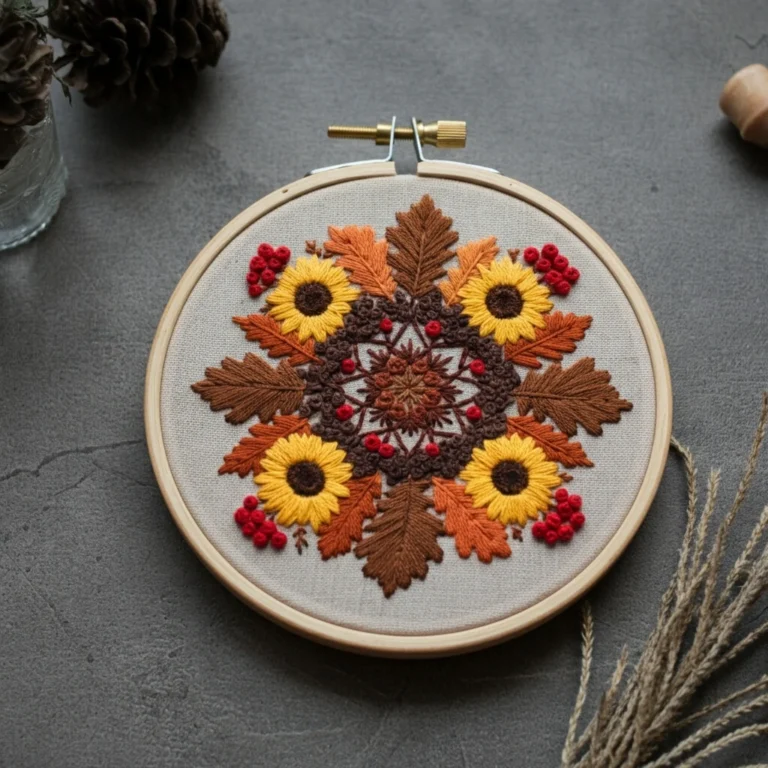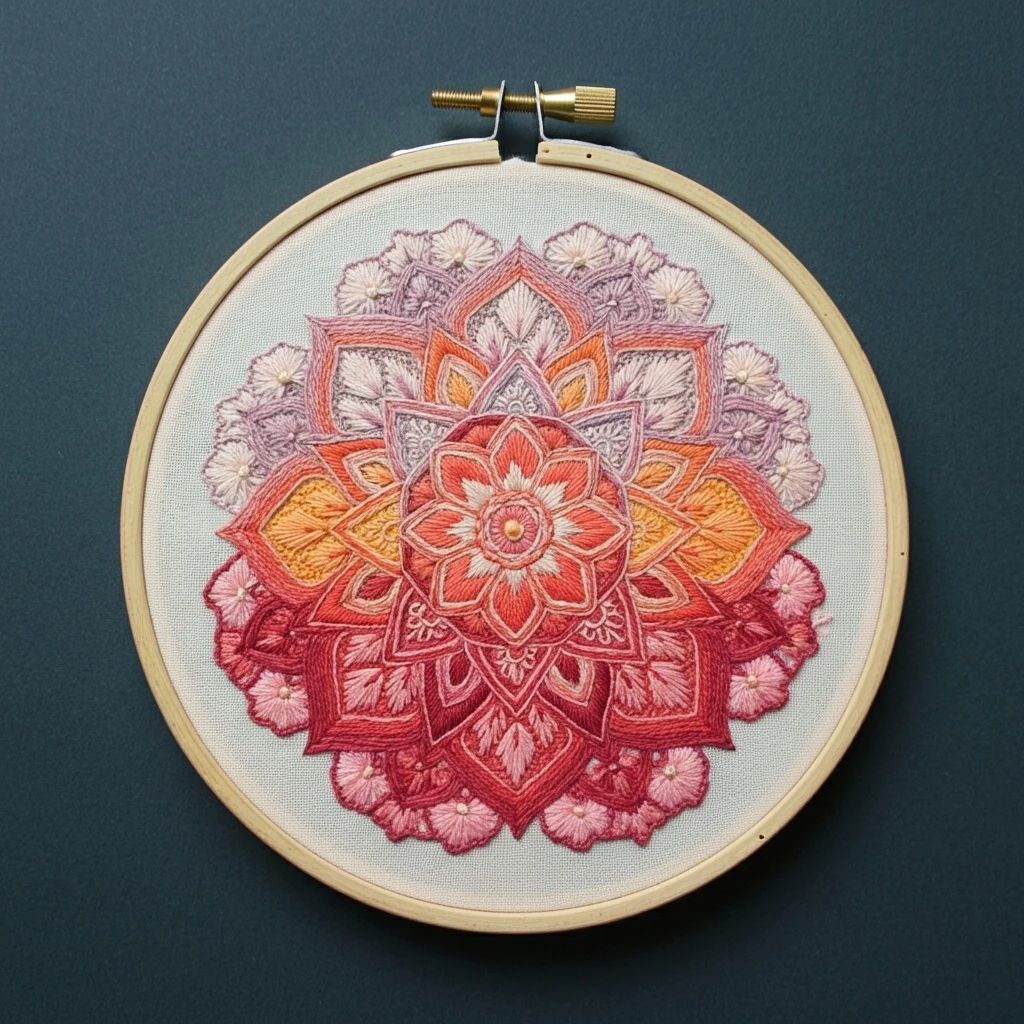

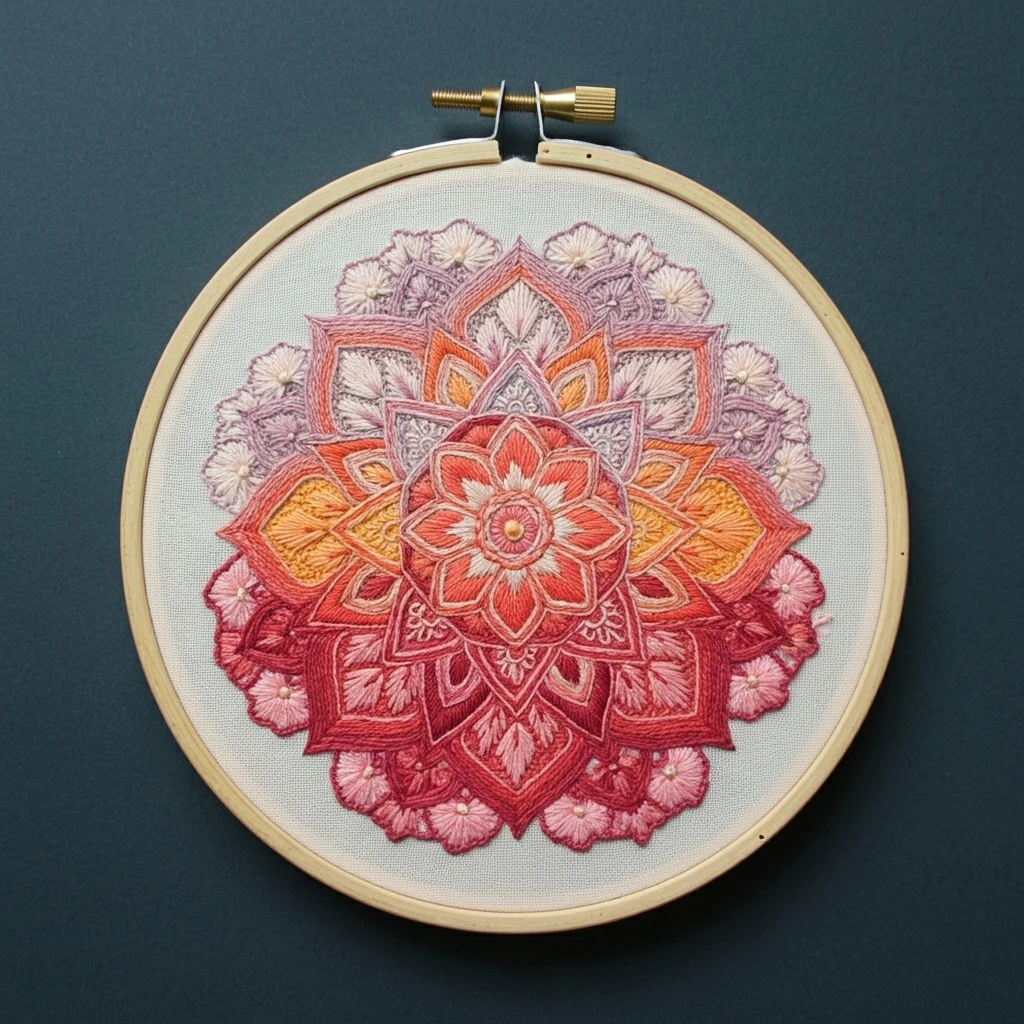
Embroidered Mandala in Warm Tones
A polished warm-toned embroidery plan for a layered floral mandala: coral and brick petals, golden inner accents, dusty mauve outer blooms, cream highlights, and fine symmetrical linework.
Suggested DMC Color Palette
The reference reads as a symmetrical mandala worked in warm reds, coral, rose, muted mauve, pink, cream, and golden yellow. Use the deeper shades to define the lower and outer petals, and reserve cream for the delicate inner highlights and small floral tips.
DMC 712 - Cream
Soft highlight petals, pale inner teardrops, and light stitches on the outer blossoms. Keeps the center luminous without stark white.
DMC B5200 - Snow White
Tiny sparkle accents, seed stitches, and the brightest flower tips. Use sparingly so it does not flatten the warm palette.
DMC 353 - Peach
Pale coral transitions inside the central flower and upper petal highlights. Excellent for blending into stronger coral.
DMC 352 - Light Coral
Main coral petal fill in the central flower and upper mandala points. Use as the lively midtone.
DMC 351 - Coral
Deeper coral for petal bases, folded edges, and warm outlines around the central bloom.
DMC 350 - Medium Coral
Strong warm-red petal shadows and lower-layer accents. Pair with 351 for smooth shade changes.
DMC 817 - Very Dark Coral Red
Darkest red outlines, lower petal bases, and scalloped edge emphasis. Use one strand for fine defining lines.
DMC 3831 - Raspberry
Rose-pink outer flower petals and mid-layer arches. Adds the rosy warmth visible around the bottom edge.
DMC 335 - Rose
Light pink petal tips, small outer blossoms, and gentle satin stitches where the design softens.
DMC 3727 - Antique Mauve
Dusty mauve upper petals and lace-like outer flower arcs. Ideal for the muted lavender-pink areas.
DMC 316 - Medium Antique Mauve
Darker mauve outlines, shadowed top-layer petals, and contrast lines between pale cream fills.
DMC 407 - Desert Sand
Warm beige transition stitches inside the cream petals and subtle outline warmth beside peach and mauve.
DMC 742 - Light Tangerine
Golden inner almond shapes, small center knots, and warm glow inside the side petals.
DMC 976 - Golden Brown
Deeper gold shading at the bases of yellow motifs and tiny textured seed stitches.
DMC 3777 - Very Dark Terra Cotta
Fine architectural outlines and the deepest warm shadows when 817 feels too red.
DMC 801 - Dark Coffee Brown
Only for optional anchoring dots or very subtle line correction. Keep it minimal to preserve the soft look.
Stitch Map & Texture Suggestions
Central flower
- Outline each petal with split stitch in 351 or 350 before filling, so the rounded points stay crisp and symmetrical.
- Fill petals with satin stitch following the petal length, then add short-and-long shading from 353 at the tips into 352 and 351 near the base.
- Use 742 or 976 French knots in the very center for the raised golden dot visible in the reference.
Large mandala points
- Work the triangular and lotus-like points with long satin stitches or closely spaced stem-stitch rows, always stitching from the center outward.
- Blend one strand 352 with one strand 351 for a soft coral band; use 817 at the lower edge for dramatic depth.
- Use 712 single-strand straight stitches inside pale petal shapes to imitate the fine veining.
Golden side motifs
- Fill the yellow almond shapes with 742 in satin stitch, then add 976 at one base or side for a warm shaded fold.
- Outline gold shapes with 351 or 3777 so they sit cleanly against the coral petals.
- For extra texture, add tiny seed stitches inside the gold sections instead of a solid fill.
Outer mauve and pink edging
- Use 3727 for the pale mauve petal fills and 316 for stitched scallop outlines or shadowed arcs.
- Small outer blossoms look best with lazy daisy petals in 335 or 3727 and a 742 French knot center.
- Keep outer details light and lacy so the mandala does not become bulky around the edge.
Thread Count, Blending & Outlining Guide
Recommended strand counts
- 1 strand: fine outlines, inner veins, lace curls, small seed stitches, and tiny center rings.
- 2 strands: most satin stitch fills, split-stitch outlines, lazy daisy petals, and stem-stitch arcs.
- 3 strands: only for raised French knots or bold outer scallop accents; avoid heavy fill with three strands.
Helpful color blends
- 353 + 352: soft peach-coral highlight for upper petals.
- 352 + 351: smooth central petal midtone, especially around the red flower.
- 351 + 817: rich red-orange shadow for the lower mandala sections.
- 3727 + 316: dusty mauve depth for the upper outer petals.
Outlining details
- Use split stitch for smooth petal borders and backstitch for geometric angles or crisp triangular points.
- Keep outlines mostly one strand in the inner mandala; use two strands only on the outermost red scallops.
- For mirrored elements, stitch the same section on opposite sides before moving to the next color so tension and thickness stay even.
Shading placement
- Place the darkest reds at petal bases, lower overlaps, and the bottom arc of the mandala.
- Keep the upper floral ring lighter with 3727, 335, and 712 to match the airy mauve-pink look.
- Use gold only in the small almond shapes and knots; too much yellow will distract from the coral focal flower.
Practical Stitching Order
Transfer the mandala cleanly
Use a fine-tip water-soluble pen or heat-erasable marker. Transfer only the key outlines first; add tiny internal veins later if the design is very detailed.
Secure the main outlines
Backstitch or split stitch the largest petal borders in coral and mauve. This gives each fill area a clean edge and prevents satin stitches from wandering.
Work from the center outward
Stitch the center flower, then the golden motifs, then the large coral points. Rotating the hoop often helps keep each mirrored petal consistent.
Add outer lace and small blossoms
Use lighter pink and mauve threads for lazy daisies, scallops, and open linework around the outside. Leave small fabric gaps for a delicate finish.
Finish with highlights and knots
Add cream veins, gold French knots, tiny seed stitches, and final dark-red accents last. Press from the back on a towel to protect raised knots.
Extra Notes for a Polished Result
Fabric and hoop
Ivory, oatmeal, or very pale blush fabric complements the warm thread palette. Avoid dark fabric unless you intentionally want the mauves and creams to pop more strongly.
Needle choice
A size 7 or 8 embroidery needle works for two-strand fills. Switch to a size 9 or 10 needle for single-strand veins, fine curls, and tiny symmetrical dots.
Avoiding distortion
Do not pull long satin stitches too tightly across petal points. If a section is wide, split it into shorter directional stitches or use long-and-short stitch instead.
Texture upgrade
Add a few seed stitches in 976 over the golden shapes and tiny couching stitches along coral outlines for a raised, decorative, hand-embroidered look.
DMC suggestions are practical close matches based on the visible reference colors; adjust one shade lighter on dark fabric or one shade deeper on bright white fabric.