
DMC palette & hand embroidery guide
Glowing Flower
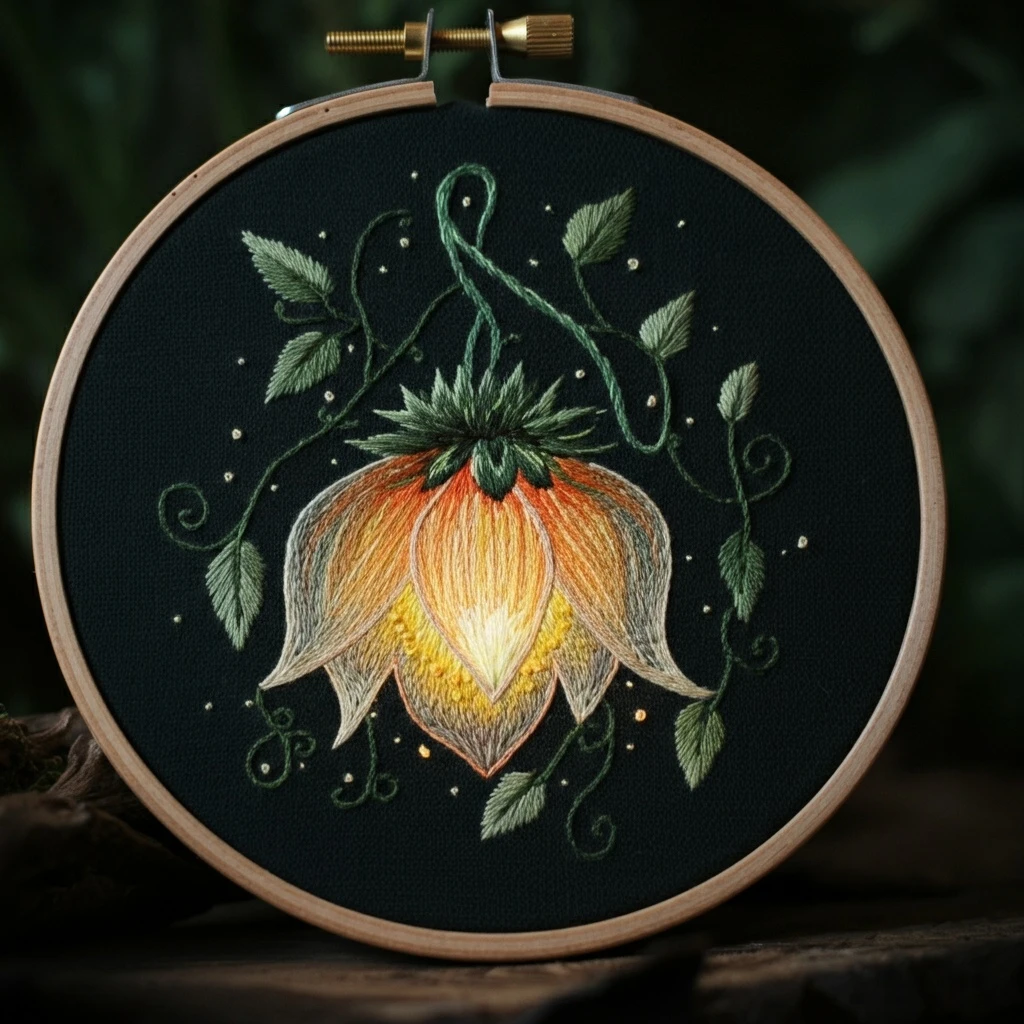
A luminous bell-shaped woodland bloom stitched on dark fabric: warm amber petals radiate from a creamy yellow center, framed by smoky taupe edges, deep green sepals, curling vines, veined leaves, and tiny star-like dots.
Suggested DMC palette
Use the warm colors for the illuminated petals, cool muted greens for vines and foliage, and soft neutrals for outer petal rims and tiny background sparks.
DMC 3823
Ultra Pale Yellow
Bright petal center; reserve clean strands for the strongest glow.
DMC 744
Pale Yellow
Transition between white-hot center and golden lower cup.
DMC 783
Topaz Medium
Honey-gold shadows in the lower bell and dotted texture.
DMC 976
Golden Brown
Main orange petal wash and warm folds near the flower crown.
DMC 920
Copper Medium
Deepest orange-red crease lines under the sepals and side petals.
DMC 950
Desert Sand Light
Soft peach outlines on lower petal tips and warm reflected edges.
DMC 613
Drab Brown Very Light
Outer translucent petal rims; blend with grey for papery edges.
DMC 646
Beaver Gray Dark
Cool grey-brown shading in side petals and underside shadows.
DMC 934
Black Avocado Green
Dark sepals, vine shadow side, and grounding details on black fabric.
DMC 3052
Green Gray Medium
Main vine line, leaf midribs, and muted botanical outlines.
DMC 3051
Green Gray Dark
Leaf bodies with soft woodland-grey undertone.
DMC 3053
Green Gray
Leaf highlights and fine feathered strokes on the vine tips.
DMC 739
Tan Ultra Very Light
Tiny specks, soft sparkle dots, and subtle petal rim highlights.
DMC 3855
Autumn Gold Light
Optional glowing accent dots and warm flickers near the flower base.
Thread-count plan
- Petal shading: 1 strand for long-and-short stitch so color changes stay soft; use 2 strands only in the brightest lower cup.
- Vines and tendrils: 2 strands for whipped back stitch or stem stitch; reduce to 1 strand at curling tips.
- Leaves: 1 strand for directional fishbone or straight stitches; add a second strand only to bold midribs.
- Dots and stars: 1 strand French knots or tiny seed stitches; vary wrap count for natural sparkle.
- Dark fabric tip: use a sharp needle, good lighting, and a pale transfer method such as white water-soluble pencil.
Glow rule: leave a narrow line of the dark fabric visible between some petal sections. The negative space makes the cream and gold tones feel brighter.
Stitch map by design area
| Area | Best stitches | Practical guidance |
|---|---|---|
| Central glowing cup | long-and-shortsatin stitch | Begin with DMC 3823 at the center, then feather 744 and 783 outward. Keep stitches vertical and slightly irregular so the light feels organic rather than striped. |
| Orange petal panels | split stitch rowslong-and-short | Shade from 976 into 920 near folds. Blend one strand 976 + one strand 783 for a softer amber transition where petals overlap the yellow center. |
| Outer grey-taupe petals | sketch stitchwhipped back stitch | Use 613 and 646 in thin, curved strokes following the petal contour. Do not overfill; a translucent, sketchy edge matches the reference. |
| Sepals and flower crown | fishbone stitchstraight stitch | Work dark 934 at the base of each sepal and pull 3052/3053 toward the tips. Vary lengths for the spiky, pine-like crown texture. |
| Curling vines | stem stitchwhipped back stitch | Stitch the main curve in 3052, then whip one side with 934 for shadow or 3053 for moonlit highlights. Keep curves smooth by shortening stitches around tight spirals. |
| Leaves | fishbonefly stitch | Use a central vein in 3052, then angle 3051 and 3053 outward like fern strokes. Leave a tiny gap down the vein for definition. |
| Background specks | French knotsseed stitch | Scatter 739 with a few 3855 knots near the flower to echo the warm glow. Use mostly single-wrap knots so they look delicate on dark cloth. |
Blending & shading ideas
- Lit center blend: 1 strand 3823 + 1 strand 744 for the brightest transition, then 744 + 783 as the cup turns golden.
- Warm fold blend: 976 + 920 for deep petal creases; place sparingly under the green crown and along the upper side folds.
- Smoky edge blend: 613 + 646 for soft outer petal veining; couch a single 739 highlight along the sharpest tip if needed.
- Leaf depth: put 934 only at leaf bases and behind overlaps, then pull 3051/3053 outward to keep foliage visible but understated.
Outlining details
- Use split back stitch in 950 or 613 for petal edges instead of stark black; it preserves the glowing, delicate look.
- Outline the center V-shaped petal with one strand 3823 first, then add 744 beside it for a halo-like edge.
- For the vine curls, complete all outlines before adding leaves so you can keep the flow continuous and graceful.
- Place gold dots last, after stretching the fabric, to avoid snagging raised knots while stitching the larger shapes.
Beginner-friendly working order
Transfer and stabilize. Use black or deep bottle-green fabric in a hoop. Mark the design lightly in white; avoid heavy lines under pale petals.
Stitch the vines first. Work the long sweeping curves in stem stitch so the composition is anchored before the flower is filled.
Fill leaves and sepals. Add leaf strokes from the center vein outward, then stitch the crown with short dark-to-light straight stitches.
Shade the flower. Start at the glowing center and work outward, following the petal direction. Change colors gradually every few stitches.
Add highlights and sparkle. Finish with pale edge lines, warm dots, and tiny knots around the bloom for a magical floating effect.
Texture suggestions
- Petals: keep stitches long, tapered, and slightly uneven to imitate fine embroidered rays.
- Leaves: use short directional strokes, almost like feathers, rather than solid satin blocks.
- Vines: whip a darker strand along only one side to create a raised, corded vine without bulky fill.
- Stars: mix seed stitches and French knots so the background does not look too uniform.
- Hoop finish: press from the back over a towel, then mount tightly so the dark ground stays smooth around the light flower.