Midnight Fox With Lantern

Midnight Fox With Lantern — DMC Palette & Stitching Suggestions
Midnight Fox with Lantern Embroidery

DMC palette & hand embroidery guide

Midnight Fox With Lantern

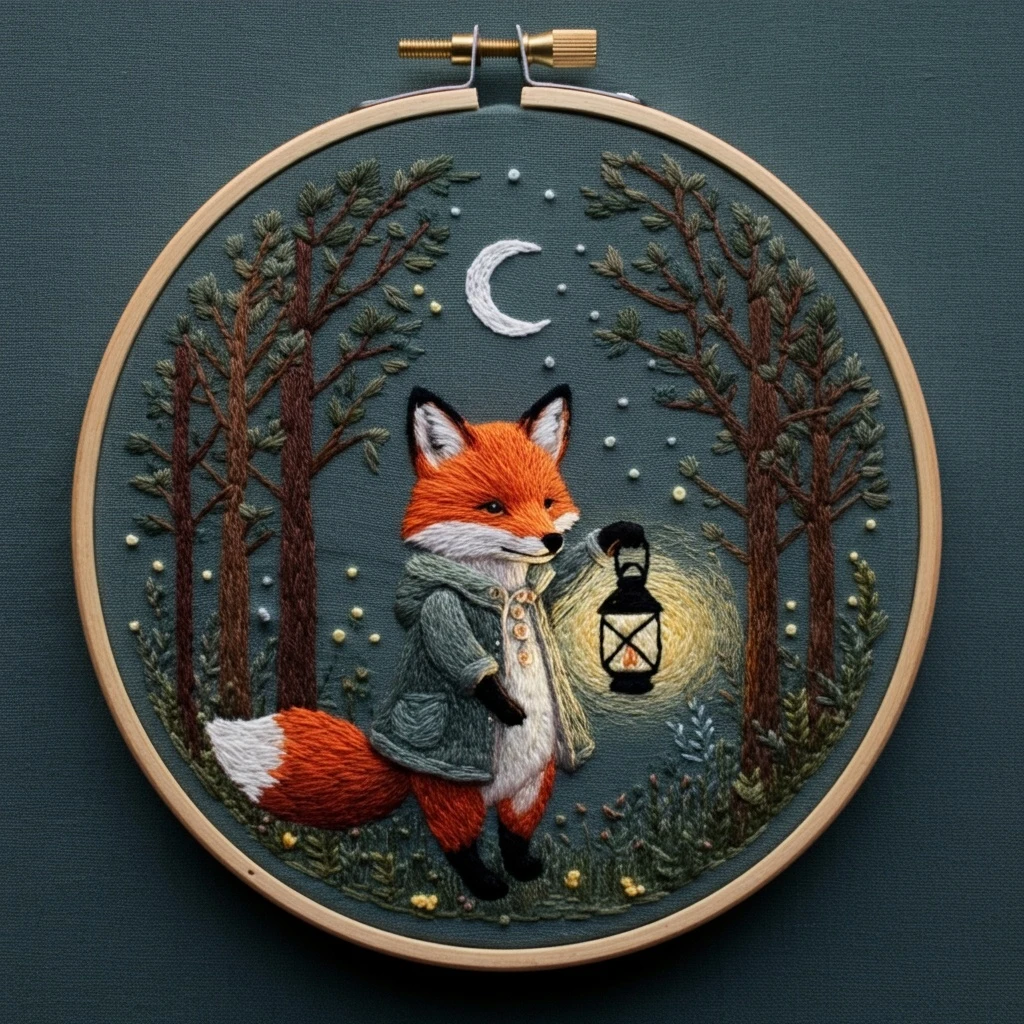
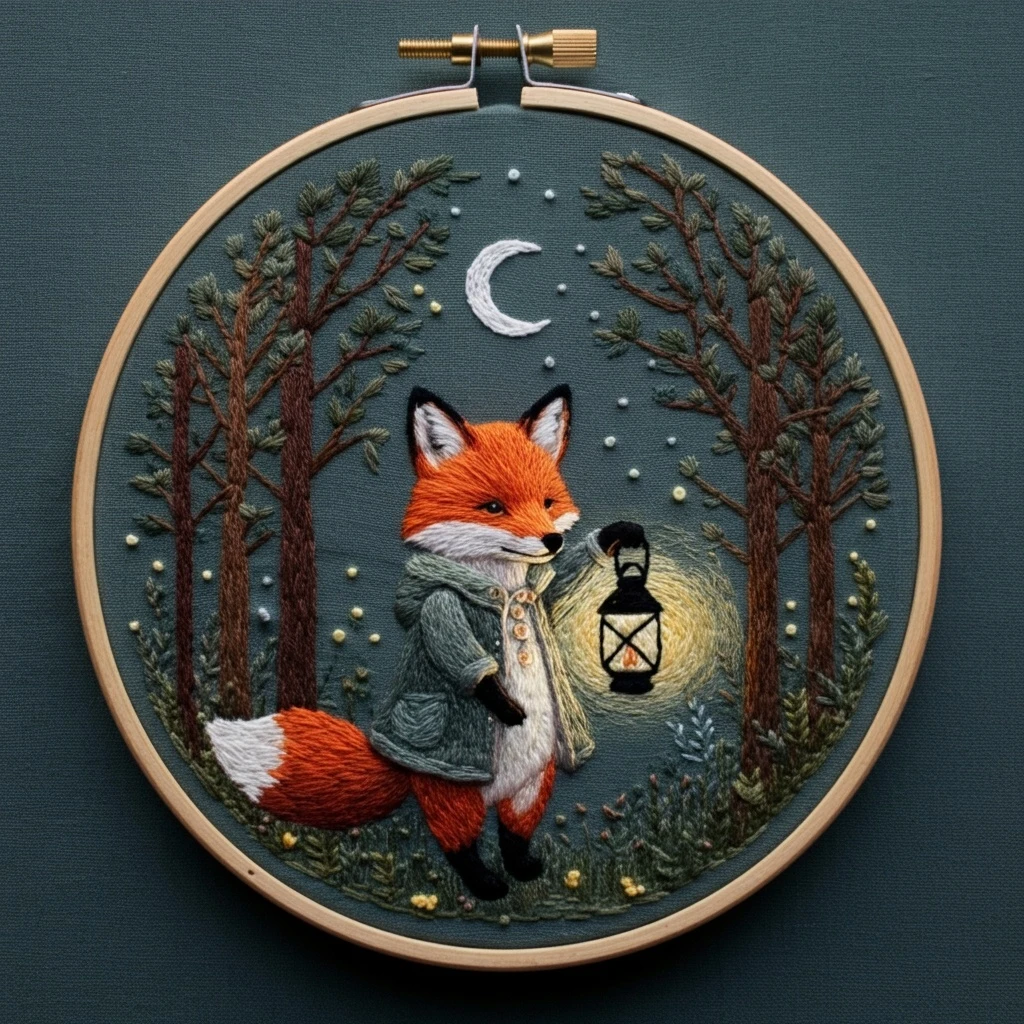
A cozy woodland-night embroidery with a russet fox, glowing lantern, crescent moon, pine trees, soft snow-like French knots, and muted blue-green fabric. The palette is built around warm orange fur against cool midnight teal, with buttery lantern light and textured bark.

Russet fox furLantern glowPine woodlandMoonlit nightBeginner-friendly layers

Color reading from the design

The reference has four dominant color families: deep blue-green night fabric, coppery fox fur, smoky sage coat and pines, and a small yellow lantern halo. Keep the darkest accents crisp so the lantern and fox face remain the focal point.

DMC 900Burnt Orange — Dark
Main fox head, body, tail and leg shadows.
DMC 920Copper — Medium
Mid-tone fur strokes and warm cheek areas.
DMC 922Copper — Light
Fine highlights along ears, brow and tail ridge.
DMC 310Black
Lantern frame, paws, nose, eye and ear tips.
DMC B5200Snow White
Tail tip, muzzle, shirt front and moon highlights.
DMC 762Pearl Gray — Very Light
Muzzle shading, inner ears, crescent moon and stars.
DMC 924Gray Green — Very Dark
Fox coat shadows and cool woodland depth.
DMC 926Gray Green — Medium
Coat body, scarf folds and pine needle transitions.
DMC 928Gray Green — Very Light
Coat highlights and frost-touched foliage.
DMC 3362Pine Green — Dark
Evergreen boughs, lower grasses and wreath texture.
DMC 3051Green Gray — Dark
Needle tips, mossy stems and muted leaf clusters.
DMC 801Coffee Brown — Dark
Tree trunks, branches and bark outlines.
DMC 898Coffee Brown — Very Dark
Deep bark splits and branch undersides.
DMC 3821Straw — Light
Lantern halo and the brightest glow knots.
DMC 744Yellow — Pale
Soft outer light, tiny flowers and warm star dots.
DMC 927Gray Green — Light
Snowy dots, cool stars and distant moonlit leaves.
Optional sparkle: add one strand of DMC Diamant D3821 only in the lantern center or a few stars. Keep it sparse so the fox’s hand-shaded fur still feels soft.

Stitch map by design area

AreaSuggested stitches and handling
Fox face & bodyUse long-and-short stitch in the direction of the fur. Begin with DMC 900 in shadow pockets, layer 920 through the center, then add single-strand 922 strokes on top.
Muzzle, chest & tail tipWork split stitch or short satin stitch with B5200 and 762. Keep the strokes slightly uneven so the white areas look furry, not flat.
Coat & scarfFill with split stitch or close stem stitch in 924/926. Add 928 on raised folds and cuffs. Use stitch direction to suggest the sleeve curve.
Lantern frameOutline with 1 strand of 310 in back stitch. Use tiny straight stitches for crossbars, then couch one black strand if you want extra-clean metal lines.
Lantern glowRadiate 3821 and 744 outward in loose straight stitches. Blend with one strand of 3821 plus one strand of 744 for a soft halo around the glass.
Pines & grassesUse fly stitch, detached chain, fishbone leaves, and seed stitches in 3362, 3051, 924, and 927. Vary length to avoid a repeated pattern.
Trees & branchesStem stitch the trunks with 801, then add 898 back-stitch cracks and short 433/801 texture lines where bark needs warmth.
Moon & snow dotsSatin stitch the crescent with 762/B5200. Work stars and snow as French knots, alternating 927, 762, and a few 744 knots near the lantern.

Thread-count guide

  • 1 strand: eyes, nose, lantern frame, whisker-like fur edges, small branch tips and star dots.
  • 2 strands: most fox fur, coat fill, pine needles, bark texture and moon satin stitch.
  • 3 strands: bold tree trunks, lower grasses, large French knots and the brightest lantern glow.
  • 4 strands only where needed: padded lantern light or raised coat cuff accents. Avoid heavy strands in the fox face.

Layering plan for a clean finish

Prepare the night background. Transfer fine details lightly. On dark teal fabric, use a white water-soluble pencil or chalk pencil and test removal first.
Stitch the farthest trees first. Build trunks and upper branches before the fox. This lets the character overlap the woodland scene neatly.
Block in the fox with direction. Place each long-and-short stitch from nose to cheek, shoulder to belly, and tail base to tip. Direction matters more than perfect length.
Add clothing after fur. The smoky green coat should sit on top of the body. Use darker stitches under sleeves and lighter stitches where lantern light would hit.
Save the lantern glow for late stages. Work the black frame first, then add yellow glow last so it stays crisp and luminous.
Finish with knots and highlights. Scatter snow, stars and tiny flowers at the end. Keep knot sizes varied for a natural winter-night effect.

Blending & shading notes

The design works best when warm and cool threads overlap subtly rather than sitting in hard blocks.

Fox fur blendUse 1 strand 900 + 1 strand 920 for the deepest orange body shadows. Switch to 920 + 922 for sunlit fur along the brow and tail.
Cool coat blendUse 924 + 926 for the main coat, then 926 + 928 on the sleeve edge closest to the lantern.
Lantern haloStart with 3821 near the flame, graduate to 744, then use a few isolated 927 stitches at the outer edge to merge into the night.

Outlining details

  • Use 310 sparingly: eye, nose, paws, ear tips and lantern frame. Too much black can flatten the soft style.
  • Outline the fox’s orange silhouette with split stitch in 900 instead of black for a natural furry edge.
  • Use 801 for branch outlines, then add small 898 marks only on the shadow side.

Texture suggestions

  • Fur: long-and-short stitch with staggered ends; add a few flyaway single-strand stitches around cheeks and tail.
  • Bark: stem stitch lines side by side, broken by tiny straight stitches in two browns.
  • Pine needles: fly stitch or angled straight stitches radiating from a branch; mix dark and light greens on each bough.
  • Snow and stars: French knots with 1 or 2 wraps. Use 2 strands for prominent knots and 1 strand for distant dots.
  • Lantern light: loose radial stitches, not a filled circle. Let the fabric show through for a transparent glow.
Beginner shortcut: If long-and-short stitch feels intimidating, use rows of split stitch for the fox, changing color every few rows. Add single-strand fur strokes on top to soften it.

Practical embroidery tips

Fabric choiceA deep teal cotton, linen or cotton-linen blend suits the night setting. Stabilize loosely woven fabric with a light backing if the lantern knots pull.
NeedlesUse a size 7 or 8 embroidery needle for 2 strands, and a size 9 or 10 for single-strand facial details and lantern lines.
Hoop tensionKeep the fabric drum-tight, especially while filling the fox and coat. Retighten before satin stitching the crescent moon.
Order of workBackground branches → pine needles → fox body → coat → lantern → moon/stars/knots. This keeps foreground edges tidy.
Back cleanupDo not carry dark 310 thread behind white moon, muzzle or tail-tip areas. It can shadow through pale stitches.
Final polishSteam from the back over a towel, then fluff fur stitches gently with a clean needle tip. Avoid pressing raised knots flat.

Design mood: warm lantern light against a cool midnight forest. Keep the fox’s orange fur vivid, but let the moon, pines and snowy dots stay soft so the tiny lantern becomes the magical focal point.
Leave a Reply

Your email address will not be published. Required fields are marked *