
DMC palette & stitch guide
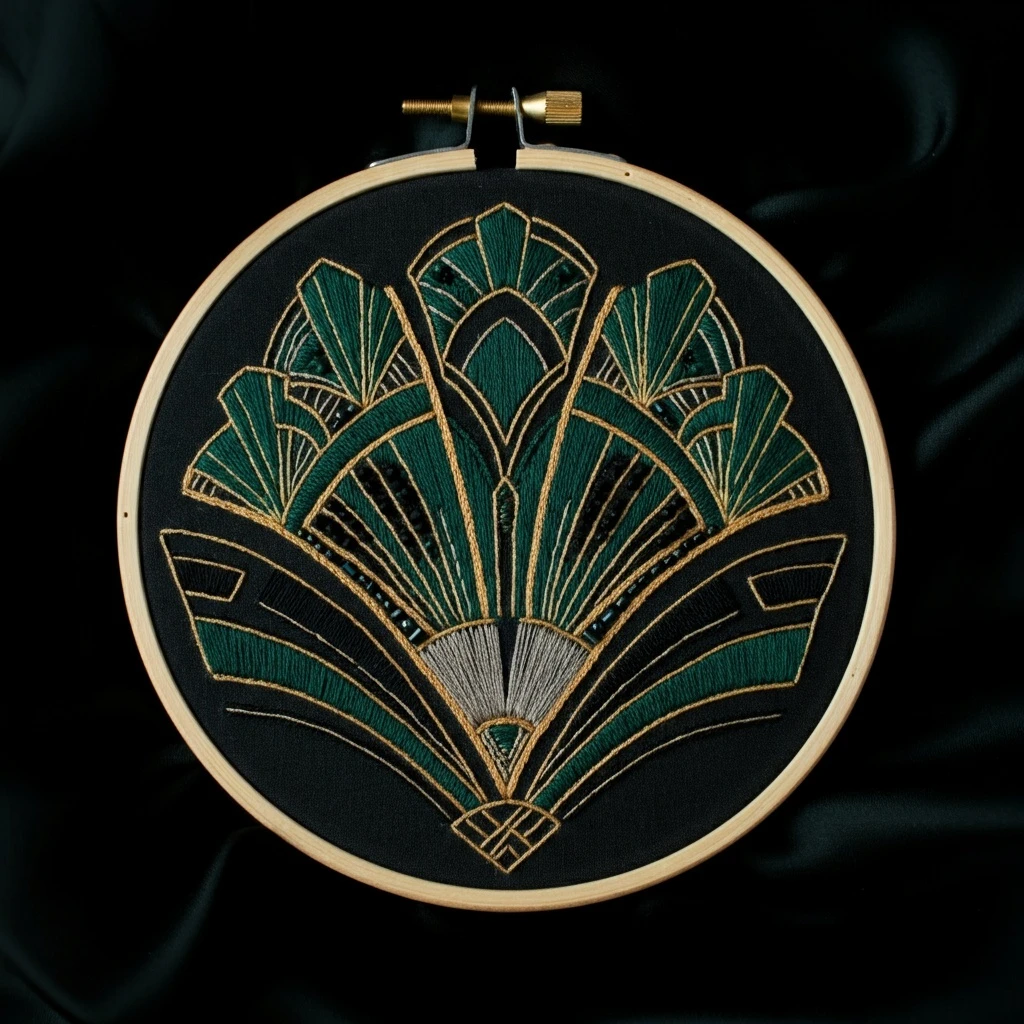
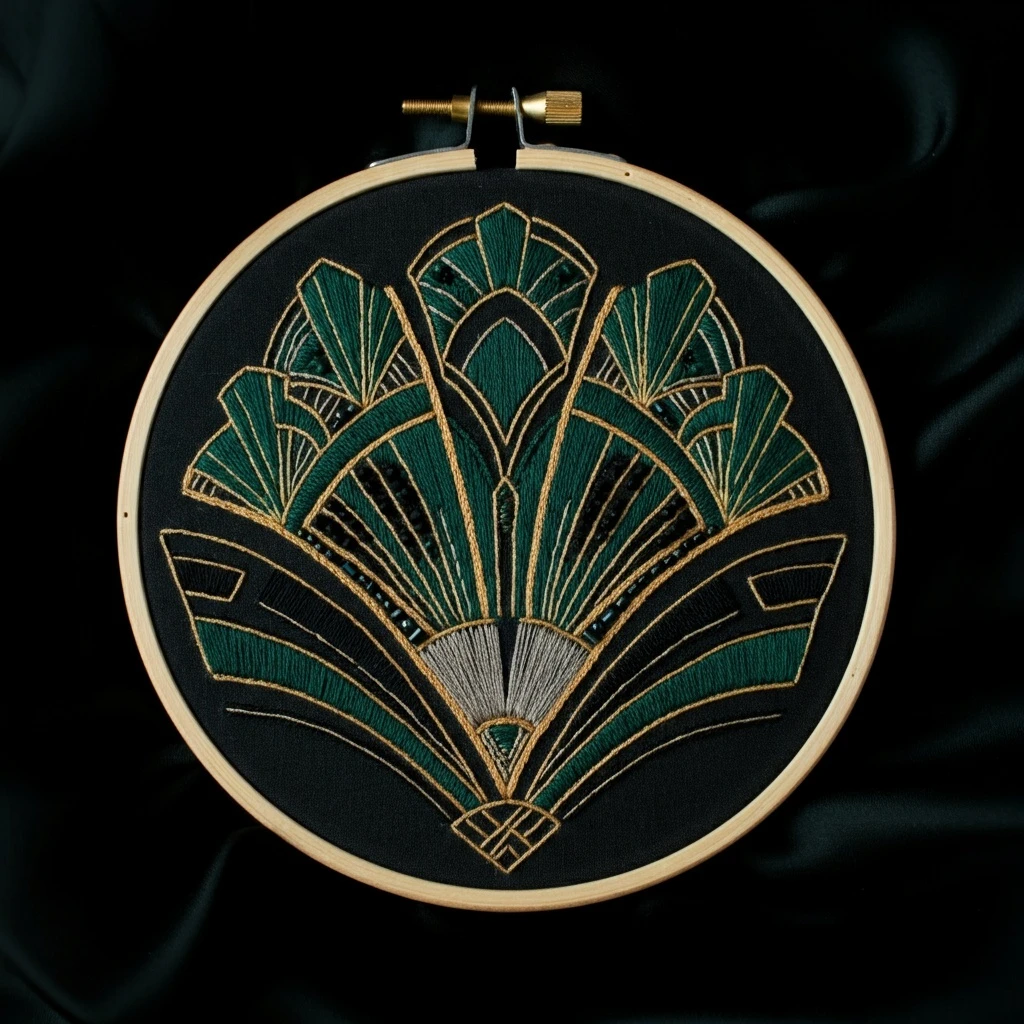
Art Deco Emerald and Gold Embroidery Hoop
This design reads as a glamorous Art Deco composition built around deep emerald greens, antique gold accents, sharp geometric framing, and smooth symmetrical linework. The most successful embroidery treatment will keep the shapes crisp, the green sections richly layered, and the metallic-looking gold areas clean and luminous.
Design Color Story
The palette is dominated by jewel-toned emerald, softened with a few cooler green-gray transitions and elevated by old-gold accents that mimic metallic trim. Because Art Deco designs depend heavily on contrast and precision, a small amount of very dark outlining is useful to separate arches, fan motifs, rays, borders, and stepped geometric details.
If your reference includes black, charcoal, cream, or ivory line details, keep them controlled and secondary. The visual hierarchy should remain: emerald first, gold second, dark outlining third.
Likely DMC Color Palette
Estimated from the visible Art Deco styling, emerald tonal range, and gold decorative accents.
| DMC | Thread Name | Coverage | Where It Appears |
|---|---|---|---|
| 3851 | Bright Green Dark | 18% | Main deep emerald sections, fan shadows, interior arches, and bold geometric panels. |
| 699 | Green | 15% | Primary emerald fill, central motif shading, and medium-depth Deco bands. |
| 700 | Bright Green | 12% | Lighter emerald transitions, outer shape highlights, and dimensional edge blending. |
| 701 | Green Light | 7% | Highlight edges, narrow inner glow lines, and softened green facets. |
| 3052 | Green Gray Medium | 5% | Muted transition areas where bright emerald needs a more antique tone. |
| 729 | Old Gold Medium | 12% | Main gold bars, radiating rays, stepped borders, and decorative trim. |
| 680 | Old Gold Dark | 9% | Gold shadowing, lower edges of metallic elements, and stronger Deco outlines. |
| 3829 | Old Gold Very Dark | 5% | Deepest gold contrast, shadow cuts between adjacent bars, and geometric separations. |
| 745 | Yellow Pale Light | 4% | Top highlights on gold motifs and the brightest Deco gleam points. |
| 3371 | Black Brown | 6% | Fine outlining, shadow channels, and the darkest internal geometry. |
| 310 | Black | 3% | Only for the sharpest line accents, if the design needs higher graphic contrast. |
| 3865 | Winter White | 4% | Tiny highlight lines, pale negative-space accents, or contrast details on dark fabric. |
Stitching Suggestions
| Element | Stitch Type | Thread Count | Notes |
|---|---|---|---|
| Large emerald fills | Long and short stitch, satin stitch | 2 strands | Use long and short stitch for larger shapes needing tonal change; use satin stitch for compact clean Deco blocks. |
| Geometric outlines | Backstitch, split stitch, whipped backstitch | 1 strand | Keep linework crisp and consistent. Use 3371 for a softer antique outline or 310 for the sharpest contrast. |
| Gold rays and bars | Satin stitch, brick stitch, padded satin stitch | 2 strands | Work smooth, even gold segments with directional consistency so the Deco architecture looks structured. |
| Arches and stepped motifs | Split stitch fill, satin stitch | 2 strands | Use split stitch when shapes are irregular or narrow; satin stitch when the shape is clean enough for polished coverage. |
| Fine inner details | Stem stitch, backstitch, couching | 1 strand | Ideal for narrow Deco dividers, fan spokes, or concentric border lines. |
| Highlight edges | Straight stitch, split stitch, tiny satin accents | 1 strand | Add 701, 745, or 3865 in controlled small areas only to keep the art-deco geometry luminous but not overworked. |
Blending Ideas & Shading Guidance
Emerald blending: build from 699 and 700, then deepen selective recesses with 3851. Add 701 on the upper or outer edges of shapes to create a faceted gemstone effect.
Antique emerald variation: if the design feels too bright, soften some transitions with 3052 between 700 and 699. This gives the hoop a more vintage Deco mood.
Gold shading: use 729 as the main gold, 680 on the lower or inner edge of bars, and 3829 only in the deepest shadow cuts. Finish with a thread or two of 745 on top-facing edges.
Directional shading: in Deco work, shading should follow the architecture of the motif, not organic curves. Keep transitions neat and parallel to the geometric shapes.
Contrast control: separate adjacent emerald and gold zones with one-strand outlining or a tiny shadow gap. This prevents the design from looking muddy.
Highlight restraint: place highlights consistently on one side of repeated shapes so the composition feels intentional and symmetrical.
Outlining Details
- Use 1 strand of 3371 for most outlining if you want a sophisticated vintage finish.
- Use 1 strand of 310 only on the most graphic outer lines or tiny focal accents.
- For gold elements, outline sparingly—often the darker gold shade (680 or 3829) is enough without adding black.
- If the design includes repeated fan or sunburst segments, outline the outer frame first, then add interior separators after the fill is complete.
- On dark fabric, a narrow 3865 highlight line can replace part of the outline to create a glamorous Deco glow.
Where to Start
Begin by stitching the main structural outlines of the geometric design so the Art Deco framework is clear. Next, fill the largest emerald areas, because they establish the overall balance. Then stitch the gold bars, rays, and trim. Add the smallest details, interior linework, and final highlight accents last.
Helpful Notes
- Use 2 strands for most filled areas and 1 strand for all precision linework.
- Shorter stitch lengths help keep tight corners and stepped Deco motifs crisp.
- If using satin stitch on long bars, add a light split-stitch padding underneath to improve smoothness.
- Check symmetry often, especially on mirrored arches, rays, and corner ornaments.
- A laying tool or large tapestry needle is helpful for keeping gold satin stitches smooth and reflective.
- Press finished work from the back over a towel so raised outlines and smooth satin sections are not flattened.