
DMC palette & hand embroidery notes
Realistic Lychee Hoop Art
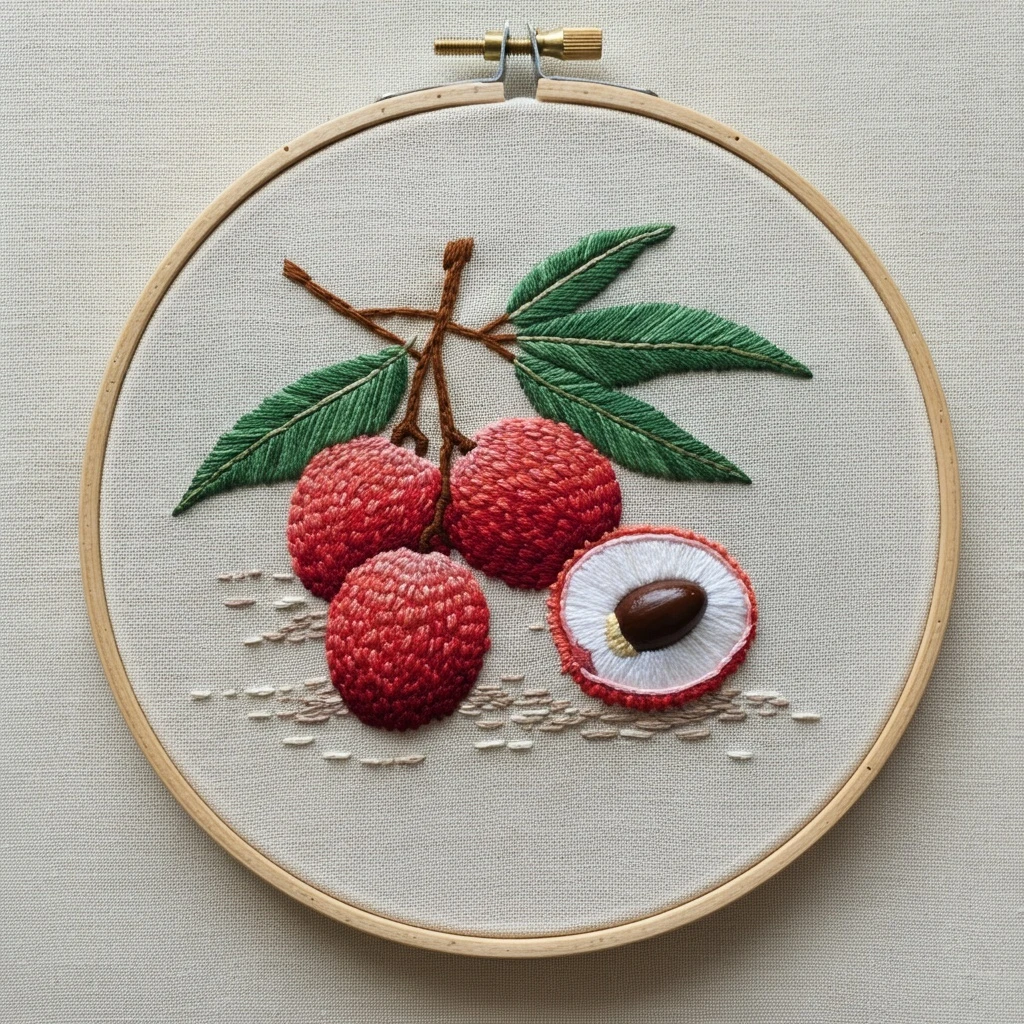
A polished stitching plan for a dimensional lychee branch: red-pink textured fruit, glossy white cut flesh, a dark seed, warm brown stems, deep green leaves, and soft neutral ground stitches on natural linen.
Color palette overview
The reference design uses a compact but layered fruit palette: coral highlights over crimson shadows for the bumpy lychee skin, cool whites for the sliced flesh, cocoa browns for the seed and twig, and several leafy greens to keep the branch realistic. Use the darkest tones sparingly so the fruit keeps its fresh, juicy look.
DMC 321
Red
Main saturated lychee shell, deepest red patches, and bold rim accents.
DMC 350
Coral Medium
Mid-tone bumps and rounded fruit body; blends naturally into red shadows.
DMC 353
Peach
Warm pink highlight stitches on raised skin texture and top-lit fruit areas.
DMC 815
Garnet Medium
Underside shadows between fruit, recessed dimples, and dark contour definition.
DMC B5200
Snow White
Brightest flesh highlights in the sliced lychee and tiny sparkle on the seed.
DMC 762
Pearl Gray Very Light
Subtle gray-white shading in the flesh so the white center does not look flat.
DMC 801
Coffee Brown Dark
Woody stems, branch joints, and the lower edge of the glossy seed.
DMC 938
Coffee Brown Ultra Dark
Seed core, deepest stem grooves, and narrow shadow outlines.
DMC 986
Forest Green Very Dark
Leaf shadows, outer leaf edges, and lower veins.
DMC 987
Forest Green Dark
Main leaf fill, long-and-short rows, and mid-tone leaf planes.
DMC 988
Forest Green Medium
Leaf highlights along the center vein and top-facing tips.
DMC 842
Beige Brown Very Light
Loose ground stitches and faint cast shadows beneath the fruit.
Stitch plan by design area
Whole lychee fruit
- Build the rounded fruit with dense seed stitch, small detached chain, or tiny padded satin dots.
- Use 2 strands for most bumps; drop to 1 strand near edges for a softer circular contour.
- Place 815 and 321 low and between fruit; float 350 and 353 across the upper-left light zones.
Cut lychee half
- Use radial satin stitch from the rim toward the seed, alternating B5200 and 762.
- Keep the outer red peel in short split stitch or wrapped back stitch for a crisp raised ring.
- Add a narrow shadow under the seed with 801 before placing the glossy dark oval.
Leaves
- Work long-and-short stitch from the central vein outward, following each leaf’s angled growth.
- Use 986 at the base and undersides, 987 through the body, and 988 on the upper ridges.
- Finish with a fine split-stitch vein in beige-green or a single strand of 842 mixed with 987.
Stems and ground
- Stem stitch or whipped back stitch gives the twig its rope-like woody texture.
- Use 801 for the main branch and 938 for knots, joins, and underside shadows.
- Scatter short horizontal running stitches in 842 and 762 to echo the linen surface without crowding it.
Thread-count, blending & texture guidance
| Area | Recommended strands | Technique notes |
|---|---|---|
| Lychee shell bumps | 2 strands, occasional 3-strand padded dots | Keep stitches short and irregular. A few raised knots or padded seed stitches create the characteristic pebbled peel. |
| Fruit shadows | 1-2 strands | Blend 815 with 321 in alternating stitches; avoid long dark blocks, which flatten the fruit. |
| White flesh | 1 strand for fine radial work, 2 strands for fill | Use directional satin stitch with slight gaps between white and gray-white for a moist translucent effect. |
| Seed | 2 strands satin, 1 strand highlight | Fill with 938 and 801 in a curved satin direction; add one tiny B5200 highlight at the top curve. |
| Leaves | 1 strand for edges/veins, 2 strands for body | Blend 986/987 in long-and-short rows, then feather 988 highlights along the light-facing vein. |
| Stem and tendrils | 2 strands for main stem, 1 strand for twig tips | Whip a darker thread over a lighter stem stitch to add bark ridges and dimension. |
Blending idea: For the most realistic lychee skin, thread the needle with one strand of DMC 350 and one strand of DMC 321 for the middle fruit zones. Switch to 353+350 only where light catches the upper dimples, and 321+815 beneath overlapping fruit.
Suggested stitching order
Transfer lightly. Mark fruit circles, leaf center lines, stem path, seed oval, and the cut fruit rim. Keep texture dots optional so they do not clutter the fabric.
Anchor stems first. Stitch the branch and small fruit stems before the fruit fill, so the fruit can visually sit on top.
Fill leaves directionally. Work from center vein outward with long-and-short stitch, then add edge definition in the darkest green.
Pad and texture fruit. Place darker underside texture first, then layer coral and peach raised stitches toward the highlight areas.
Complete the slice. Stitch the red peel ring, then the white flesh, then the dark seed last for the cleanest dimensional overlap.
Add ground stitches sparingly. Use small beige and gray horizontal strokes under the fruit to ground the design while leaving plenty of linen visible.
Beginner-friendly practical tips
For clean realism
- Use a sharp crewel needle so dense fruit texture does not distort the fabric weave.
- Keep satin stitches short on curved areas; long stitches can snag and lose the round form.
- Rotate the hoop as you stitch leaves so the needle always follows the leaf grain.
For dimensional finish
- Do not outline everything equally. Reserve dark outlining for the seed, fruit overlaps, and leaf undersides.
- Let some red bumps cross over previous stitches; this creates a natural raised lychee peel.
- Press finished work face down on a towel, using steam from above rather than flattening raised texture.
Final check: from arm’s length, the three whole fruit should read as rounded red forms, the sliced fruit as clean white with a glossy seed, and the leaves as directional green strokes rather than solid blocks.