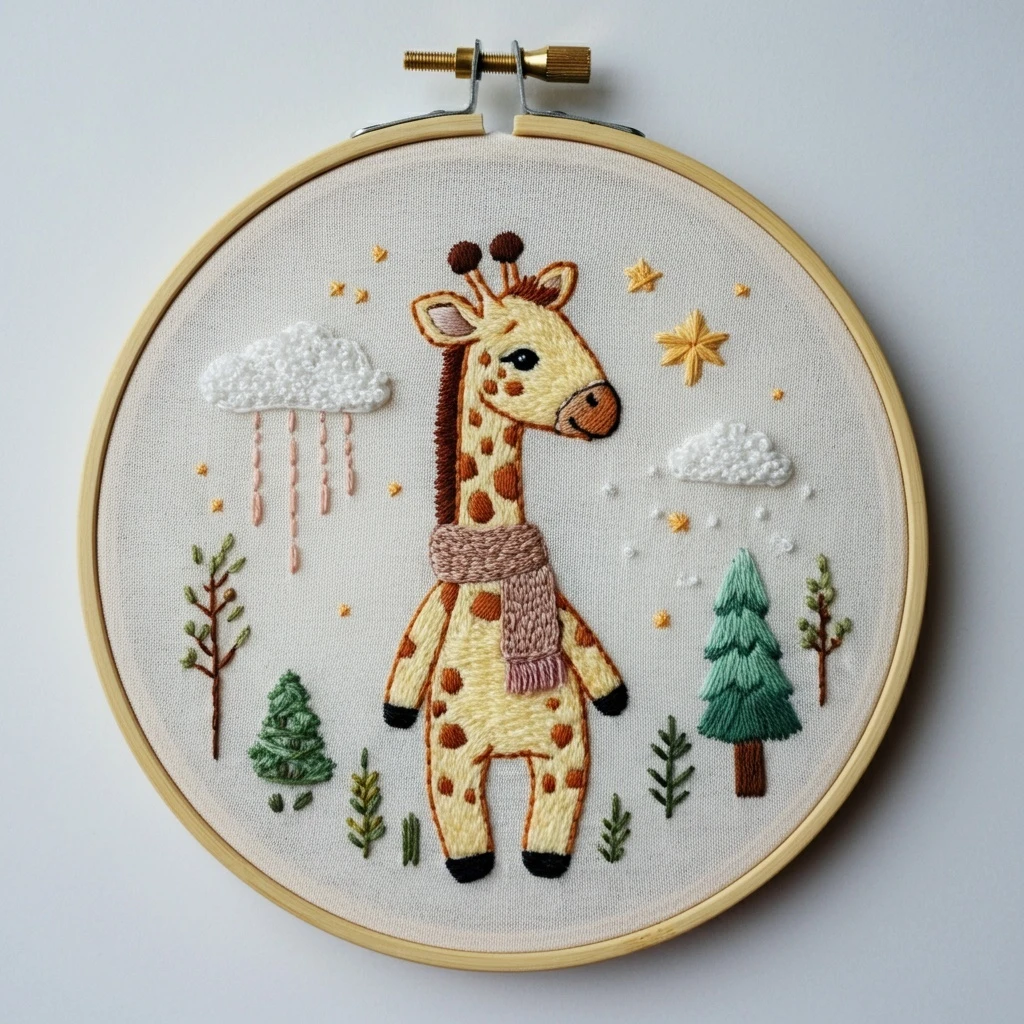

Embroidered Giraffe in a Winter Landscape
A friendly winter hoop with a golden giraffe, cozy knitted scarf, bobbly snow clouds, tiny stitched stars, evergreen trees, bare branches, and soft falling snow. Colors are estimated from the visible preview and matched to practical DMC embroidery floss choices.
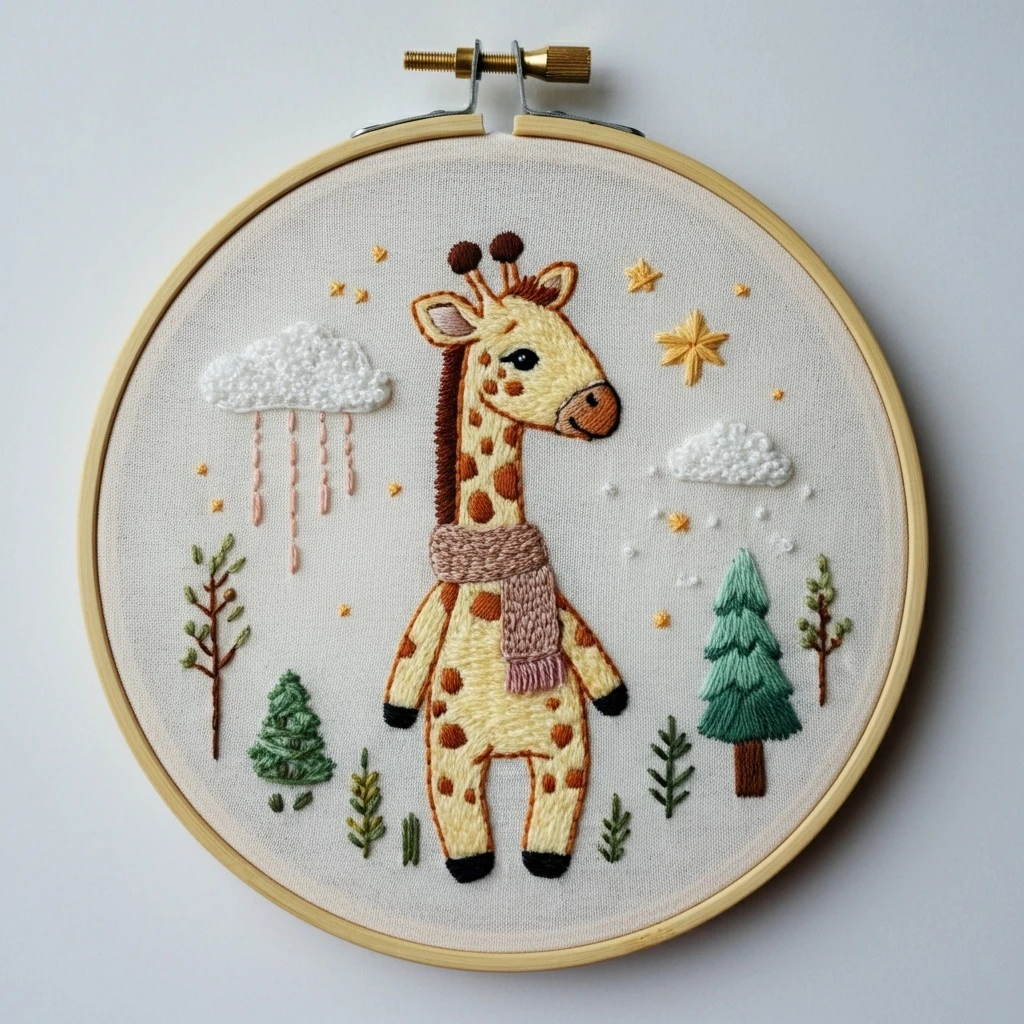
Preview image from the linked sample file.
Likely DMC Color Palette
The design relies on a cheerful contrast: buttery giraffe yellows, warm chestnut spots and outlines, muted mauve scarf threads, snowy whites, blue-green pine trees, olive sprigs, black accents, and little golden stars.
Coverage percentages are visual estimates from the preview, not exact thread usage.
Stitching Suggestions
| Element | Stitch Type | Practical notes |
|---|---|---|
| Giraffe body | Long and short stitch | Work the yellow base in the direction of the body shape: vertical on the neck, curved on the belly, and shorter on the face. Add 783 along edges for soft shading. |
| Spots and antlers | Satin stitch plus split-stitch outline | Fill spots with 975, then touch selected lower edges with 898 for depth. Keep spots slightly irregular to preserve the handmade charm. |
| Mane | Dense straight stitch or turkey-work trim | Use very dark brown in short vertical strokes. For a fuzzy ridge, add tiny upright stitches and gently fluff them after finishing. |
| Face and muzzle | Satin stitch, split stitch, tiny backstitch | Use 3856 for the muzzle, outline with brown, and save black eye/nostril stitches until the end for clean expression. |
| Scarf | Stem stitch rows, chain stitch, or woven fill | Build horizontal rows in 3722, then add 315 ribbing lines and fringe. Slightly offset the rows for a knitted scarf effect. |
| Snow clouds | French knots, colonial knots, seed stitch | Lay a pale winter-white base first, then cluster B5200 knots densely at the cloud bottom and more loosely at the top. |
| Falling snow | French knots and tiny straight stitches | Use one strand for small dots and two strands for the closest flakes. Scatter unevenly so the sky stays airy. |
| Stars | Straight stitch starbursts | Use 725 with 2 strands for larger stars and 1 strand for tiny cross-stars. Start all spokes from the center for a tidy sparkle. |
| Evergreen trees | Layered straight stitch, fishbone stitch | Start at the top and stitch downward in overlapping boughs. Mix 3812 with 500 under the branches for wintery depth. |
| Bare trees and shrubs | Stem stitch, backstitch, detached chain leaves | Use brown trunks with olive detached-chain leaves. Keep the side trees slimmer than the giraffe so they remain background details. |
Thread Count, Blending & Texture Guidance
Main fill
Use 2 strands for the giraffe body, muzzle, trees, scarf, and most outlines. This gives good coverage without making the small shapes bulky.
Fine details
Use 1 strand for facial lines, tiny branches, star points, falling snow dots, and the delicate rain lines below the cloud.
Raised accents
Use 2 strands for French knots in the clouds. For extra plush snow, wrap knots twice and place them close together.
Blending ideas
- For the giraffe body, blend one strand of 744 with one strand of 783 in shadow zones along the neck and belly.
- For warmer spots, use one strand of 975 with one strand of 898 on the darkest spot edges.
- For pine trees, alternate 3812 and 500 every few rows instead of mixing every stitch; this keeps branches readable.
- For scarf softness, combine 3722 and 315 sparingly in the underside folds, then top with neat horizontal rib lines.
Outlining & Shading Details
This hoop reads best when the giraffe is crisp and the winter landscape stays light. Outline only the key edges: the face, neck, spots, hooves, scarf silhouette, and major tree trunks. Leave some cloud and snow edges soft so they feel fluffy.
Giraffe contour
Use split stitch in 975 around warm edges and 898 only on the mane side, under chin, and hooves. Too much dark outline can flatten the body.
Face focus
Place the eye after all surrounding fill is complete. A single, glossy black satin stitch with one tiny white highlight stitch can make the character lively.
Winter depth
Use the largest knots on the left cloud, smaller knots for falling snow, and fine straight stitches for distant stars to create scale.
Where to Start
Beginner-Friendly Practical Tips
- Keep fabric drum-tight in the hoop, especially before stitching the dense cloud knots and satin-filled giraffe spots.
- Use shorter satin stitches on the spots; long stitches can snag and look uneven on rounded shapes.
- Mark star centers with a tiny dot, then stitch all spokes outward from that point for symmetrical sparkle.
- When stitching trees, do not try to make both sides perfectly equal. Slight unevenness makes the evergreens feel natural.
- Trim thread tails carefully behind white cloud areas so darker threads do not shadow through the snow.
- Save all French knots, tiny snow dots, and black facial accents for the final pass to avoid catching them while stitching larger areas.