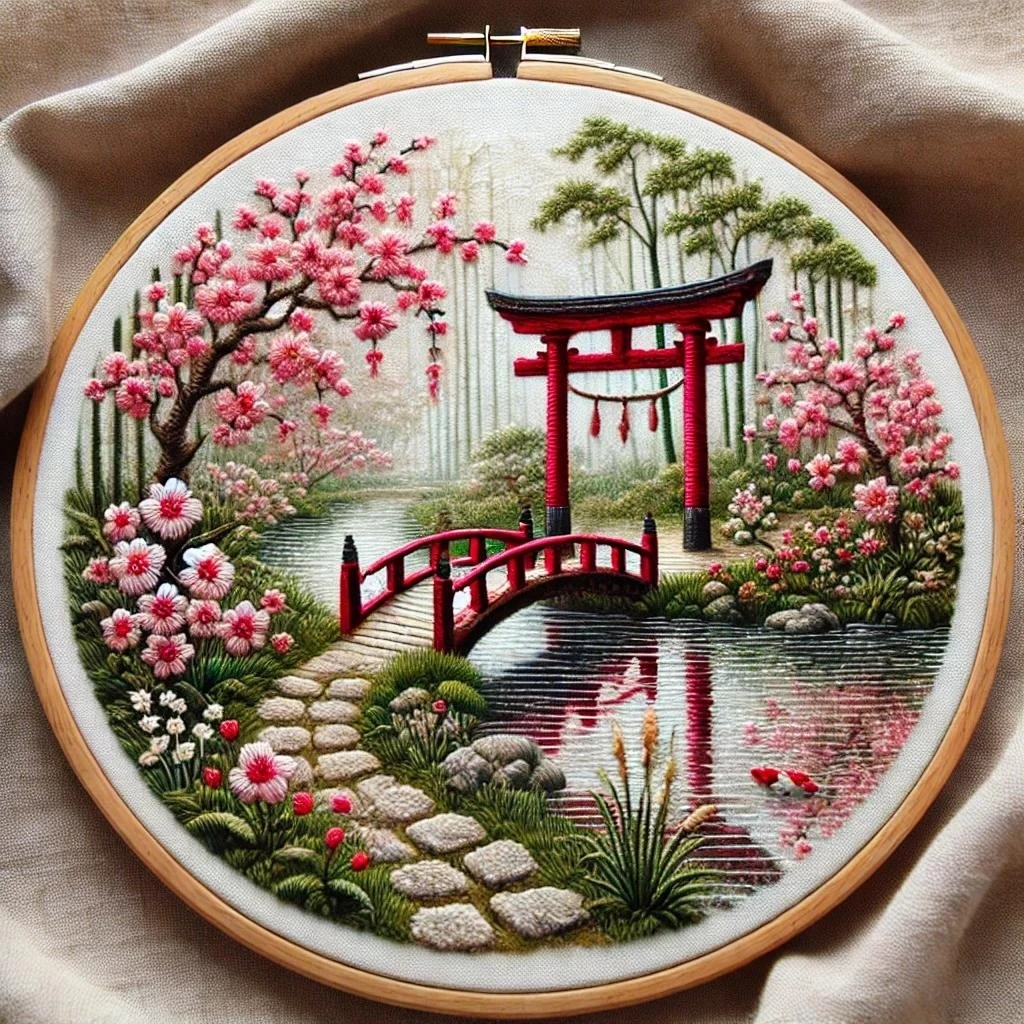

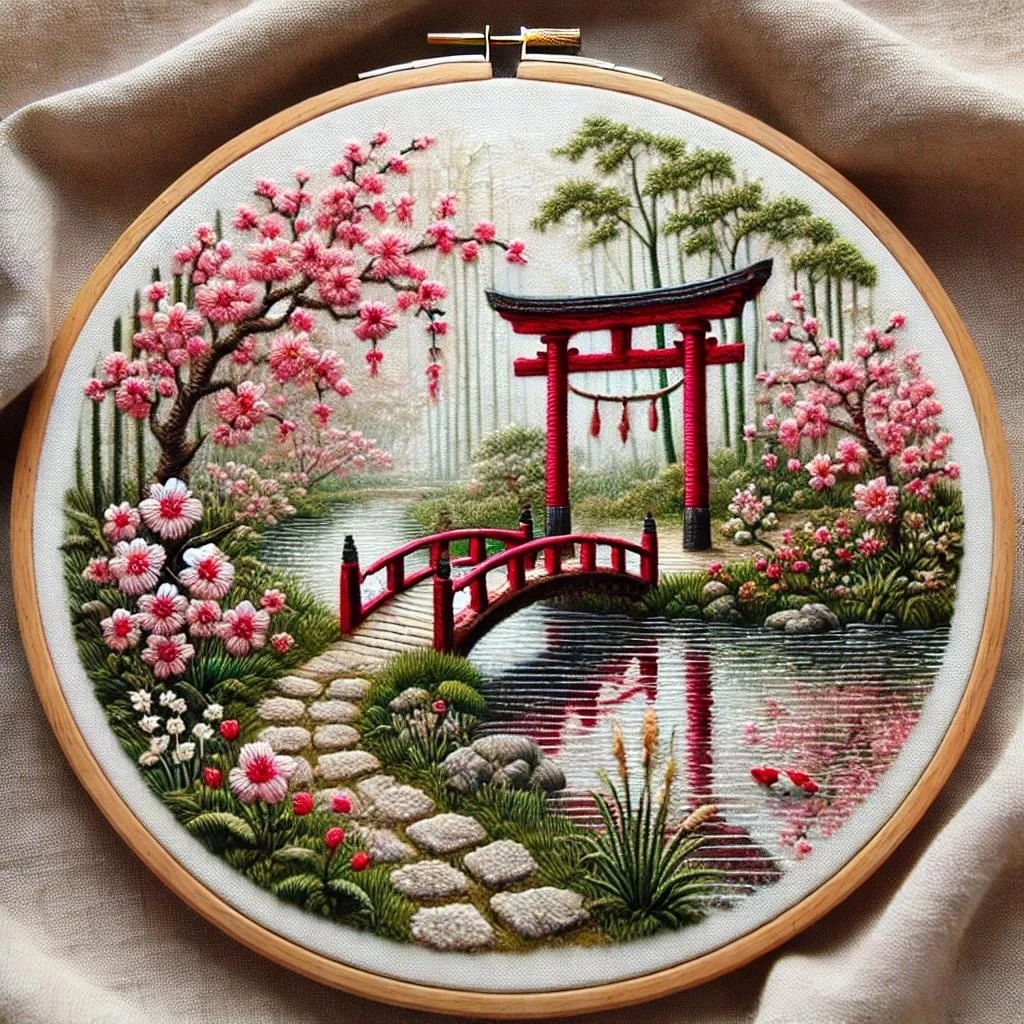
DMC palette & stitching guide
Serene Japanese Garden
A calm garden composition calls for controlled color transitions: mossy greens for shrubs and pines, soft blue-greens for water, warm stone neutrals, muted bridge reds, and restrained blossom pinks. The embroidery should feel peaceful rather than busy, with smooth outlines, light directional shading, and tiny accents that suggest raked paths, leaves, petals, and reflection.
Design read
Use crisp linework for architecture and stepping stones, softer stitches for foliage, and quiet horizontal movement for pond reflections. Keep high-contrast details small so the scene remains meditative.
Polished DMC Color Palette
These floss choices are selected to echo a tranquil Japanese garden: evergreen structure, mossy ground cover, pale water, weathered stone, warm wood, red bridge accents, and delicate blossom highlights. Use the darkest shades sparingly as anchors and let the midtones carry most of the stitched surface.
Deep pine shadows, underside of shrubs, and the darkest pond edges. Excellent for tiny anchoring stitches.
Main moss and garden foliage. Use as the primary leafy midtone for a muted natural look.
Soft shrub highlights, low grasses, and lighter leaf clusters around paths and water.
Gentle leaf tips and blended foliage transitions. Also useful for distant, airy garden texture.
Pond surface, reflected greenery, and cool shadow lines under bridges or stones.
Water glints, distant mist, and delicate highlight stitches on reflective areas.
Stone lanterns, stepping stones, rock outlines, and shaded gravel sections.
Base color for paths, sand, pale stone, and raked-garden areas.
Red bridge shadows, lantern trim, and small dramatic architectural accents.
Warm wooden rails, gate details, and weathered red-brown structural lines.
Cherry blossom petals, soft floral clusters, and subtle garden warmth.
Petal tips and tiny highlight knots. Keep sparse for a graceful, airy blossom effect.
Tree trunks, bridge undersides, roof beams, and grounding outlines.
Warm wood grain, path transitions, and sun-kissed stone edges.
Tiny golden highlights on lantern light, dry grasses, or warm afternoon accents.
Final sparkle on water, pale sand highlights, and separating stitches between dense areas.
Stitch Plan by Design Element
A Japanese garden scene benefits from contrast between clean man-made edges and organic foliage texture. Work the largest quiet areas first, then add architectural details and tiny blossoms last.
| Area | Recommended stitches | Practical guidance |
|---|---|---|
| Pond & reflections | Long and short stitch, straight stitch, split stitch | Use mostly horizontal stitches in 3768 and 928. Break lines into short segments so the water shimmers rather than forming heavy stripes. |
| Bridge, gate, or woodwork | Back stitch, split back stitch, satin stitch for small rails | Outline first with 815 or 801, then fill narrow bands with 3777. Add one-strand 436 highlights along upper edges. |
| Pines and shrubs | Fishbone stitch, fern stitch, seed stitch, detached chain | Layer 500 under 3051, then scatter 3012 and 3053 on top. Vary stitch angle to prevent flat-looking foliage. |
| Cherry blossoms | French knots, lazy daisy, tiny straight stitches | Use 223 for petal bodies and 225 for sparkle. Add very few knots at branch tips for a refined, airy feel. |
| Stone lanterns, rocks, paths | Split stitch, satin stitch, couching, seed stitch | Fill with 644 and shade one side with 414. Use seed stitches in one strand to suggest gravel or raked sand. |
| Tree trunks and branches | Stem stitch, whipped back stitch, split stitch | Work trunks in 801, then whip selected lines with 436 for bark ridges. Keep branches tapered with one strand near the tips. |
Thread Count, Blending & Shading
Thread-count guide
- 1 strand: distant branches, petal dots, water glints, fine stone cracks, and delicate outlines.
- 2 strands: most foliage, bridge outlines, pond lines, medium leaves, and path textures.
- 3 strands: only for bold foreground shrubs or strong architectural accents that need more visual weight.
- 6 strands: reserve for a few French knots if the design includes prominent blossoms or berries.
Color blending ideas
- Water: blend 1 strand 3768 + 1 strand 928 for gentle reflective midtones.
- Moss: blend 1 strand 3051 + 1 strand 3012 to soften transitions between shrubs and ground.
- Weathered wood: blend 1 strand 3777 + 1 strand 801 for bridge shadows; switch to 3777 + 436 on lit rails.
- Blossoms: blend 223 + 225 for pale petals, then add single-strand 223 knots for depth.
Texture & Outlining Details
Quiet water texture
Stitch water in short, staggered horizontal marks. Leave small spaces of fabric showing between rows; this keeps the pond luminous and avoids a dense block of thread.
Refined garden outlines
Use split stitch instead of heavy back stitch around stones and bridge curves when you want softer edges. Use one-strand 500 or 414 only where separation is truly needed.
Layered greenery
Place the darkest green first in the deepest recesses, then add overlapping fern or fly stitches in mid-greens. Keep the lightest green on the top-left edges for natural dimension.
Beginner-Friendly Practical Tips
Order of stitching
Begin with background water and paths, then work stones, trees, shrubs, bridge details, and finally blossoms. This order prevents small accents from being crushed by later stitching.
Keep the scene balanced
After every major color change, step back and check the hoop from arm’s length. A serene garden should have a few strong focal points, not equal detail everywhere.
Needle and fabric
Use a size 7–9 embroidery needle on medium cotton or linen. If the fabric is loosely woven, back it with lightweight stabilizer so satin stitches and French knots stay neat.
Finishing polish
Press from the back on a towel after stitching. Trim traveling threads behind pale areas so they do not show through the water or light stone sections.