
DMC palette & embroidery guide
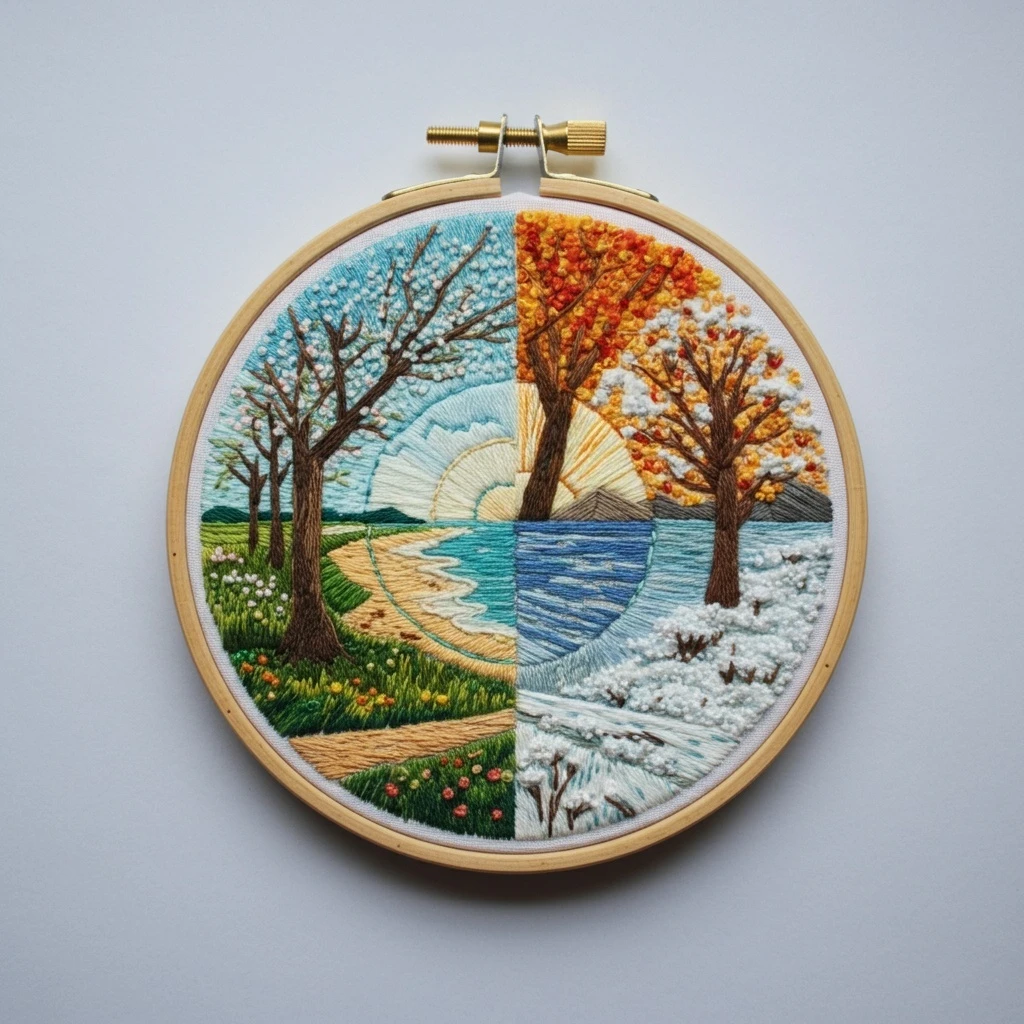
Four Seasons Coastal Landscape
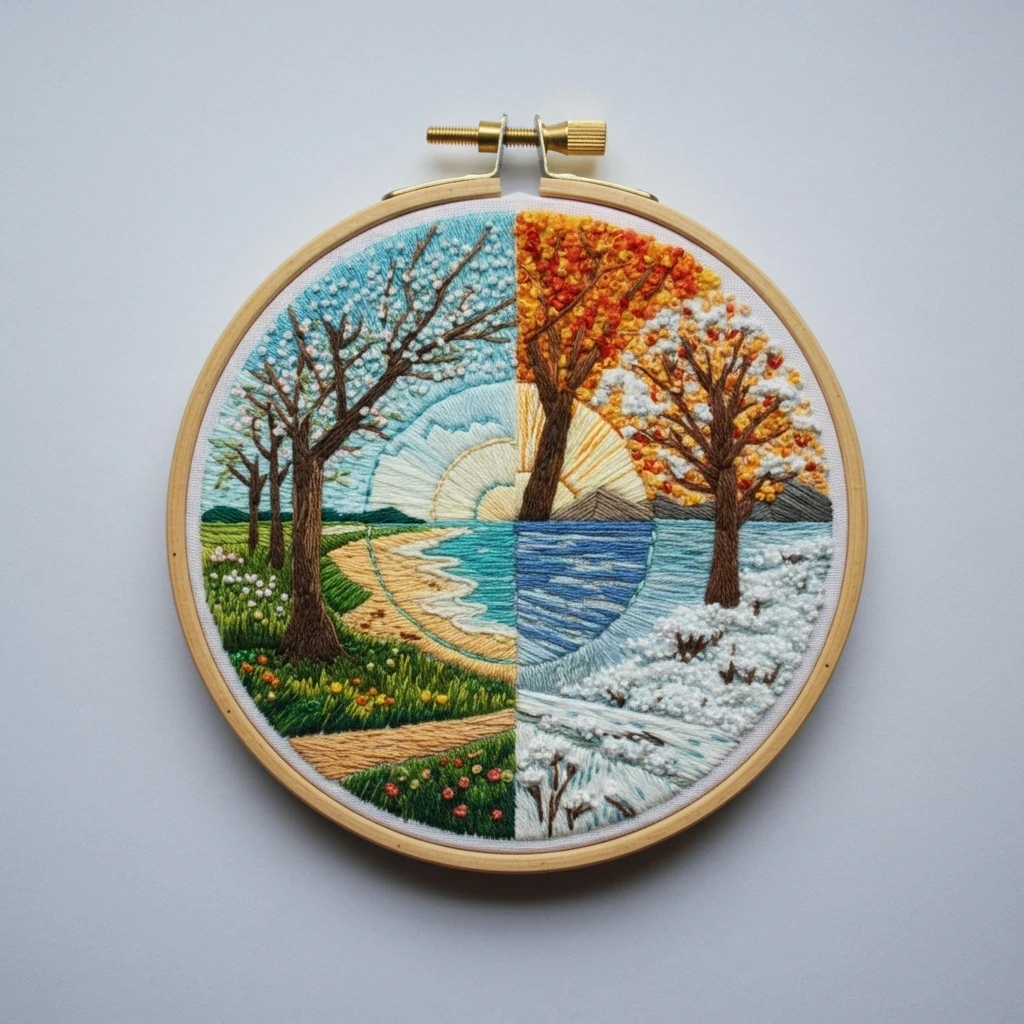
A divided hoop landscape that moves through spring blossom, summer shore, autumn foliage, and winter snow around one coastal horizon. The strongest color families are sea turquoise, deep water blue, beach sand, bark brown, fresh greens, fiery orange leaves, and icy whites.
- Keep the circular horizon continuous while changing the stitch texture in each season.
- Use directional long stitches for sky, sea, hills, sand, and snow so each quadrant feels windswept.
- Reserve raised knots for blossom, autumn leaves, and winter snow texture.
Polished DMC color palette
This palette is built to cover the whole seasonal composition without becoming overwhelming. Use the blues and neutrals as the common thread through the seascape, then let each season borrow its own accent group: spring pink-white blossoms, summer grasses, autumn oranges, and winter blue-greys.
Thread-count guidance
Work most large landscape fills with 2 strands so the sky, sea, paths, and snow cover smoothly without becoming bulky. Use 1 strand for horizon lines, tree branch tips, wave ripples, sun rays, and tiny plant stems. Use 3 strands only for French knots and raised seasonal textures.
Best fabric choice
A warm natural linen, cream cotton-linen, or pale oatmeal ground suits all four seasons. It keeps the beach sand and sunrise warm while still allowing white snow and blossoms to stand out. For a cooler look, choose pale blue-grey fabric and strengthen the sand with DMC 436.
Season-by-season stitching focus
Stitch plan by design element
Blending, shading, and outlining notes
| Area | Recommended blend | How to use it |
|---|---|---|
| Bright coastal water | 1 strand DMC 3845 + 1 strand DMC 3846 | Use in the turquoise spring and summer water where the light catches the surface. |
| Deep sea bands | 1 strand DMC 798 + 1 strand DMC 3845 | Place below horizon lines and near the center divide to deepen the water without turning it navy. |
| Soft snow shadow | 1 strand DMC 3756 + 1 strand DMC 762 | Add beneath tree bases, along snow ridges, and around winter foreground contours. |
| Warm sand | 1 strand DMC 739 + 1 strand DMC 436 | Use along the beach path and shoreline transition for a natural beige gradient. |
| Autumn glow | 1 strand DMC 742 + 1 strand DMC 920 | Use for mid-canopy knots, then add pure 726 dots sparingly as bright leaf highlights. |
| Fresh grass | 1 strand DMC 3346 + 1 strand DMC 3013 | Ideal for grass tips and spring field highlights; keep darker 895 closer to the ground. |
Use DMC 898 rather than black for most outlines. The design has many delicate seasonal transitions, and a brown outline keeps the trees, coast, and paths natural. Reserve the darkest 938 for branch forks, deepest bark grooves, and very small winter twigs.
Beginner-friendly practical tips
Order of stitching
First mark the central cross and curved horizon lines with a water-soluble pen. Stitch the large sky, water, sand, and snow areas next, then add trees, grass, blossoms, foliage knots, and fine outlines. This keeps the seasonal borders clean.
Keeping the four sections neat
Do not carry dark brown or green threads across the pale sun or snow areas. End and restart threads at the back of each quadrant so no shadows show through the light fabric.
Texture suggestions
Let stitch texture communicate season: airy seed stitches for spring, smooth satin for summer beach, raised knots for autumn leaves, and slightly uneven horizontal stitches for winter snow. The contrast makes the same coastline feel seasonal.
Finishing
Steam from the back over a fluffy towel so knots and raised snow stay dimensional. Trim long back threads behind the sun and water before final hooping, then lace the fabric evenly to preserve the round composition.