
DMC palette & hand embroidery guide
Tranquil Lavender Field Landscape
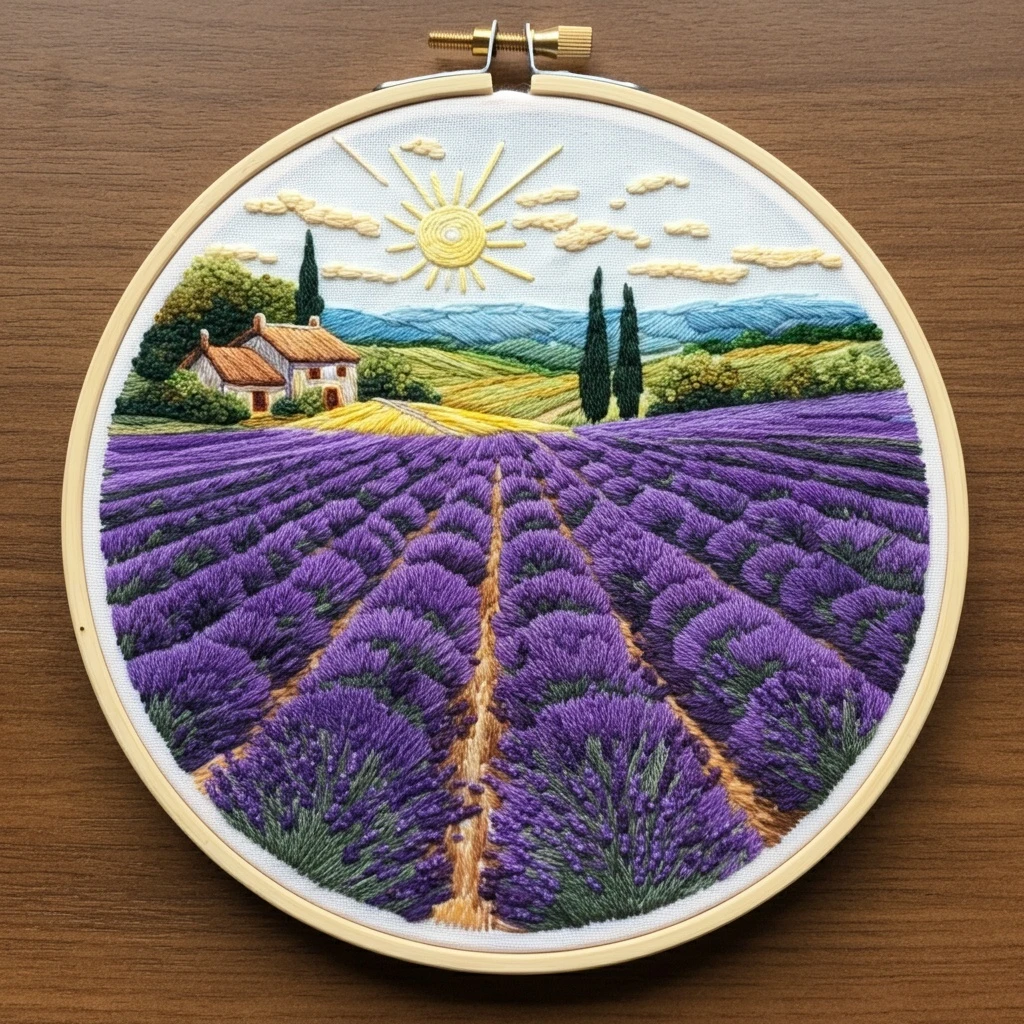
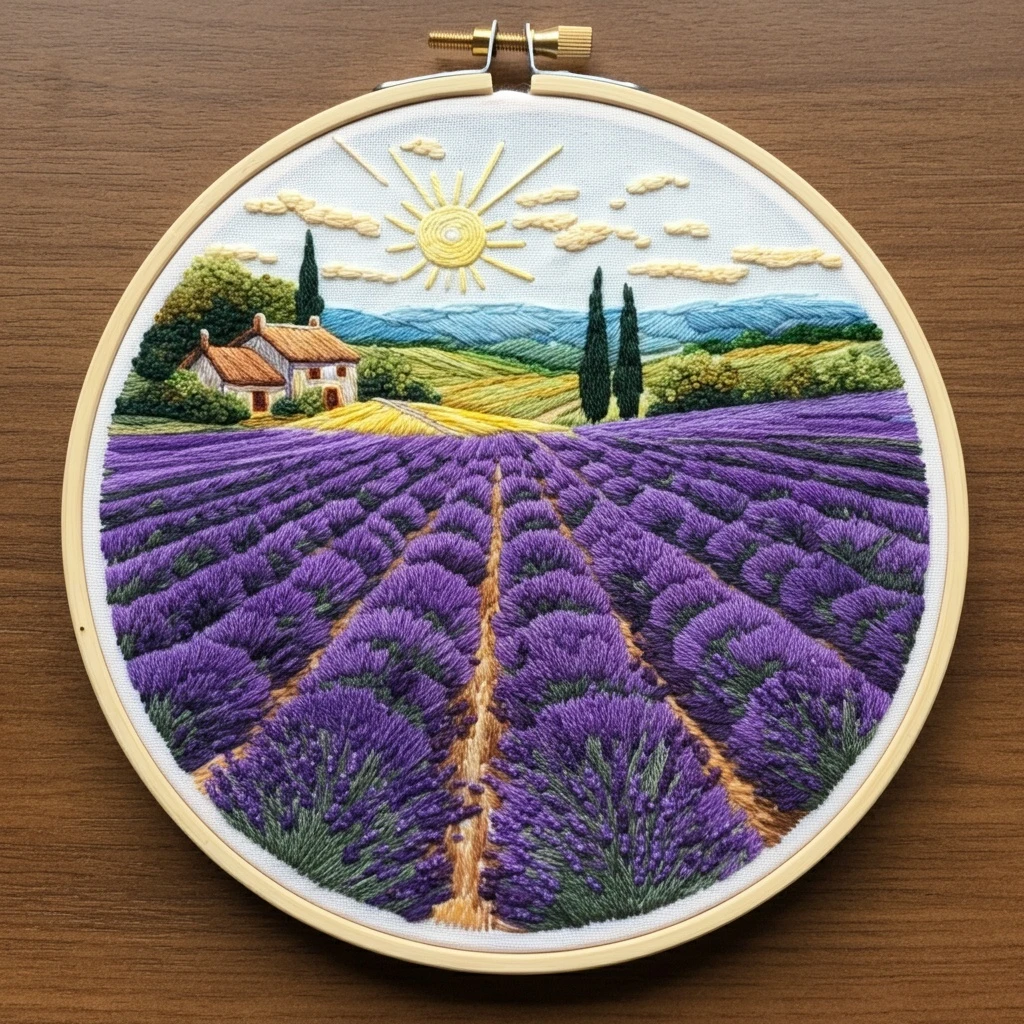
Colors and stitching notes are estimated from the visible hoop preview: sweeping purple lavender rows, dark green foliage, golden field paths, a small cottage, blue distant hills, cream clouds, and a warm stitched sun.
Preview
Design read
This landscape depends on perspective: the lavender rows widen toward the foreground and narrow toward the horizon. Keep foreground stitches fuller and more textured, then make the background rows flatter, shorter, and slightly cooler in color. The cottage and cypress trees give the eye a resting point, while the sun, clouds, and blue hills keep the upper half light and calm.
Likely DMC Color Palette
Use these as close DMC matches rather than exact thread-usage quantities. The strongest visual families are violet lavender, deep green, straw gold, soft sky blue, and warm cottage browns.
Stitching Suggestions
| Element | Stitch Type | Practical Notes |
|---|---|---|
| Foreground lavender mounds | Long and short stitch, turkey work accents, tiny straight stitches | Use 2 strands for the base and add scattered 1-strand violet highlight stitches. Angle stitches outward from each mound center so the plants feel rounded. |
| Lavender rows and furrows | Directional satin stitch, split stitch guide lines | Mark the perspective lines first with a removable fabric pen. Stitch dark purple shadows along the furrows, then overlap medium violet so the rows look layered. |
| Distant lavender field | Short straight stitches and seed stitch | Switch to 1 strand near the horizon. Keep stitches shorter and less raised so the background recedes instead of competing with the foreground. |
| Green stems and leaf bases | Straight stitch, fishbone stitch, stem stitch | Add dark green underneath purple clusters in broken lines. Do not fill every gap; tiny fabric breaks help the field stay airy. |
| Central path and golden fields | Long and short stitch with couching accents | Blend 725 with 977 for the sunlit path. Use vertical or slightly converging stitches to pull the viewer’s eye toward the cottage. |
| Cottage walls and roof | Satin stitch, split stitch outline, backstitch details | Work the roof in warm copper browns, then outline windows, doors, and roof edges with 1 strand for crisp miniature detail. |
| Cypress trees and shrubs | Stem stitch, dense straight stitch, French knots | Use 890 for the tall tree silhouettes, softened with 3345 on the lit side. French knots make rounded shrubs feel textured. |
| Distant hills | Horizontal long and short stitch | Use blue-gray threads in soft bands. Keep the stitch direction horizontal so the hills contrast with the vertical lavender texture. |
| Sun and rays | Whipped backstitch spiral, straight stitch rays | Stitch the sun center as a small spiral, then radiate single straight stitches. Use lighter yellow or off-white on the top of the spiral for glow. |
| Clouds | French knots, colonial knots, small detached chain | Keep cloud texture light and creamy. Small knots clustered loosely will echo the raised look in the reference without becoming heavy. |
Thread Count, Blending & Shading Plan
Beginner-Friendly Order of Work
- Transfer the horizon, cottage, central path, and the main lavender perspective lines before stitching.
- Stitch the distant hills and sky details first with 1 strand so the background stays flat.
- Complete the cottage, cypress trees, and shrubs next; these act as landmarks for the landscape.
- Fill the golden fields and path, keeping stitches pointed toward the horizon for depth.
- Build lavender rows from back to front, increasing thread thickness and texture as you move downward.
- Finish with dark row outlines, light violet highlights, cloud knots, and sun-ray refinements.
Practical tips
- Use a hoop that keeps the fabric drum-tight; dense lavender stitches can pucker loose fabric quickly.
- Trim thread lengths to about 14–18 inches to avoid fuzzy purple strands after repeated pulling.
- Do not outline every lavender mound. Selective dark accents look more natural than heavy black borders.
- Step back often. Landscapes need value contrast more than perfect individual stitches.
- Save French knots and raised texture until the end so they do not snag while you work nearby areas.