
Design #691 · Botanicals & Neutrals
Embroidered Fern Leaves in Neutral Tones
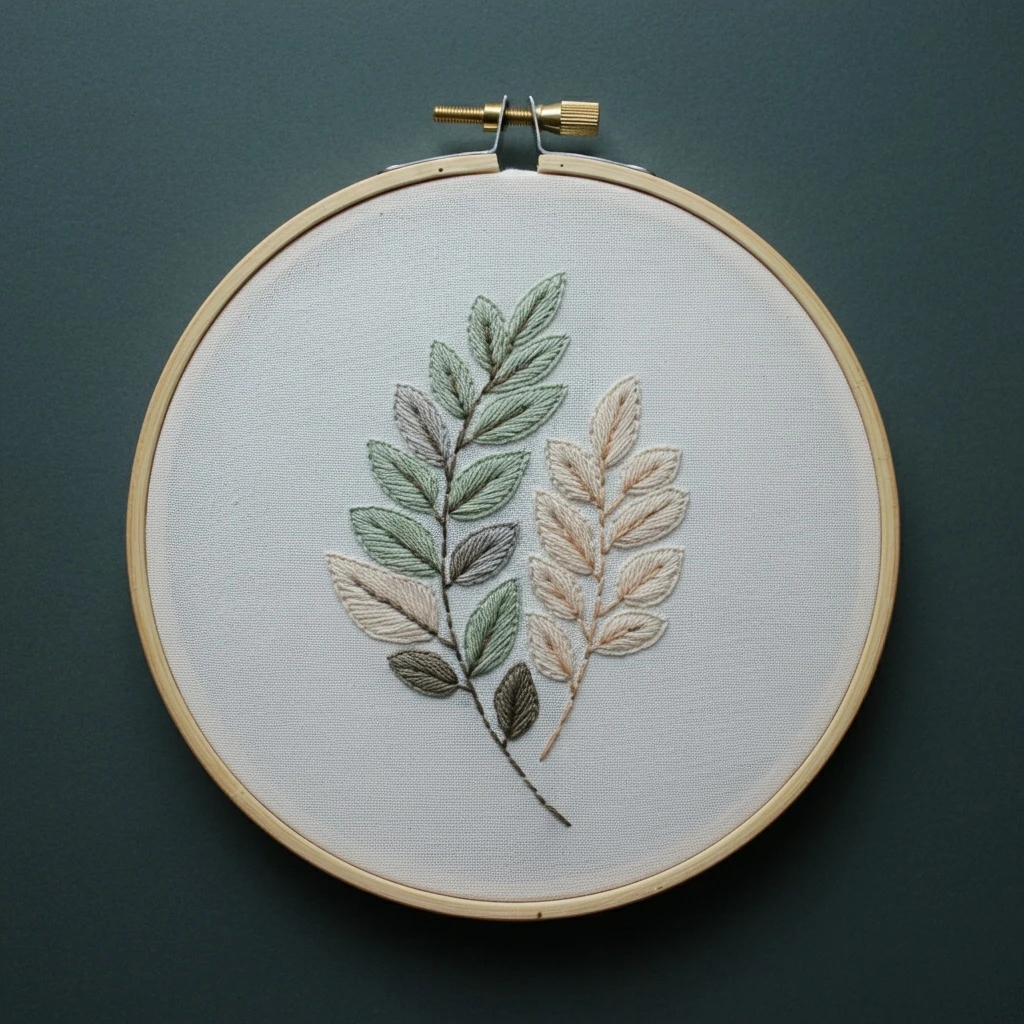
A soft, modern hoop design built from two airy fern stems: dusty green leaves, warm oatmeal fronds, charcoal-taupe shadows, and fine stitched veins. Colors are estimated from the visible preview and matched to close DMC embroidery floss shades.
Preview
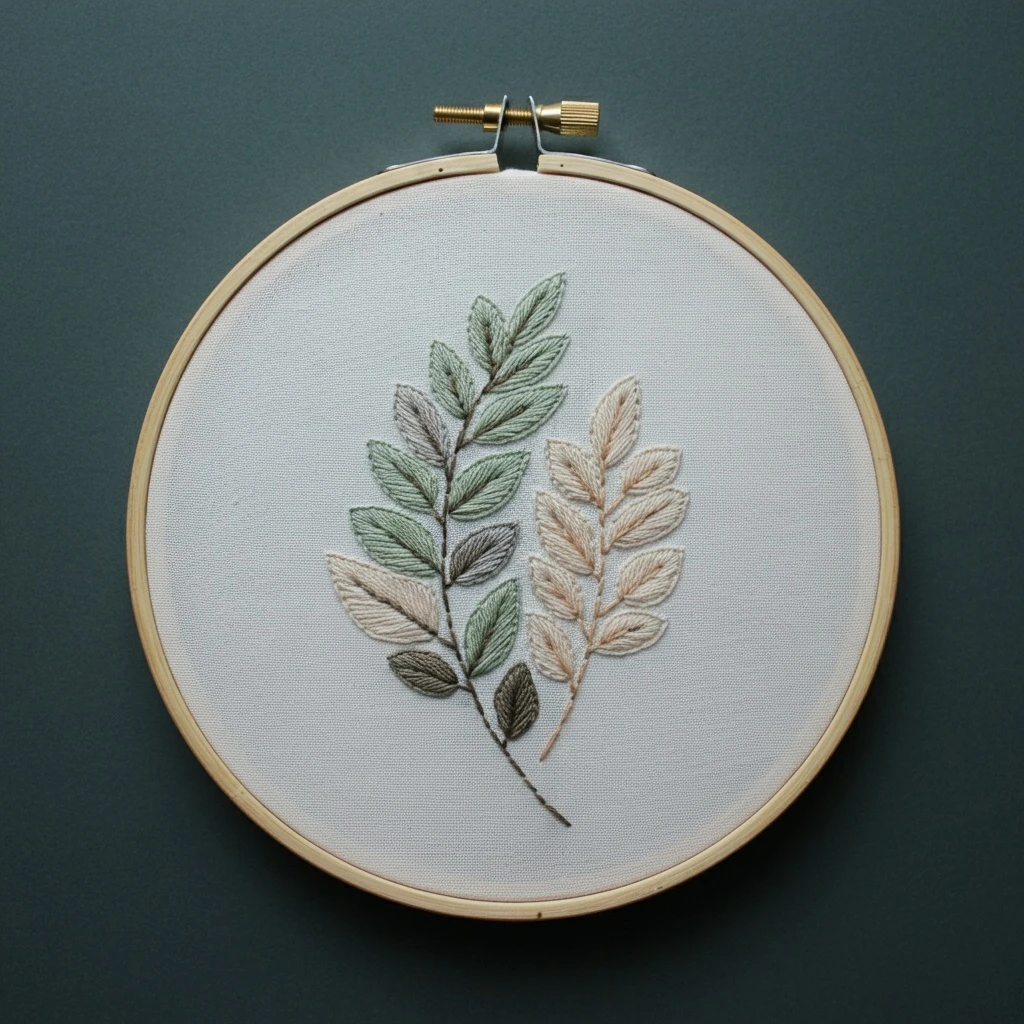
Preview image from the linked sample file. Palette and thread coverage are visual estimates, not exact kit quantities.
Likely DMC Color Palette
The design relies on quiet contrast rather than bright color: pale linen ground, muted sage, grey-green midtones, beige highlights, and deep brown-grey details for stems and inner veins.
DMC 3021
3021 · Brown Gray Very Dark
Use for the darkest lower leaves, the left stem base, and tiny split-stitch accents where the fern needs depth.
DMC 3022
3022 · Brown Gray Medium
Good for smoky shadow leaves and the central vein on the green fern, especially where leaves overlap.
DMC 3013
3013 · Khaki Green Light
Main dusty sage fill for the upper and middle green leaves; keep stitches directional and leaf-shaped.
DMC 3012
3012 · Khaki Green Medium
Blend with 3013 along the leaf bases and outer edges for subtle fern shading.
DMC 842
842 · Beige Brown Very Light
Primary fill for the warm neutral frond on the right and the pale leaf that crosses the left fern.
DMC 841
841 · Beige Brown Light
Use for warmer vein lines, shadowed beige leaf bases, and a soft outline on the right-hand stem.
DMC 822
822 · Beige Gray Light
Optional highlight shade for the pale leaf tips and a few fine stitches on top of the neutral frond.
DMC 640
640 · Beige Gray Very Dark
Thin outlining and crisp shadowing on the lower beige leaves without making the piece look black.
DMC 3371
3371 · Black Brown
Use sparingly for the very base of the left stem and only the deepest punctuation stitches.
DMC 3865
3865 · Winter White
For tiny glints on raised satin stitches if the fabric is darker than the sample; skip on bright white linen.
Stitching Suggestions
| Element | Stitch type | Practical notes |
|---|---|---|
| Main fern stems | Stem stitch or split stitch | Work the left stem in 3022/3021 and the right stem in 841. Use one strand for slim elegance; switch to two strands only at the thicker lower base. |
| Individual fern leaves | Fishbone stitch | This is the best match for the sample: stitch from the center vein out to the leaf edge, alternating sides so each leaflet forms a neat V-shaped rib. |
| Leaf fills | Satin stitch or long-and-short stitch | For a smoother botanical look, use short satin stitches on small leaves and long-and-short on larger leaves that need color transitions. |
| Central veins | Backstitch, split stitch, or couching | Add veins after the fills. One strand keeps the lines fine; couch a single laid thread when you want a straighter, polished rib. |
| Soft shadows | Thread blending | Blend one strand 3013 with one strand 3012 for sage midtones; blend one strand 842 with one strand 841 for the warm beige frond. |
| Outer leaf edges | Single-strand split stitch | Outline only a few edges, not every leaf. This keeps the fern light and prevents the neutral palette from feeling heavy. |
| Lower dark leaves | Fishbone with accent backstitch | Fill with 3022, then add small 3021 or 3371 strokes near the vein to create the darker folded-leaf effect. |
| Fabric texture | Minimal surface stitching | Leave generous negative space around the stems. The open linen is part of the design and makes the fern shapes look calm and modern. |
Thread Count & Blending Guide
1 strandBest for fine stems, vein lines, outer leaf definition, and the tiny dark details at the base.
2 strandsUse for most fishbone leaves so the texture is visible but still refined.
3 strandsOnly for slightly raised foreground leaves if stitching on a larger hoop or loose-weave fabric.
Blended needleTry 3013 + 3012 for sage leaves and 842 + 841 for beige leaves. This creates the soft heathered effect seen in the preview.
For the cleanest neutral result, avoid high-contrast outlines on every leaflet. Let the direction of the fishbone stitch define the shape, then add darker thread only where leaves tuck behind each other.
Where to Start
Transfer lightly.
Use a fine removable pen or pencil so the airy stems and leaf tips stay delicate.
Use a fine removable pen or pencil so the airy stems and leaf tips stay delicate.
Stitch the stems first.
Follow the curve from bottom to top with one-strand stem stitch, keeping the line relaxed and botanical.
Follow the curve from bottom to top with one-strand stem stitch, keeping the line relaxed and botanical.
Fill the larger leaves.
Work the green fern in 3013/3012 and the beige fern in 842/841. Keep every stitch angled toward the central vein.
Work the green fern in 3013/3012 and the beige fern in 842/841. Keep every stitch angled toward the central vein.
Add darker overlaps.
Use 3022, 3021, and small touches of 640 for leaves that sit behind or underneath.
Use 3022, 3021, and small touches of 640 for leaves that sit behind or underneath.
Finish with fine veins.
Add single-strand backstitch only after the leaf fills are complete, then trim any fuzzy thread tails.
Add single-strand backstitch only after the leaf fills are complete, then trim any fuzzy thread tails.
Beginner-Friendly Practical Tips
| Hoop tension | Keep the fabric drum-tight before starting each frond. Fishbone stitch looks uneven if the fabric loosens while you work. |
| Needle choice | A size 7 or 8 embroidery needle works well for two-strand leaves; use a finer size 9 for single-strand veins. |
| Stitch length | Use shorter stitches near pointed leaf tips and longer stitches through the wider center of each leaflet. |
| Shading control | Place darker stitches near the stem and lighter stitches toward the outer leaf edge to mimic the subtle dimensional shading in the preview. |
| Texture balance | Do not pack every leaf too tightly. A little fabric showing between stitches helps the design retain its soft, neutral, natural look. |
| Final pass | Step back before adding more outline. This design should feel calm and restrained, with detail visible up close rather than heavy from across the room. |