Embroidered Night Sky And Mountain Landscape

DMC Palette & Stitching Guide – Embroidered Night Sky And Mountain Landscape
Embroidered Night Sky and Mountain Landscape
DMC palette & stitching notes

Embroidered Night Sky And Mountain Landscape

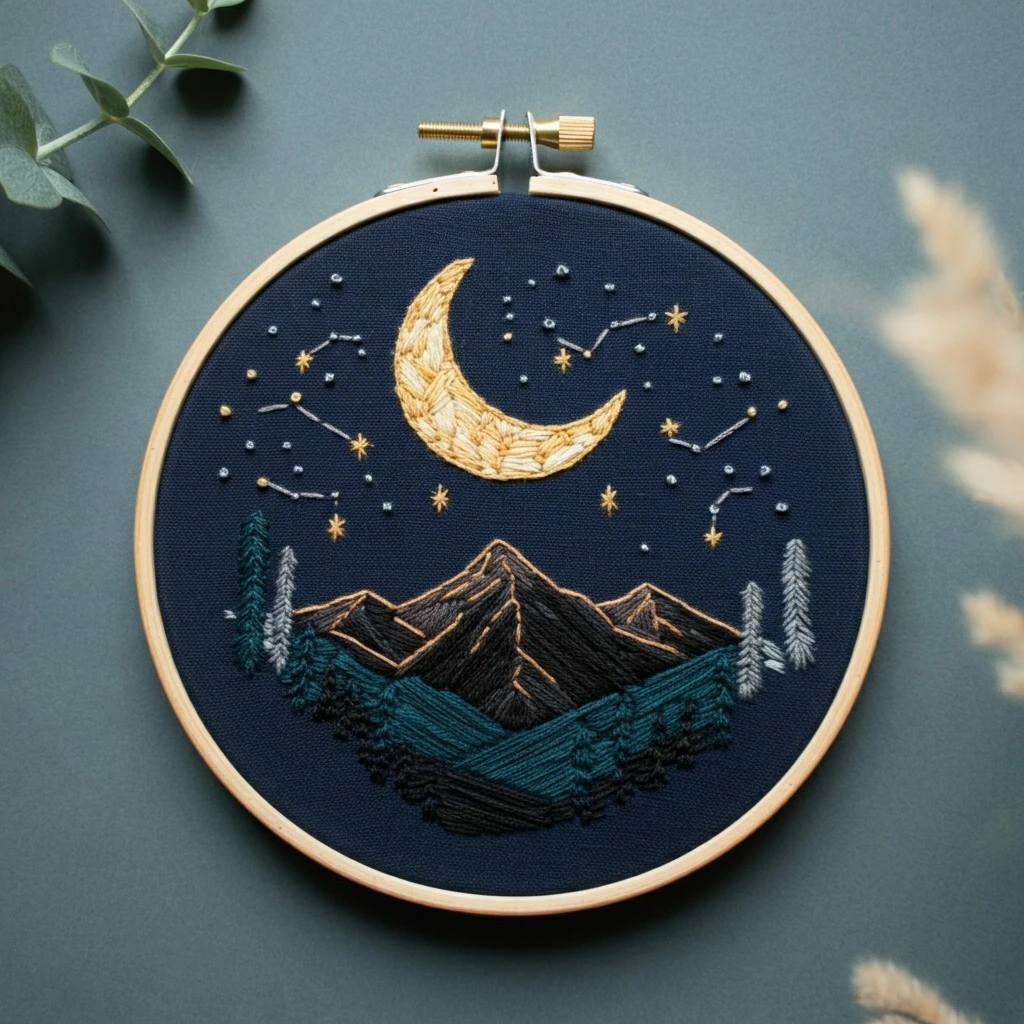
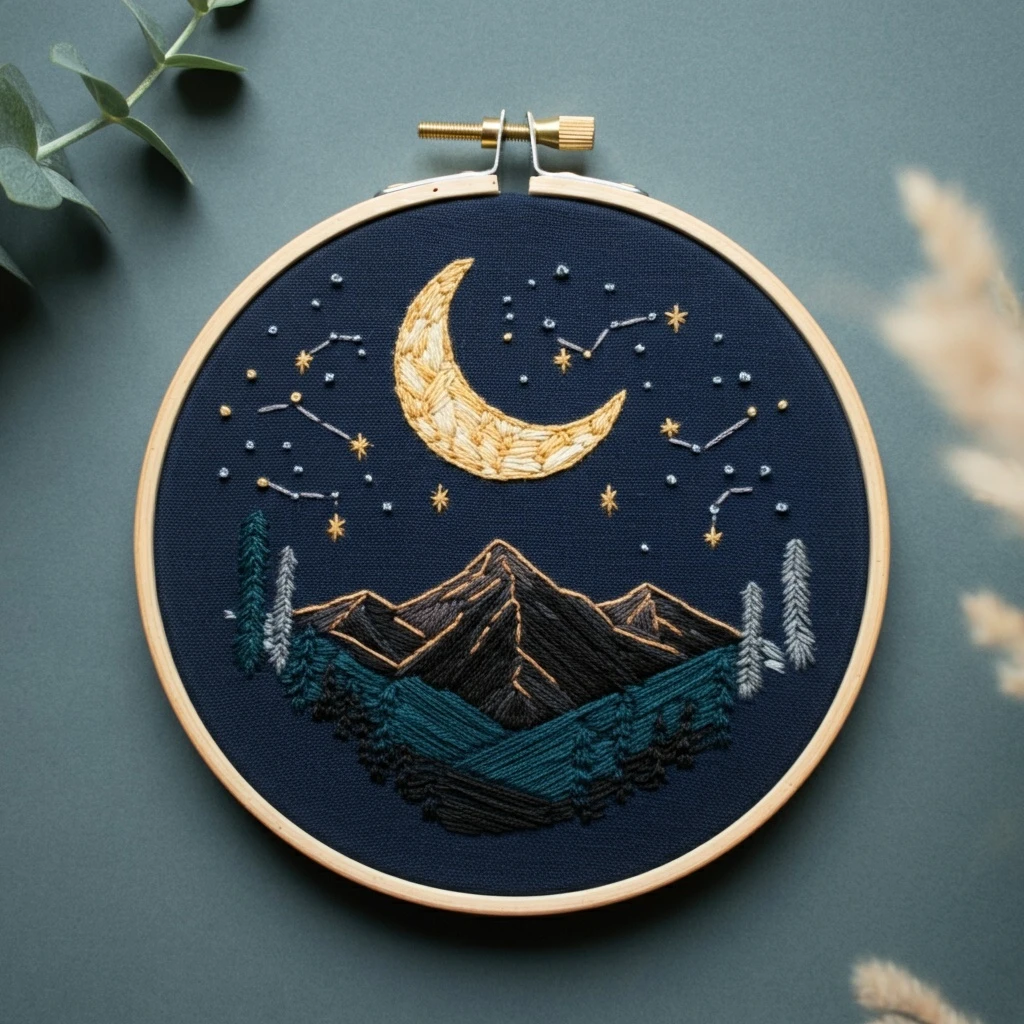
A calm alpine scene with a deep indigo sky, moonlit mountains, pine silhouettes, and cool lake reflections. Use smooth gradients for the sky and water, crisp darker outlines for the ridges, and tiny bright accents for stars and moon shimmer.

Night-sky bluesMoonlit highlightsLayered mountainsReflective water

Design color read

The reference design is built around strong value contrast: a dark, starry sky above cool blue-gray mountains, a shadowed evergreen band, and a lake that mirrors the lighter sky glow. The most important embroidery decision is keeping the sky and water soft while preserving clean silhouette edges on the mountains and trees.

DMC 939
Very Dark Navy Blue
Deepest night sky, lower sky corners, darkest mountain cuts, and selected outline reinforcement.
DMC 823
Dark Navy Blue
Main sky fill and shadow blend between 939 and brighter blue tones.
DMC 312
Baby Blue - Very Dark
Mid sky glow, lake reflections, and cooler mountain faces.
DMC 932
Antique Blue - Light
Soft reflected light on water, distant ridges, and gentle transition areas.
DMC 3756
Baby Blue - Ultra Very Light
Moonlit highlights, thin lake glints, snow edges, and brightest mountain caps.
DMC 3823
Yellow - Ultra Pale
Moon, larger stars, and a few warm sparkles reflected in the water.
DMC 3363
Pine Green - Medium
Evergreen silhouettes, tree texture, and forest band variation.
DMC 3371
Black Brown
Darkest tree trunks, foreground bases, and tiny contrast accents where outlines need strength.
DMC 414
Steel Gray - Dark
Mountain shadow planes, rock texture, and muted dividing lines between ridges.
DMC 318
Steel Gray - Light
Snowy mountain slopes, misty ridge transitions, and pale rock highlights.
DMC 3768
Gray Green - Dark
Muted lake shadow, distant tree reflections, and blue-green blending in the water.
DMC B5200
Snow White
Pinpoint stars only; use sparingly so the moonlit palette stays soft.

Stitch map

Sky gradientUse long-and-short stitch in horizontal or slightly arched bands. Blend 939 → 823 → 312 with one strand changes at the boundaries.
Stars & moonWork stars with single-wrap French knots, tiny straight stitches, or seed stitches. Fill the moon with satin stitch using 3823, then add a few B5200 glints.
MountainsUse split stitch outlines first, then fill facets with satin, long-and-short, or brick stitch. Keep ridge edges sharp with one strand of 414 or 939.
Pine lineLayer detached chain stitches, fly stitches, and short straight stitches downward from tree tips. Alternate 3363 and 3371 for natural depth.
Lake reflectionUse horizontal straight stitches in broken lengths. Let small spaces of fabric show so the water feels reflective rather than solid.

Thread-count guidance

1 strandStars, distant ridge outlines, pine tips, thin snow highlights, and delicate water glints.
2 strandsMain mountain fills, sky blending, most lake lines, and medium tree texture. This is the safest default.
3 strandsForeground dark silhouettes, bold lower tree masses, and areas that need visual weight on larger hoops.
4+ strandsUse only for chunky foreground accents or decorative border details; too many strands can blur the mountain lines.

Blending, shading & texture

Build the sky from dark to light

Start with DMC 939 around the outer sky and deepen the corners. Move into 823, then feather 312 toward the moon or horizon. For a smoother transition, thread the needle with one strand of each neighboring color.

Keep the mountain planes directional

Change stitch direction on each mountain face. A left slope stitched diagonally one way and a right slope stitched the opposite way gives the landscape dimension even when the colors are close.

Use quiet reflections

In the lake, repeat the sky colors in shorter, flatter strokes. Reflections should be softer and more broken than the objects above them. Add 3756 and 3823 as very thin horizontal highlights.

Finish silhouettes last

Save the darkest tree line and foreground outlines for the end. This prevents light stitches from dulling the silhouette and gives the finished hoop a crisp, framed look.

Beginner tip: Do not try to fill every tiny sky space. A few visible gaps between dark blue stitches can read like natural texture and keep the background from becoming bulky.

Outlining details

Use split stitch for mountain ridges because it bends cleanly and creates a neat edge under fill stitches. Back stitch works well for the hoop border, moon edge, and longer horizon lines. For trees, avoid perfect outlines; stagger short stitches so the forest feels organic.

Where the mountains overlap the sky, outline with one strand of 939 or 414. Where snow meets rock, use 318 or 3756 in tiny broken stitches rather than a continuous white line.

Practical finishing tips

Use a medium-weight cotton or linen with a firm hoop tension. Dark blues show tension marks easily, so avoid pulling long stitches too tight. Knotless starts or small away knots are helpful for the sky because the fabric may show through pale highlight areas.

Press from the back on a towel after stitching. If the night sky looks too flat, add just five to seven extra stars with B5200 or 3823 rather than overfilling the whole background.
Suggested stitching order

Transfer the design lightly, marking only key ridge lines, tree mass, moon position, and water horizon.
Stitch the moon and main sky gradient first, keeping star placement open until the end.
Work distant mountains, then front mountains, changing stitch direction with each slope.
Add lake reflections in horizontal broken strokes, echoing the colors used above.
Finish with pines, dark outlines, stars, snow glints, and final water highlights.

Leave a Reply

Your email address will not be published. Required fields are marked *