
DMC color palette · stitch planning guide
Mountain Lake Reflection
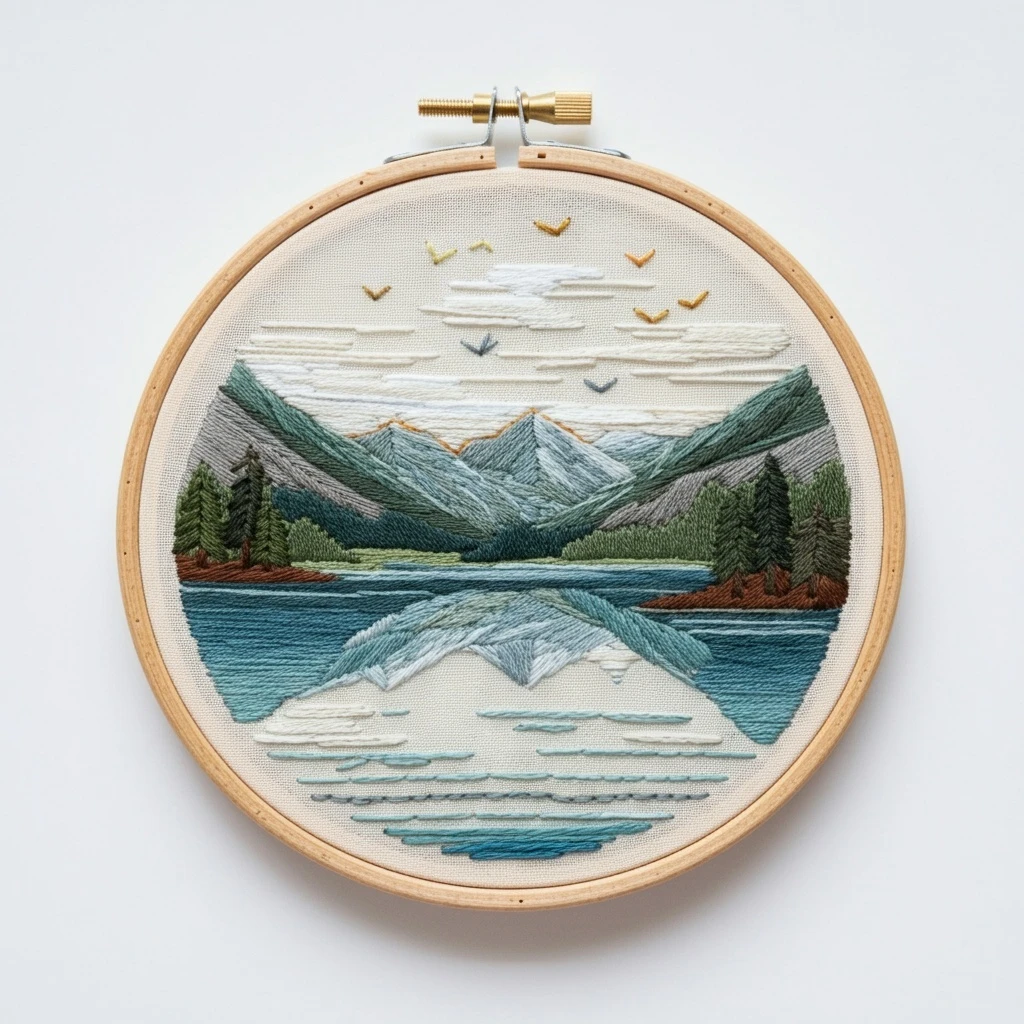
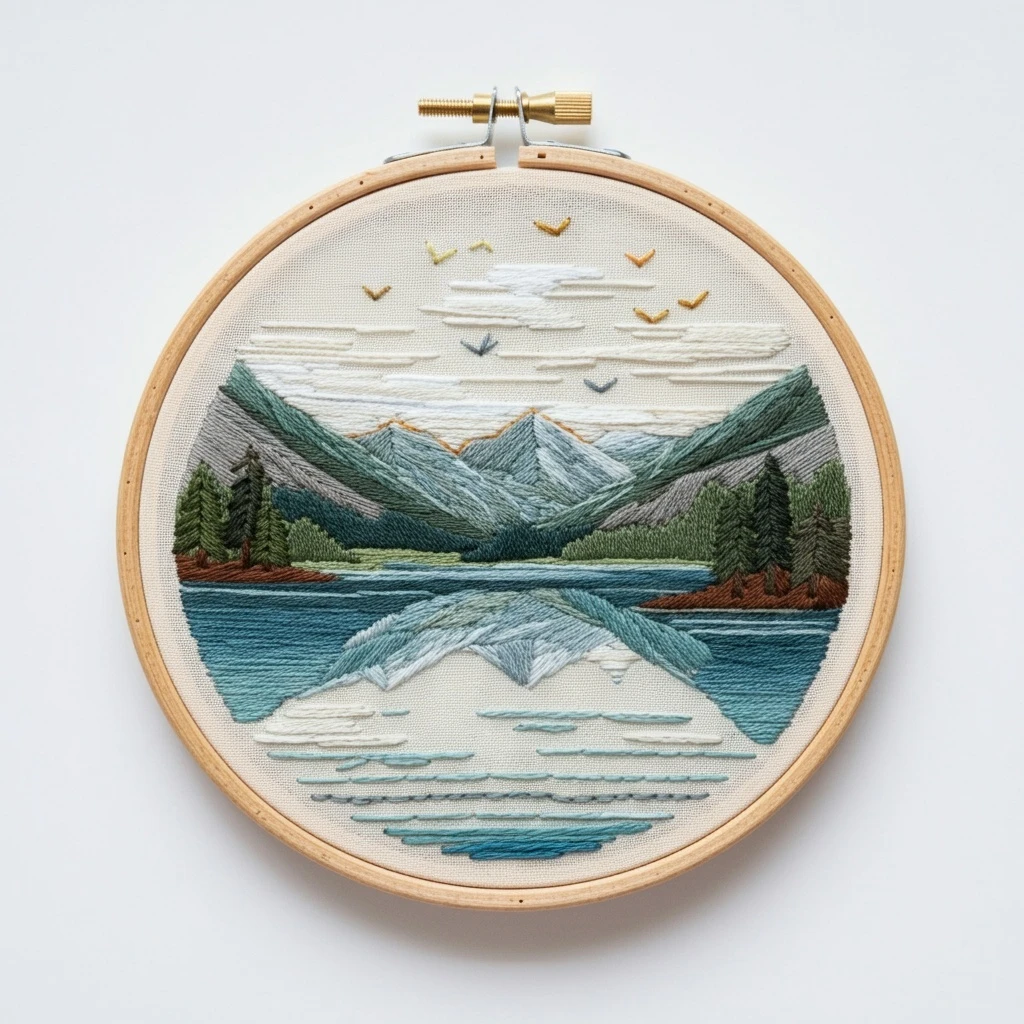
A calm hoop landscape with misty mountains, pine forests, mirrored lake water, soft cloud bands, small birds, and warm shoreline accents. The palette leans cool and natural: blue-greens, smoky greys, sage pines, cream clouds, and touches of ochre-brown for life and warmth.
Design read & color strategy
The artwork is built around horizontal calm: pale sky and cloud stitches above, layered triangular mountains in the center, dark evergreen tree masses at both sides, and a reflection that repeats the mountains downward into the lake. The strongest values are the deep teal water bands and dark pine silhouettes; the quietest values are the ivory clouds and pale blue-grey mountain highlights.
Keep the mountain peaks crisp, but let the lake reflection become slightly softer and more broken. Use directional stitches to make each form readable: diagonal for mountain slopes, vertical for pines, horizontal for clouds and lake ripples.
Recommended materials
- Fabric: oatmeal, ivory, or natural linen/cotton. A warm neutral ground preserves the airy sky and saves stitching time.
- Needles: size 7 embroidery needle for 3 strands; size 8-9 for 1-2 strand details.
- Hoop: 6-inch hoop for a compact landscape; 7-inch if you prefer more room for long stitches.
- Transfer: use a fine water-soluble pen and mark the mountain ridges, lake horizon, reflection tips, and main tree borders.
Thread count guide
1 strand: birds, thin cloud edges, bright water glints, final tree needles. 2 strands: mountain shading, distant trees, reflection lines. 3 strands: lake fills, foreground pines, shoreline earth. 4 strands only sparingly: darkest pine trunks or the deepest water edge if extra weight is needed.
DMC floss palette
The notes below pair each color with where it appears in the design and how to use it practically for a polished stitched result.
Deepest lake bands, shadow under the far shore, and the darkest mirrored mountain shapes.
Primary blue-green water, mid reflection fills, and cool shadow planes on the central mountains.
Lake highlights, pale reflection streaks, and soft accents where the sky catches the water.
Snowy mountain highlights and the coolest, thinnest water glints near the reflection point.
Mist across distant peaks, cloud edges, and soft separation lines between sky and mountains.
Cream cloud bands, bright snow flecks, and final sparkle stitches on the lake surface.
Rocky mountain slopes, muted cloud shadow, and gentle grey breaks in the reflection.
Blend with pale blue for middle mountain faces; use short stitches to soften hard edges.
Dark pine masses at the sides, lower tree shadows, and strong vertical evergreen silhouettes.
Mid-tone tree layers and the soft forest band at the base of the mountains.
Distant tree line, mossy shore highlights, and muted transition between mountain and forest.
Warm shoreline soil, tree trunks, and small grounding details on both banks.
Tiny bird wings and warm ridge accents. Use sparingly so it stays luminous.
Optional lighter bird highlights or sun-kissed tips along the far mountain ridge.
Stitch map by design area
Clouds & sky
Use 1-2 strand straight stitches and loose back stitch in horizontal, broken bands. Mix DMC 3865 with 3756 for soft cloud shadows. Leave small gaps of fabric between bands for airiness.
Mountain faces
Use long-and-short stitch following each slope angle. Keep one direction per triangular plane: left slopes down-left, right slopes down-right. Blend 747, 3756, 3811, 647, and 648 for icy depth.
Pine forests
Use fishbone stitch or stacked straight stitches for individual pines. Work trunks in 975 first, then add 520 shadows and 522/3052 outer needles with 1-2 strand tips.
Lake surface
Use horizontal satin stitch in short segments, not one long pass across the lake. Alternate 3809, 3810, and 3811 so the water feels layered rather than striped.
Reflections
Mirror the mountain angles with softer long-and-short stitches, then interrupt them with horizontal ripple lines. Reflections should be slightly lighter and less detailed than the real mountains.
Birds & tiny details
Use 1 strand fly stitch for birds. Place ochre birds above the clouds and one cool grey bird closer to the mountains to echo the sample’s quiet movement.
Blending & shading guidance
| Area | Blend | Use |
|---|---|---|
| Snowy peaks | 1 strand 747 + 1 strand 3756 | Cool bright highlights without stark white edges. |
| Blue mountain shadow | 1 strand 3811 + 1 strand 647 | Smoky blue-grey slope transitions. |
| Deep water | 1 strand 3809 + 1 strand 3810 | Rich lake base; stitch in short horizontal strokes. |
| Far forest | 1 strand 522 + 1 strand 3052 | Soft green band that recedes behind the shore. |
| Cloud warmth | 1 strand 3865 + 1 strand 3821 | Optional cream-gold glints in the upper sky. |
Outlining & finishing details
Use outline sparingly. A full dark outline would make the landscape look heavy; instead, place short back-stitch accents only where the eye needs definition: the far shoreline, the sharp central peak, the outer edges of the largest pines, and a few ripples beneath the reflected mountain.
For the hoop edge, keep stitched shapes slightly inside the drawn circle so the composition feels airy. Press from the back on a towel when finished to preserve raised tree and mountain texture.
Beginner-friendly practical tips
- Start with the largest shapes in mid-tones; add darkest and lightest stitches after the structure is visible.
- Do not carry dark green or teal thread behind pale sky areas; it may shadow through light fabric.
- Use shorter satin stitches in the water to prevent snagging and keep tension even.
- Turn the hoop while stitching mountain slopes so your hand follows the angle comfortably.
- For pine trees, stitch a central trunk first, then add angled branches from top to bottom.
- Let some fabric show through the clouds and lower ripples; the negative space is part of the design.
- When blending two strands, separate all strands first, then recombine them for smoother coverage.
- Check the reflection from a distance before adding final highlights; too many lines can flatten the lake.