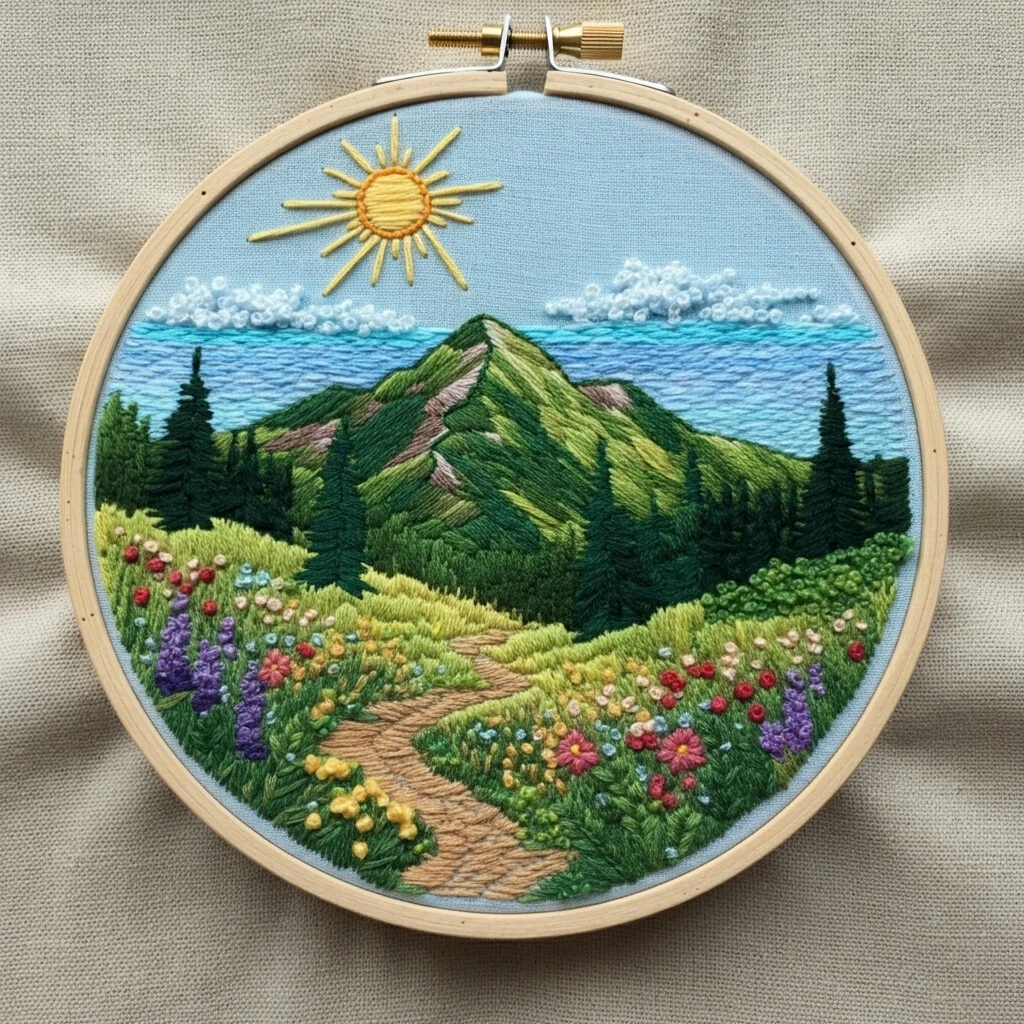

Design read: what to preserve
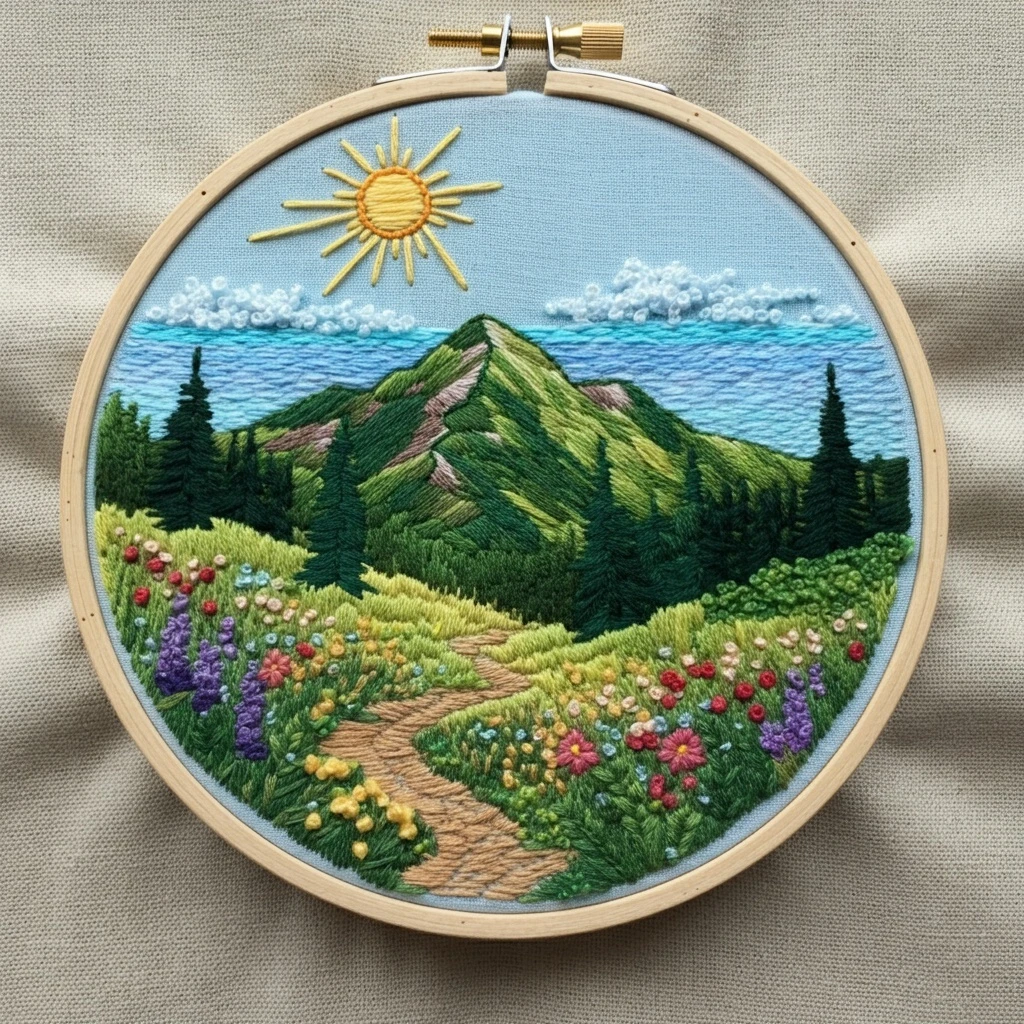
Sunny upper half
The reference has an airy sky, a stitched yellow sun, and soft cloud clusters. Let the background stay open and light so the lower meadow can carry the texture.
Directional mountain planes
The mountain is green rather than snowy, with angled stitches showing bright grassy slopes, dark forested faces, and narrow mauve-gray rock breaks.
Abundant meadow detail
The foreground is busy by design: a curving path separates clusters of leafy greens and small flowers. Use many tiny stitches rather than large filled petals.
Suggested DMC palette
These floss suggestions match the visible color families: sky blue, sun gold, cloud white, layered mountain greens, deep pines, straw path browns, and mixed meadow blossoms.
Cloud highlights, tiny flower centers, and the brightest glints on pale petals.
Softest cloud shadows and the lightest air around the horizon.
Main blue sky washes and gentle background fill if the fabric is not already blue.
Thin horizon band and cool blue accents below the clouds.
Sun rays and the brightest inner sun stitches.
Sun outline, warm flower centers, and golden meadow dots.
Sun rim, small shadow at ray bases, and warm depth in yellow blooms.
Darkest pines, tree trunks, and shadowed meadow pockets.
Main evergreen branches and the deepest mountain faces.
Mid-tone mountain slopes, leafy stems, and fuller meadow clumps.
Sunlit grass, tree tips, and bright patches on the lower mountain.
Light meadow tufts and highlighted grass around the path edge.
Tiny pale yellow flowers and extra sparkle in sunlit grass.
Base color for the winding dirt path and dry grasses.
Path shadows, broken ground texture, and darker straw stitches.
Deepest path creases and small shadow under flower clusters.
Red meadow berries or small round flower heads.
Pink daisy petals and warm red-pink blossoms in the foreground.
Creamy pale flowers and soft blossom highlights.
Purple flower spikes, lavender clumps, and a few cool flower shadows.
Lighter tips on purple blossoms and blended lavender stems.
Tiny blue wildflowers and cool sparkle among the greens.
Stitch plan by area
Sky, sun, and rays
Stitches: long straight stitch for rays, satin stitch or woven fill for the sun, and split stitch for the rim.
Threads: 2 strands for sun body and rays; 1 strand for the orange-gold outline.
Stitch rays before the sun circle so the center covers their inner ends. Keep rays slightly uneven like the reference rather than perfectly mechanical.
Cloud banks
Stitches: French knots, colonial knots, lazy daisy puffs, and tiny detached chain stitches.
Threads: 1 strand for small knots; 2 strands for front puffs.
Cluster Blanc knots along the top edge, then mix in DMC 747 below to keep the clouds soft and dimensional.
Green mountain
Stitches: long-and-short stitch, split stitch, and short diagonal straight stitches.
Threads: 2 strands for broad slope coverage; 1 strand for rock cracks and highlight veins.
Change stitch direction with each slope. Blend 895 into 699 for shadowed faces, then add 3347 and 734 on the brightest grassy planes.
Evergreens
Stitches: stacked fly stitch, fishbone, fern stitch, and short straight branch marks.
Threads: 2 strands for silhouettes; 1 strand for outer branch tips.
Anchor each tree with a dark central line first, then build triangular branch layers outward. Use 890 sparingly so the details do not turn into a black mass.
Winding path
Stitches: stem stitch, split stitch, seed stitch, and diagonal satin stitch.
Threads: 2 strands for the path base; 1 strand for dark creases and top highlights.
Follow the curve of the path with each row. Place 839 shadows along the edges and 3828/3860 broken strokes through the center for a worn trail look.
Wildflower meadow
Stitches: French knots, lazy daisy, detached chain, seed stitch, woven picot for a few large petals, and fern stitch for greenery.
Threads: 1 strand for tiny flowers; 2 strands only for larger foreground blooms.
Vary flower height and spacing. Group colors in small patches, then connect them with green stem stitches so the meadow feels natural instead of dotted randomly.
Thread-count and blending guide
| Area | Recommended strands | Blend ideas | Practical notes |
|---|---|---|---|
| Sky and horizon | 0–1 strand accents, or 2 strands if filling fabric | 3841 + 747 for a pale sky; 3846 only as a narrow horizon accent | Leave open fabric where possible. A filled sky can make the hoop stiff and distract from the meadow. |
| Sun | 2 strands for rays and fill; 1 strand for outline | 307 with touches of 3820; 3853 around the rim | Make the rim slightly darker to echo the raised orange outline visible in the reference. |
| Mountain | 2 strands fill, 1 strand detail | 895 + 699 for shadow; 699 + 3347 for mid greens; 3347 + 734 for highlights | Keep stitches angled downward from the summit so the mountain has structure. |
| Evergreens | 2 strands branches, 1 strand tips | 890 + 895 for deep mass; 895 + 3347 for selected lit tips | Do not highlight every branch. Choose a light source from the upper left and stay consistent. |
| Path | 2 strands base, 1 strand texture | 3828 + 3860 for warm dirt; 3860 + 839 for edge shadows | Short, broken strokes look more natural than one smooth satin block. |
| Flowers | 1 strand most flowers; 2 strands large foreground flowers | 321 + 3801 for red-pink blooms; 333 + 340 for purple spikes; 727 + 3820 for yellow clusters | Use a sharp needle and small knots. Oversized knots can crowd the meadow quickly. |
Suggested stitching order
Map the horizon
Lightly mark the sky, mountain peak, tree line, path, and main flower masses before threading the needle.
Work background first
Stitch sun rays, sun circle, clouds, and mountain slopes while the fabric is still flat and easy to handle.
Add depth layers
Place the ridge and evergreens over the lower mountain edge, then build the path from the far end toward the foreground.
Finish with texture
Add meadow leaves, flower knots, large blossoms, and final outlines last so the foreground stays crisp.
Outlining, shading, and texture tips
Soft outlines
Use split stitch instead of heavy backstitch on the mountain and path edges. Reserve strong backstitch for tree trunks, the sun rim, and a few foreground stems.
For the clouds, avoid a continuous outline; let clustered knots create the edge naturally.
Beginner-friendly checks
Cut floss lengths to about 18 inches, separate strands before recombining, and test dense flower knots on scrap fabric first.
Step back after every color group. The meadow should look full, but the path and mountain shapes should remain readable from a distance.
Small finishing details
Cloud sparkle
Add three to five single-strand Blanc straight stitches on top of the knot clusters for tiny highlights. Keep them short and irregular.
Flower balance
Repeat each flower color at least three times across the meadow so no color appears accidental. Let purple spikes sit taller than the yellow dot flowers.
Hoop presentation
After stitching, gently steam from the back, lace the fabric evenly, and avoid crushing the cloud knots and flower clusters with the iron.