Embroidered Autumn Landscape with Mount Fuji - DMC Palette & Stitching Tips
DMC palette & embroidery guide
Embroidered Autumn Landscape with Mount Fuji
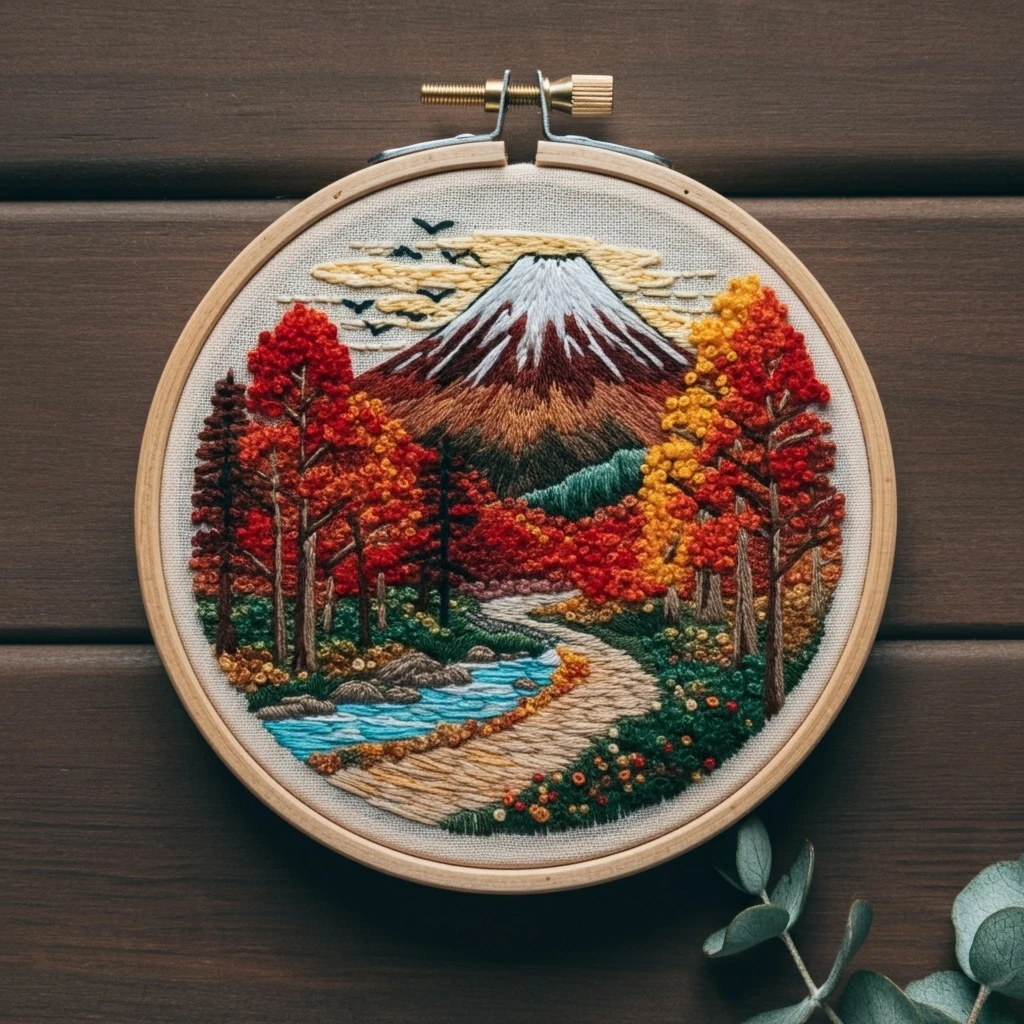
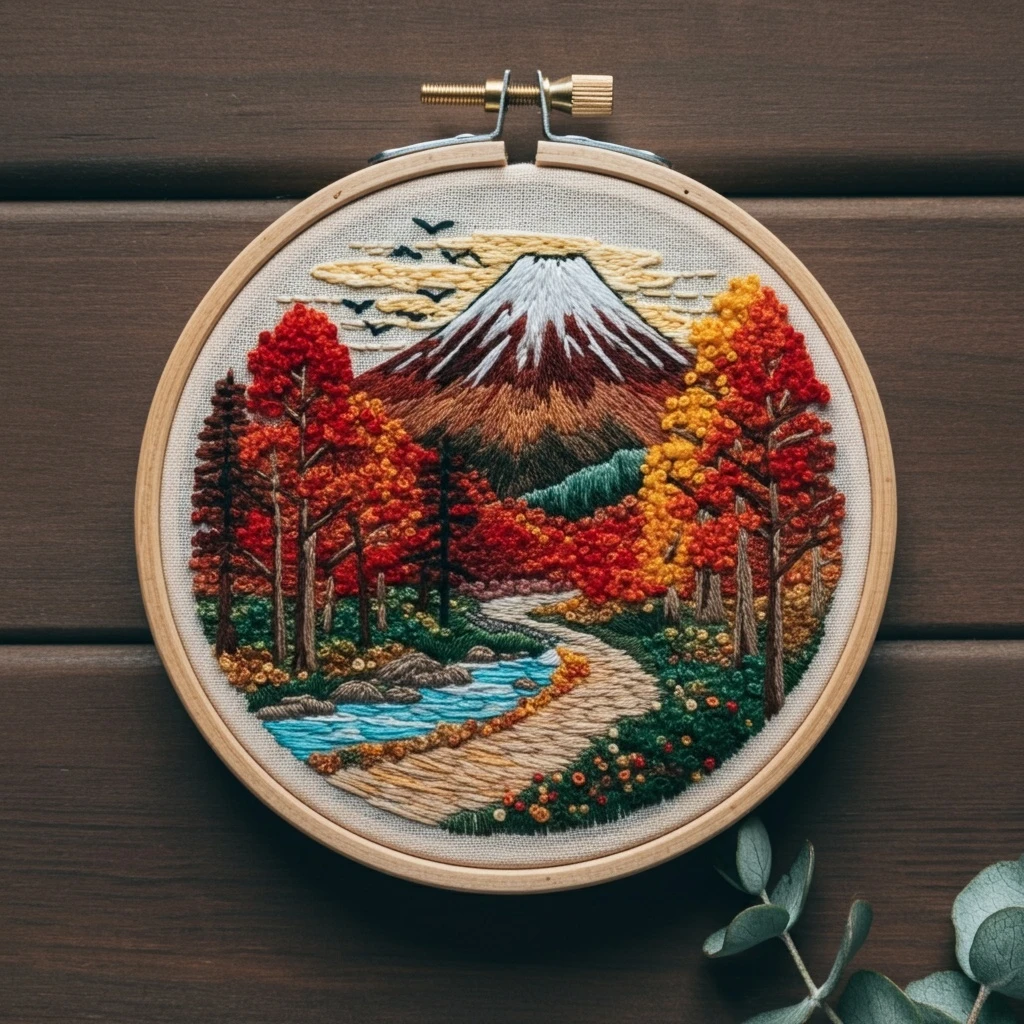
A warm scenic hoop with snow-capped Mount Fuji, layered copper foothills, glowing maple trees, golden foliage, a winding path, blue river, dark evergreens, tiny birds, and textured autumn blossoms. This guide keeps the palette rich but stitchable, with clear choices for depth, texture, and beginner-friendly sequencing.
Autumn reds & goldsSnowy mountain shadingRiver and pathway textureFrench-knot foliage
⌒⌒⌒
Color story from the reference
The design is built around contrast: cool white and pale blue snow at the mountain peak, reddish brown volcanic slopes, dense emerald forests, and a brilliant foreground of red, rust, orange, and golden autumn trees. The river adds a fresh turquoise accent, while the road and rocks soften the composition with sand, taupe, and grey-brown neutrals.
Use the darker colors sparingly as structure and shadow. Let the reds, yellows, and turquoise become the eye-catching accents.
DMC B5200Snow White
Bright snow cap highlights and crisp glints along Mount Fuji’s ridges. Use 1 strand for the cleanest snowy points.
DMC 415Pearl Grey
Cool shadow in the snow and small rock highlights. Blend with white where the snow turns away from the light.
DMC 902Garnet, Very Dark
Deep mountain shadow, dark maple interiors, and shaded tree masses. Best used in short broken stitches rather than solid blocks.
DMC 918Red Copper, Dark
Main autumn slope color and warm bark undertones. Mix with browns for the lower mountain and distant shrubs.
DMC 919Red Copper
Rust-orange leaves, midtone maples, and transition areas between red foliage and gold foliage.
DMC 321Christmas Red
Bright red tree clusters. Place in small knots and seed stitches so the trees sparkle instead of becoming flat.
DMC 742Tangerine, Light
Golden tree crowns, flower dots, and sunlit foliage beside the path. Use beside reds for autumn warmth.
DMC 3821Straw
Soft sky bands behind Fuji and light golden highlights on the right-hand trees.
DMC 500Blue Green, Very Dark
Deep evergreen silhouettes, shaded shrubs, and the darkest foreground greenery. Excellent for grounding the landscape.
DMC 501Blue Green, Dark
Middle forest layers and soft texture in the distant hills. Alternate with 500 for depth.
DMC 3846Turquoise, Light
Bright river strokes. Use long-and-short or split stitch lines following the water’s curve.
DMC 3843Electric Blue
River highlights and small reflective ripples. Add last so the water stays lively and clean.
DMC 3863Mocha Beige, Medium
Winding path base, dry grass, and warm neutral ground. Work in directional stitches to show the road’s curve.
DMC 840Beige Brown, Medium
Tree trunks, pathway texture, stones, and soft outlines where black would feel too harsh.
DMC 3371Black Brown
Birds, fine tree limbs, deepest trunk shadows, and tiny definition marks. Use 1 strand for refined linework.
DMC 646Beaver Grey, Dark
Rocks near the river and muted contour shading. Blend with 415 for cooler stone highlights.
Stitch plan by design element
Mount Fuji peakUse long-and-short stitch with 1-2 strands, following the mountain’s downward ridges. Keep B5200 at the top and add 415 in narrow slivers for snow shadows.
Volcanic slopesWork irregular satin, split, or long-and-short stitches in 902, 918, and 919. Angle stitches downward from the peak to preserve the mountain’s triangular form.
Autumn tree crownsBuild dense texture with French knots, colonial knots, and seed stitch. Cluster 321, 919, 742, and 3821 so the trees feel variegated.
Evergreen forestUse fly stitch, straight stitch, and fern stitch in 500 and 501. Stitch vertical silhouettes first, then fill around them with shorter strokes.
River movementUse split stitch or stem stitch in 3846 for the river edge, then add curved 3843 and B5200 highlights to suggest ripples.
Path and foregroundUse directional straight stitches in 3863, then add 840 lines along the curve. Scatter tiny 742 and 919 knots beside the path for fallen leaves.
Thread-count guidance
For a 5-6 inch hoop
Use 1 strand for birds, mountain snow ridges, tree branches, and fine outlines. Use 2 strands for mountain fills, river lines, and pathway texture. Use 2-3 strands for French-knot foliage when you want a plush, raised tree canopy.
For a 7-8 inch hoop
Use 2 strands for most fills, 1 strand for delicate details, and 3 strands for foreground knots or bolder tree clusters. Larger hoops can handle more knot texture without crowding.
Practical rule: distant details should be thinner and smoother; foreground leaves, trunks, rocks, and flowers can be thicker and more textured.
Blending and shading ideas
Shade the mountain before the trees. Establish the Fuji silhouette with white, grey, garnet, and copper first. This keeps the central landmark crisp behind the foliage.
Create leaf depth with mixed knots. Thread one needle with 321 and another with 919, then alternate knots randomly. Add 742 on the light-facing edges and 902 in the shaded interiors.
Blend the distant forest softly. Work 500 and 501 in alternating short strokes. Avoid heavy outlines in the middle distance so the foreground trunks stand out.
Keep the river fresh. Do not overfill the turquoise area. Leave tiny fabric breaks or pale highlight stitches so the water feels reflective.
Finish with fine outlines. Add 3371 or 840 only where needed: birds, tree branches, select trunks, rock edges, and a few mountain creases.
Beginner-friendly stitching tips
Work back to frontStitch sky bands, mountain, distant hills, then foreground trees, path, river, rocks, and final knots. This layering keeps the scene readable.
Mark stitch directionBefore stitching, lightly pencil a few arrows on the path, river, and mountain slopes. Direction matters more than perfect fill.
Limit bulky knotsReserve the chunkiest knots for the closest red and golden trees. Smaller seed stitches are better for distant foliage.
Use a sharp needleDense autumn foliage can become tight. A sharp embroidery needle helps place knots accurately between existing stitches.
Check values oftenStep back from the hoop. If the trees look flat, add dark 902/3371 in shadows and a few 742/3821 highlights on top.
Press from the backAfter finishing, steam lightly from the reverse side on a towel so raised knots are not crushed.
Suggested stitch menu
Long-and-short stitch: mountain snow, copper slopes, distant hills. Stem stitch: riverbanks, tree trunks, path edges. Split stitch: smooth outlines and water ripples. French knots: red, orange, and golden leaf clusters. Seed stitch: scattered fallen leaves and distant texture. Fly stitch or fern stitch: evergreens and small branches. Straight stitch: grasses, rock marks, bark, and sky lines.
For a softer hand-stitched look, avoid outlining every shape. Let color changes and stitch direction define the landscape, using dark linework only as a finishing accent.