Charming Hand Embroidered Mouse with Cheese

Charming Hand Embroidered Mouse with Cheese — DMC Palette & Stitching Guide
Charming Hand Embroidered Mouse with Cheese
DMC palette & stitching notes

Charming Hand Embroidered Mouse with Cheese

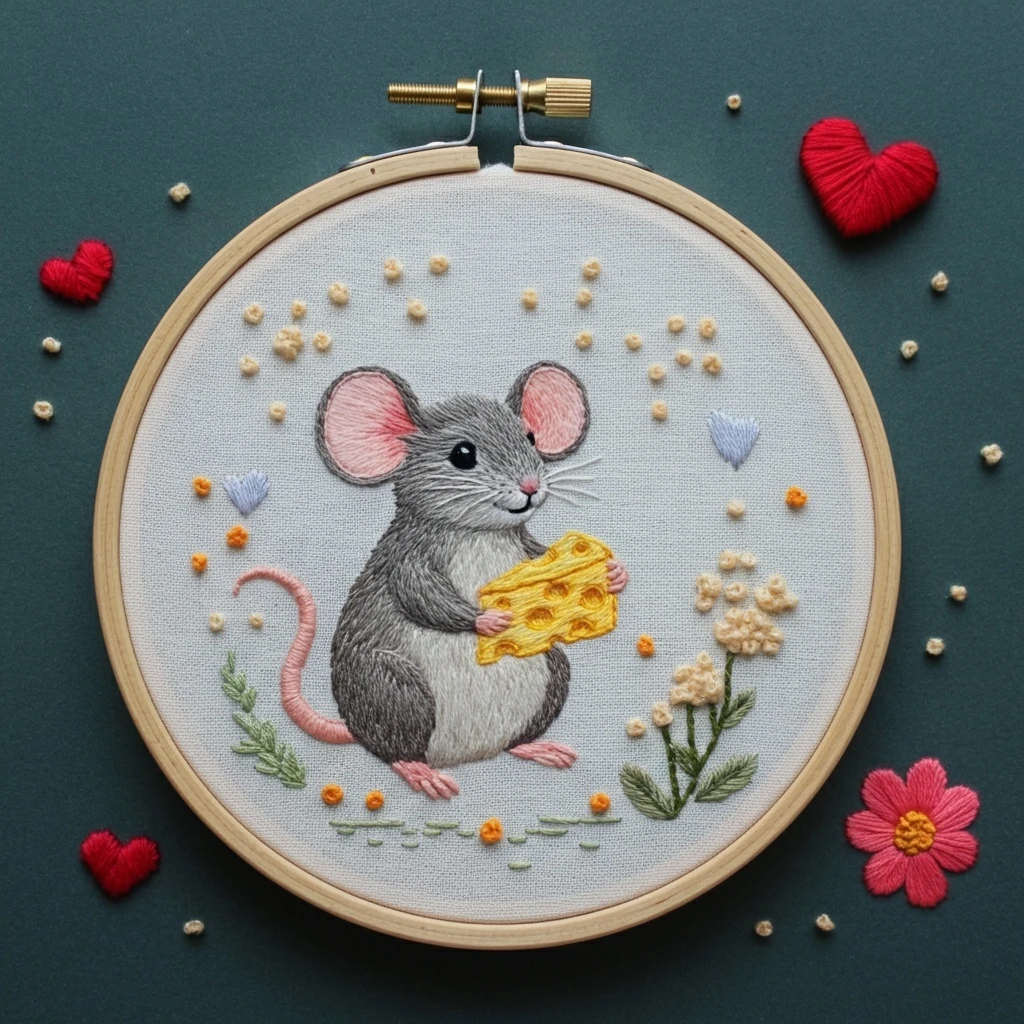
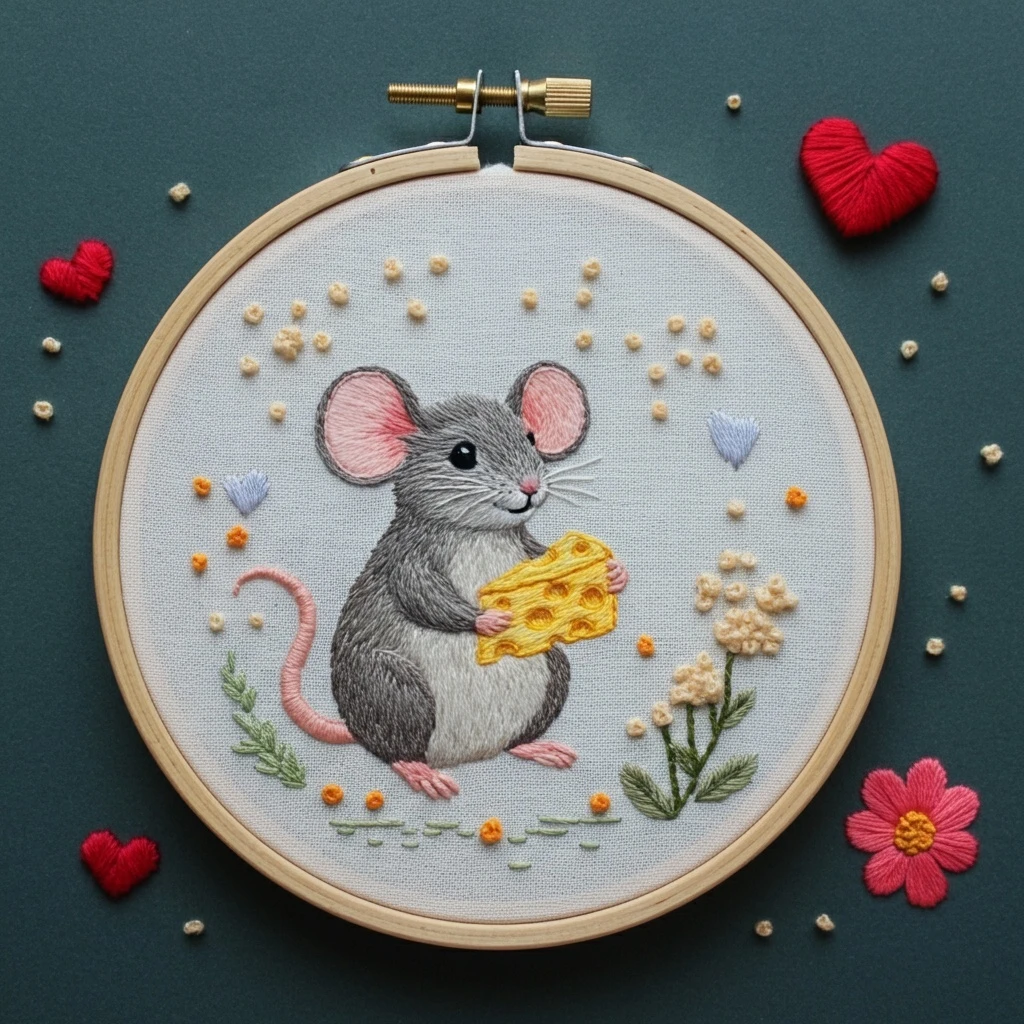
This cozy miniature design pairs a sweet little mouse with a bright wedge of cheese. The best stitched version keeps the mouse soft and delicate, with rounded gray fur, pink ear and nose details, fine whiskers, tiny paws, and a cheerful golden cheese wedge with darker holes and warm shadowing for dimension.

Polished DMC Color Palette

This palette combines soft mouse grays with warm cheese yellows and small pink facial accents. Keep the mouse understated and plush, then use the saturated yellows and golden browns to make the cheese the cheerful focal prop.

DMC 413
Pewter Gray Dark
Deepest mouse shadows, underside, ear folds, paw separation, and tiny eye outline.
DMC 414
Steel Gray Dark
Main contour shading, tail shadow, body underside, and soft outline definition.
DMC 318
Steel Gray Light
Main mouse body fill, face, cheeks, paws, and gentle rounded mid-tone.
DMC 762
Pearl Gray
Soft fur highlights, belly, muzzle, ear edges, and top-facing body planes.
DMC 746
Off White
Bright muzzle highlights, tiny eye glint, cheese shine, and soft transition stitches.
DMC 3799
Pewter Gray Very Dark
Tiny eye, nostril, deepest whisker roots, and small final outline points only.
DMC 761
Salmon Light
Inner ears, nose, cheek blush, tiny paw pads, and soft mouse warmth.
DMC 3722
Shell Pink Medium
Deeper ear shading, nose shadow, and small rosy details.
DMC 3821
Straw
Main cheese fill, brightest cheese face, and sunny highlight areas.
DMC 783
Topaz Medium
Cheese mid-tone, wedge sides, cheese-hole edges, and golden shadow transitions.
DMC 977
Golden Brown Light
Cheese underside, holes, darker side plane, and warm depth around the wedge.
DMC 976
Golden Brown Medium
Deepest cheese holes, small wedge outline, and shadowed bite or corner details.
DMC 801
Coffee Brown Dark
Optional ground shadow, warm outline under cheese, and tiny earthy accent details.
DMC 433
Brown Medium
Soft floor or crumb accents, cheese rind warmth, and small grounding stitches.
DMC 472
Avocado Green Ultra Light
Optional tiny leaf or background sprig if the design includes a decorative accent.
DMC 932
Antique Blue Light
Optional cool shadow under the mouse or soft background accent on pale fabric.

Stitch Map by Design Element

Mouse body
Use long-and-short stitch or smooth split-stitch rows that follow the rounded body shape. Fill with DMC 318, shade the belly and underside with 414 and 413, then add 762 and 746 on the cheek, muzzle, and upper back.
Fur texture
Use very short one-strand straight stitches in 318, 414, and 762 over the filled body. Keep the texture sparse and directional so the mouse looks soft, not scratchy.
Ears and nose
Use satin stitch or long-and-short stitch. Fill inner ears with 761, deepen the base with 3722, and outline gently in 414. Use a tiny satin stitch or French knot in 761 or 3722 for the nose.
Eye and whiskers
Use one strand only. Work the eye in 3799 with a tiny 746 glint if space allows. Stitch whiskers with one-strand back stitch, straight stitch, or couching in 413, 414, or 762; keep them thin and slightly curved.
Cheese wedge
Use satin stitch or long-and-short stitch following the wedge planes. Fill the bright face with 3821, shade the side with 783, deepen the underside with 977, and add 746 highlights along the top edge.
Cheese holes
Use small satin circles, padded dots, or tiny ringed back stitch. Fill the deepest holes with 976 or 977 and outline one side with 783 so the holes look recessed rather than flat dots.
Ground shadow
Use scattered seed stitch or short straight stitches in 822, 801, 433, or 932. Keep this very light; it should anchor the mouse and cheese without becoming a heavy base.

Thread Count & Blending Guide

Fine details

Use 1 strand for whiskers, eye, nostril, tiny paws, fur strokes, cheese-hole outlines, and final corrections. One strand is essential for keeping the small mouse charming and delicate.

Main fills

Use 2 strands for the mouse body, ears, tail, cheese wedge, and any larger accent shapes. Two strands give smooth coverage without making the miniature design bulky.

Raised details

Use 2–3 strands for the nose, cheese holes, or tiny crumb knots. Use three strands sparingly so the face and cheese details stay proportional.

Blending idea: Blend 318 with 762 for soft mouse highlights, 414 with 318 for rounded gray shadows, 761 with 3722 for warm ear depth, and 3821 with 783 for a cheerful cheese mid-tone.

Shading, Outlining & Texture Suggestions

Soft mouse shape

  • Keep the top of the head, cheek, and back lighter than the belly and paws.
  • Follow the curve of the body with stitch direction to make the mouse look rounded.
  • Use dark gray sparingly around the face so the expression stays gentle.
  • Add fur texture after the base fill, using short broken stitches only.

Cheese dimension

  • Treat each side of the cheese wedge as a different plane: bright front, golden side, darker underside.
  • Shade cheese holes darker on one edge and lighter on the opposite edge for a recessed look.
  • Add a few 746 stitches on the top edge to suggest shine.
  • Use warm browns only in small amounts so the cheese remains bright and playful.

Tiny facial details

  • Use one strand and very short stitches for eye, nose, mouth, and whiskers.
  • Place the cheek blush after the gray fill so it sits softly on top.
  • Make whiskers slightly uneven in length for a natural storybook look.
  • Step back before adding extra dark stitches; small animals can become overoutlined quickly.

Outlining approach

  • Outline after filling so the mouse silhouette and cheese wedge stay crisp.
  • Use 414 or 413 for the mouse outline instead of black.
  • Use 783 or 977 for cheese outlines so the wedge remains warm.
  • Use split stitch for curves and back stitch for small straight cheese edges.

Beginner-Friendly Stitching Order

  1. Transfer lightly: mark the mouse outline, ears, eye, nose, whisker roots, cheese wedge, cheese holes, and any ground shadow. Keep face markings very fine.
  2. Stitch the mouse body: fill the main gray shape first, adding shadows and highlights before tiny facial details.
  3. Add ears, paws, and tail: work pink ear centers and small paw details with one or two strands.
  4. Stitch the cheese: fill the wedge planes, then add darker holes and bright top highlights.
  5. Add face details: stitch the eye, nose, cheek blush, and whiskers carefully with one strand.
  6. Finish with texture: add sparse fur strokes, cheese crumbs, ground shadow, and final outline corrections last.

Practical Tips for a Clean Finish

Fabric & hoop

Warm cream cotton, linen, or cotton-linen suits the cozy mouse-and-cheese palette. Keep the hoop drum-tight so small satin stitches, whiskers, and cheese edges stay neat.

Needle choice

Use a sharp embroidery needle size 7–9 for one- and two-strand work. For tiny knots or padded cheese holes, use a slightly larger needle only if needed.

Keeping the scale cute

Small animals look best with fewer, cleaner details. Choose one tiny eye, a small pink nose, and a few whiskers rather than overworking the face.

Preventing show-through

Do not carry dark gray floss behind pale muzzle or cheese highlight areas. End dark threads cleanly and restart nearby so the light sections remain fresh.
Best beginner shortcut: use split stitch for outlines, long-and-short stitch for mouse fur, satin stitch for cheese, and one-strand straight stitch for whiskers.
Best realism upgrade: shade the mouse with three soft gray values and shade the cheese wedge with separate bright, mid-tone, and shadow planes.
Designed as a practical DMC floss and stitch-planning companion for the Charming Hand Embroidered Mouse with Cheese embroidery artwork.

Leave a Reply

Your email address will not be published. Required fields are marked *