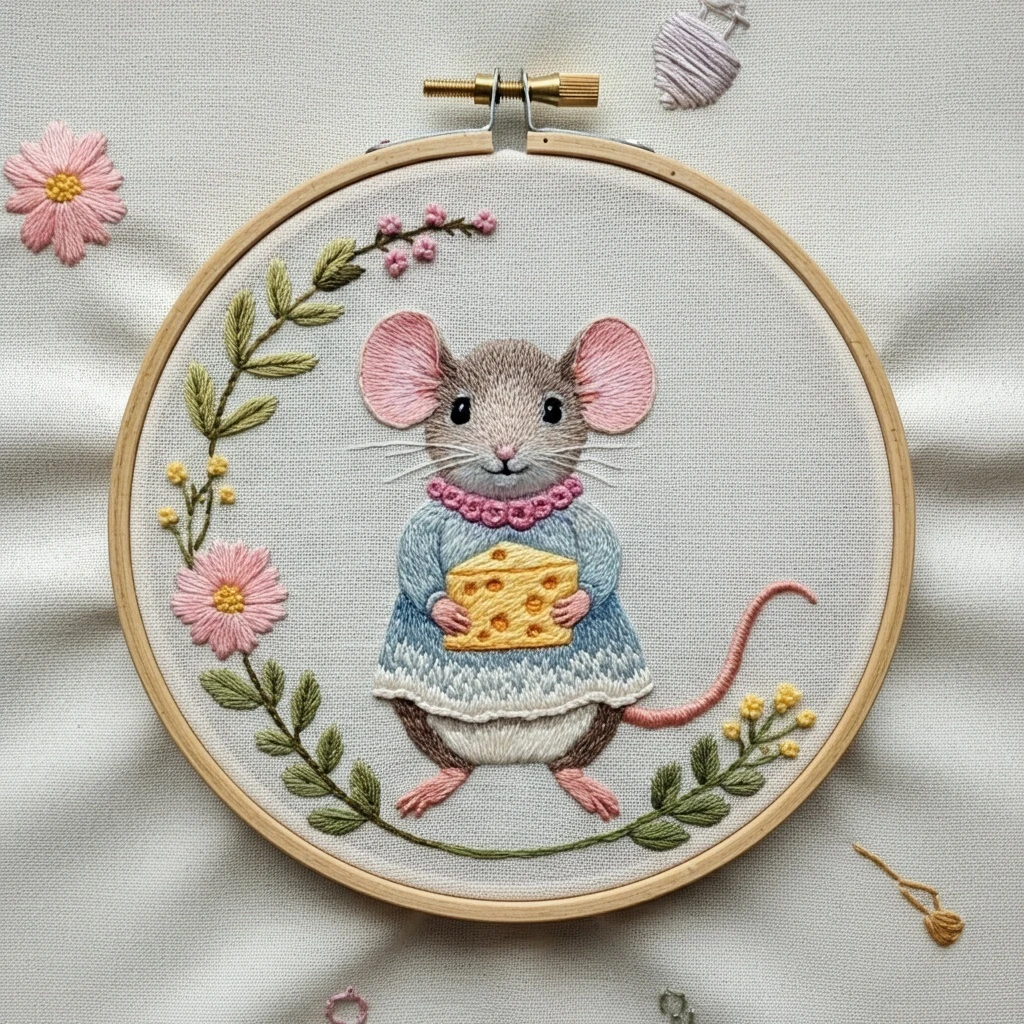

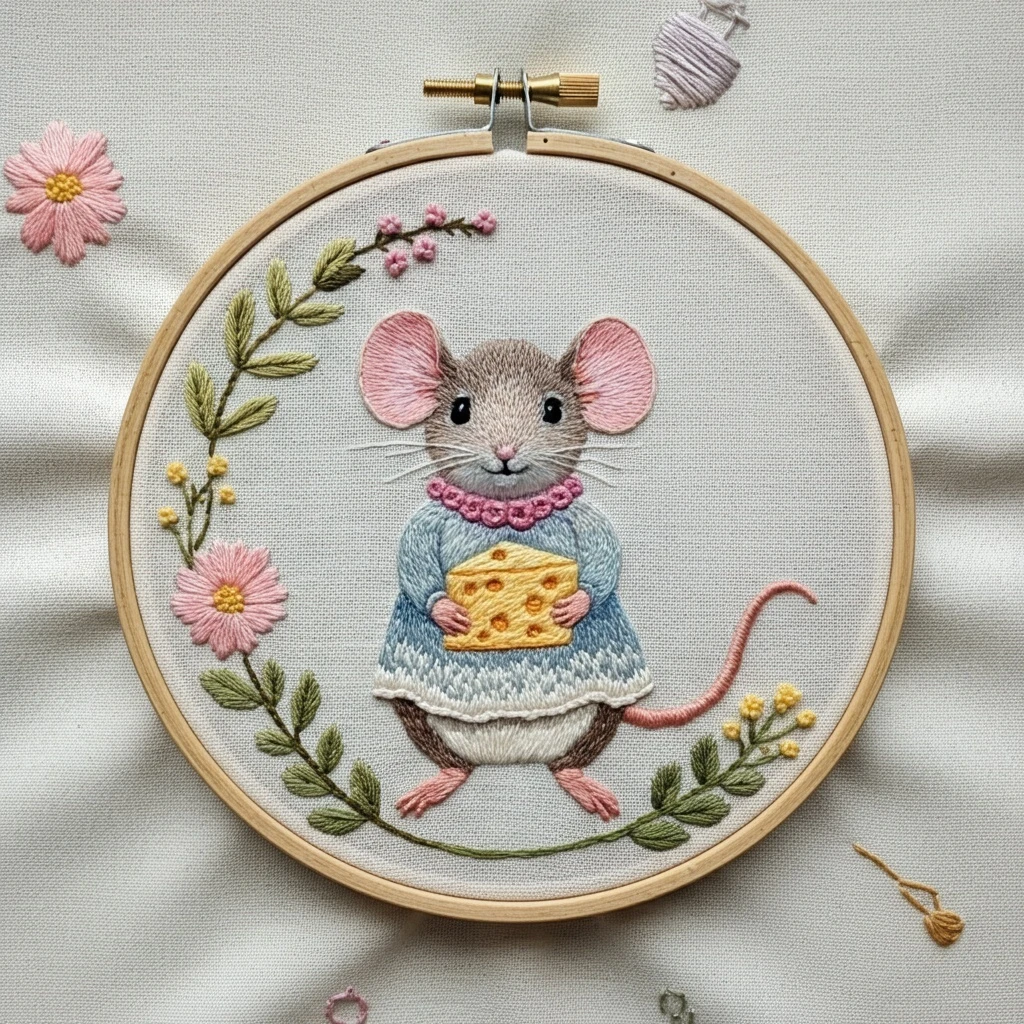
Embroidered Mouse with Swiss Cheese in a Floral Wreath Hoop
A soft storybook palette for a grey-brown mouse, rosy ears and flowers, golden Swiss cheese, a blue knitted sweater, olive foliage, and delicate hoop-framed meadow details.
Observed Design Colors
The reference design uses a warm natural linen background, a pale wooden hoop, a taupe-grey mouse with darker facial shadows, blush-pink ears, paws and tail, a powdery blue sweater with a cream hem, bright golden cheese, olive stems and leaves, pink daisy-like flowers, tiny yellow berries, and black glossy eyes. Keep the overall look muted and handmade rather than overly saturated.
Suggested DMC Floss Palette
Main mouse head and body; use as the mid-tone fur base with short directional stitches.
Darker cheek, belly side, lower body, and fur accents around ears and paws.
Soft highlights on the muzzle, forehead, and upper curve of the body.
Inside ears, tiny nose, paws, tail highlights, and pale petal areas.
Petal shadows, ear rims, tail outline, and pink necklace beads.
Swiss cheese base and flower centers; keep it bright but soften with one strand.
Cheese holes, lower cheese edge, and golden berry shadows.
Sweater base, stitched in smooth satin or rows of split stitch.
Sweater side shadows, lower folds, and small knit-like contrast marks.
Sweater hem, belly highlight, whiskers if you want a soft stitched look.
Leaf centers, darker side of the wreath stems, and leaf veins.
Leaf fill, lighter wreath arcs, and fresh highlights on foliage tips.
Tiny mouth, nostril, darkest fur accents, optional fine outlines.
Eyes only; add a single white catchlight after the black is fully stitched.
Hoop-inspired warm accents, cheese edge blending, and optional stem warmth.
Stitch Plan by Design Area
Mouse Fur & Face
- Use 1 strand for long-and-short stitch on the face so the small facial curves stay delicate.
- Work from the nose outward, following the direction of natural fur; vary DMC 642, 3862, and 3781 in short strokes.
- Stitch the muzzle with lighter taupe, then add two or three dark split-stitch mouth details with DMC 3371.
Ears, Paws & Tail
- Fill ears with satin stitch or long-and-short stitch in DMC 151, shading the outer edge with DMC 3328.
- Use stem stitch for the curved tail; blend one strand DMC 151 with one strand DMC 3328 for a soft corded line.
- Keep paws simple with two-strand satin stitch and a few darker toe marks.
Swiss Cheese
- Fill the cheese wedge with 2 strands of DMC 744 in neat satin stitch, angled with the wedge shape.
- Outline the wedge with back stitch in DMC 782 or one strand of DMC 436.
- Make cheese holes with tiny padded satin circles or French knots flattened slightly with the needle tip.
Floral Wreath
- Use stem stitch for the arcing wreath stems, alternating 3011 and 3012 to avoid a flat green ring.
- Leaves look best in fishbone stitch: dark vein first, then slanted green stitches to each edge.
- Flowers can be lazy daisy petals around French-knot centers; vary petal length for a natural hand-stitched look.
Thread Count, Texture & Blending Guidance
Thread Counts
Use 1 strand for facial fur, eyes, whisker placement, mouth details, and tiny wreath accents. Use 2 strands for sweater fill, cheese, flower petals, leaves, and the tail. Use 3 strands only for raised flower centers or necklace beads.
Blending Ideas
For the mouse, blend 1 strand DMC 642 with 1 strand DMC 3862 for soft highlight strokes, and 1 strand DMC 642 with 1 strand DMC 3781 for shadowed fur. For the sweater, blend DMC 3811 and 932 in alternating rows rather than mixing everywhere.
Outlining Details
Keep outlines broken and light. Use one-strand split stitch around the face, ears, and paws, and reserve black for the eyes only. A full heavy black outline would make the design less soft and less embroidered-looking.
Texture Suggestions
Combine smooth satin stitch on the cheese, directional long-and-short fur on the mouse, fishbone leaves, French knots for berries and flower centers, and chain stitch for the necklace to create varied surfaces in a small hoop.
Beginner-Friendly Working Order
- Transfer the mouse, cheese, wreath, and flower outlines lightly onto linen or cotton fabric.
- Stitch the wreath stems first so the floral frame is established.
- Add leaves and flowers, keeping knots tidy on the back so the hoop lies flat.
- Fill the mouse body and face before adding ears, paws, and tail details.
- Stitch the sweater and cream hem, then place the cheese on top so it reads as held in front.
- Finish with eyes, whiskers, mouth, bead necklace, and tiny highlights after all filled areas are complete.
Extra Practical Tips
- Fabric choice: natural linen, cotton-linen blend, or tightly woven quilting cotton will support the small fur stitches and French knots well.
- Needle: use a sharp embroidery needle size 7 or 8 for most areas; switch to size 9 for one-strand face details.
- Whiskers: stitch with one strand of DMC 3865 or a pale grey; make each whisker in one confident straight stitch and avoid overworking.
- Eyes: fill with DMC 310, then add one tiny white straight stitch or seed stitch for sparkle.
- Cheese dimension: pad the cheese wedge with one underlayer of split stitch before satin stitching if you want it to sit raised in the mouse's paws.
- Hoop finish: leave generous fabric around the hoop, trim after lacing, and back with felt for a clean display piece.