
Realistic Papaya Hoop Art
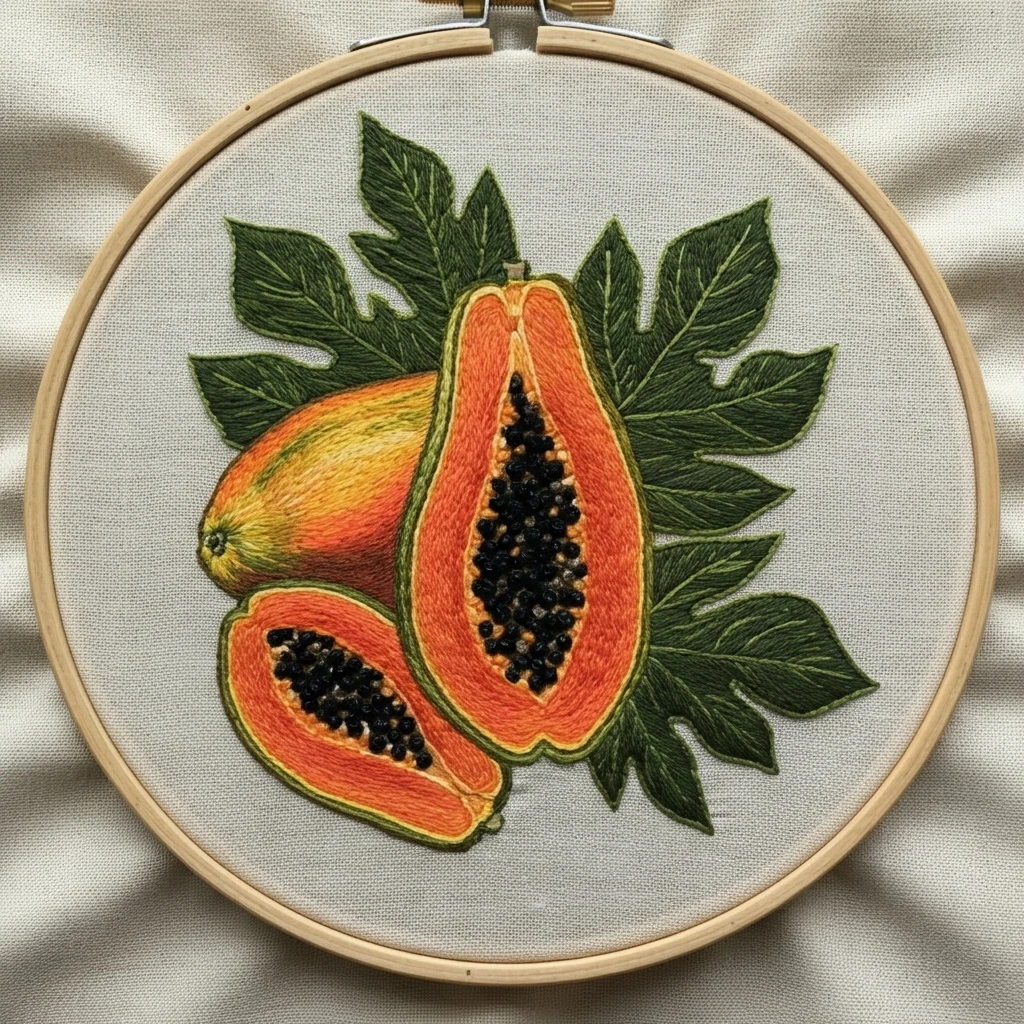
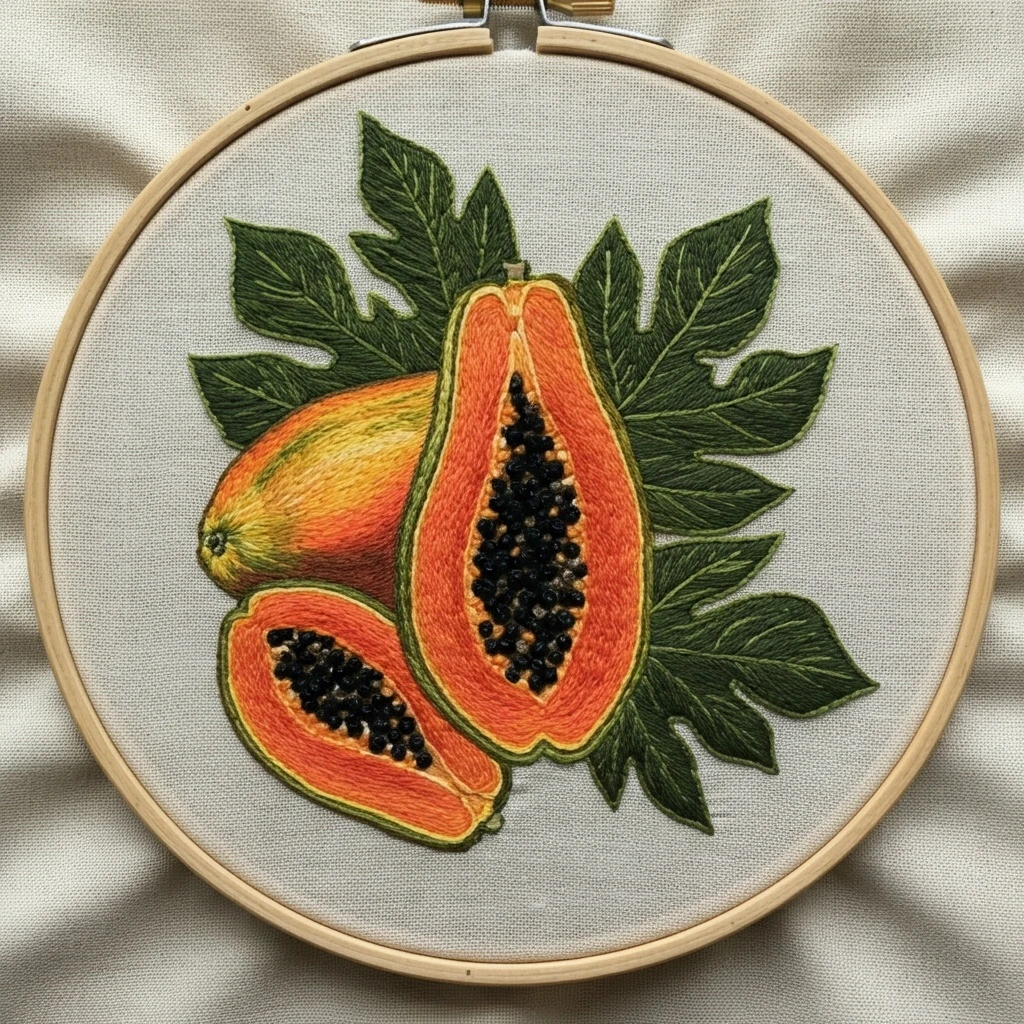
A polished thread guide for stitching a realistic papaya arrangement: split fruit with glowing coral-orange flesh, yellow-green rind, clustered black seeds, and deep lobed tropical leaves on natural linen.
Color Story
The reference design is built around strong warm-cool contrast. The papaya flesh should feel saturated and dimensional, moving from golden yellow near the rind into coral and orange-red through the center. Dark seeds create the highest contrast, while the large leaves use layered forest greens with pale stitched veins.
Fruit Flesh & Dimensional Shading
- Use long and short stitch following the fruit curve, not straight vertical rows. This makes the halves look rounded and full.
- Begin with DMC 742 and 743 near the rind, then feather into 741, 947, and finally 900 in the deepest orange-red zones.
- For smoother transitions, stitch single strands in irregular lengths; avoid hard color bands unless defining the rind edge.
- Add a few very fine 742 highlight strokes over finished orange areas to imitate the glossy fibrous surface of ripe papaya.
Rind, Leaves & Outlines
- Work the rind in split stitch or stem stitch with 734, then add a narrow darker rim using 730 or 934.
- Stitch leaves with directional long and short stitches radiating from the central vein to each lobe tip.
- Use 934 sparingly at leaf notches and under the fruit, then overlay 469 and 732 so the leaves do not become flat black shapes.
- Outline fruit edges with one strand of 730 or a 730/898 blend for a natural botanical contour.
Recommended Stitch Plan
Thread Count Guidance
- Fruit flesh: 1 strand for realistic shading; 2 strands only for larger hoops or fast coverage.
- Rind and outlines: 1 strand for inner outlines, 2 strands for the outer rind if you want a bolder graphic edge.
- Leaves: 2 strands for base fill, then 1 strand for veins, edge strokes, and final highlights.
- Seeds: 2 strands for French knots; wrap twice for small seeds and three times for front-facing raised seeds.
Blending Ideas
- Blend 742 + 741 in the needle for the glowing yellow-orange transition near the rind.
- Blend 947 + 900 for the deepest flesh creases, especially along the lower slice and inside the tall half.
- Blend 469 + 934 for dark leaf sections without making them look solid black.
- Blend 310 + 898 on a few seeds for warmer, less flat shadows within the seed cluster.
Texture & Practical Tips
Making the Papaya Look Juicy
Keep your stitches slightly glossy by laying each strand flat with a needle or laying tool. Follow the cut-face direction: long strokes should travel from rind toward seed cavity and curve gently around the fruit form.
Keeping the Leaves Crisp
Outline each leaf lobe lightly with split stitch before filling. Use short darker stitches at the notches and longer mid-green stitches toward the tips to keep the leaf shape sharp but natural.
Seed Cluster Control
Place the largest knots in the visual center, then reduce wraps near the top and bottom points. Leave small orange gaps between some knots so the seed cavity does not become a single black patch.
Fabric & Hoop Advice
Natural linen or cotton-linen in oatmeal, ivory, or warm beige suits the tropical palette. Use a firm hoop and avoid pulling knots too tightly, since dense seed work can pucker lighter fabrics.
Suggested order: leaves → fruit flesh → rind outlines → seed knots → final highlights → outer contour corrections.
Quick Stitch Reference
Long & Short Stitch
Best for the papaya flesh and leaves. Vary stitch lengths and overlap colors to avoid stripes.
Stem Stitch
Use for rind edges, fruit contours, and larger vein lines that need a smooth botanical curve.
Split Stitch
Excellent for crisp outlines before filling, especially around leaf lobes and seed cavity edges.
French or Colonial Knots
Ideal for raised black papaya seeds. Vary wraps and thread blends for natural depth.