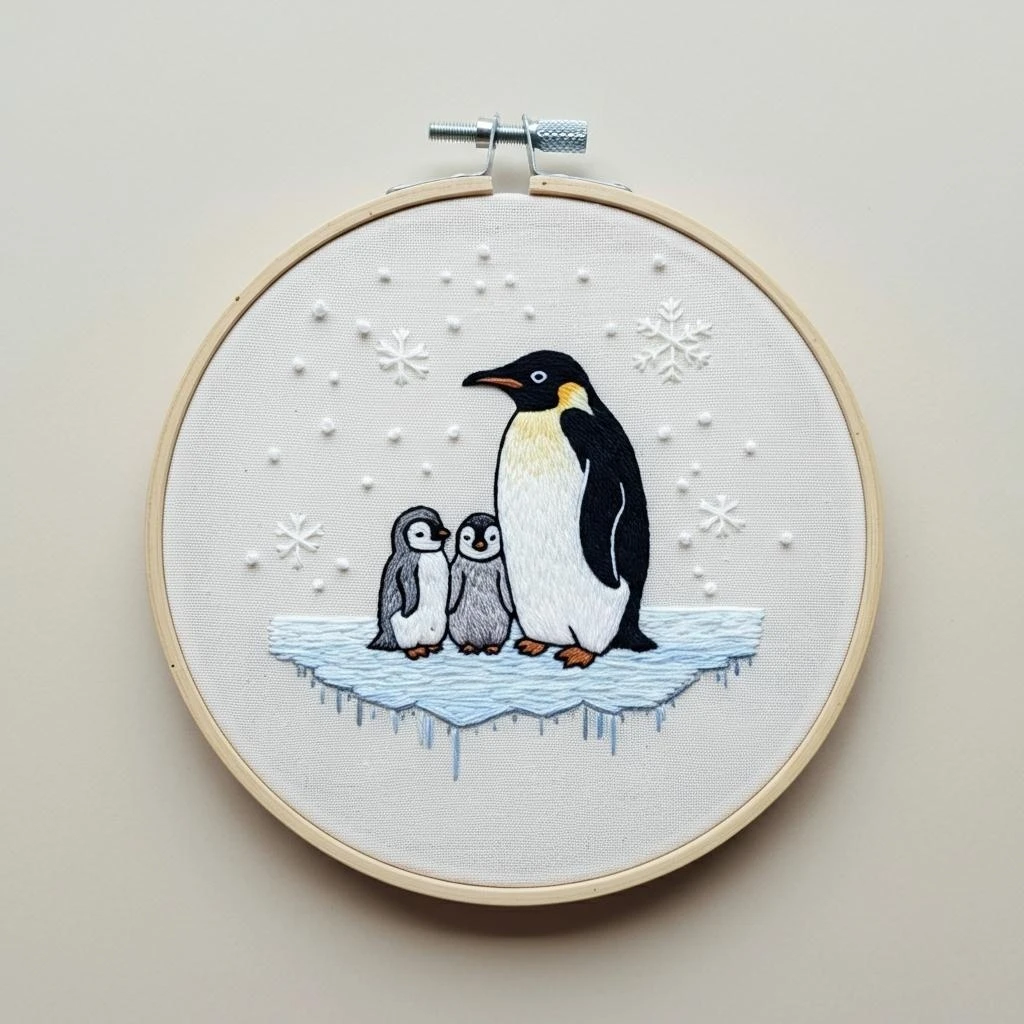

Embroidered Penguin Family In A Snowy Hoop
This snowy penguin family hoop relies on crisp black-and-white character shapes, soft gray contouring, icy blue snow shadows, and small warm accents in the beaks, feet, or winter accessories. Keep the penguins clean and graphic, then use gentle thread blending in the snow so the scene feels soft, rounded, and wintery without losing the adorable family focus.
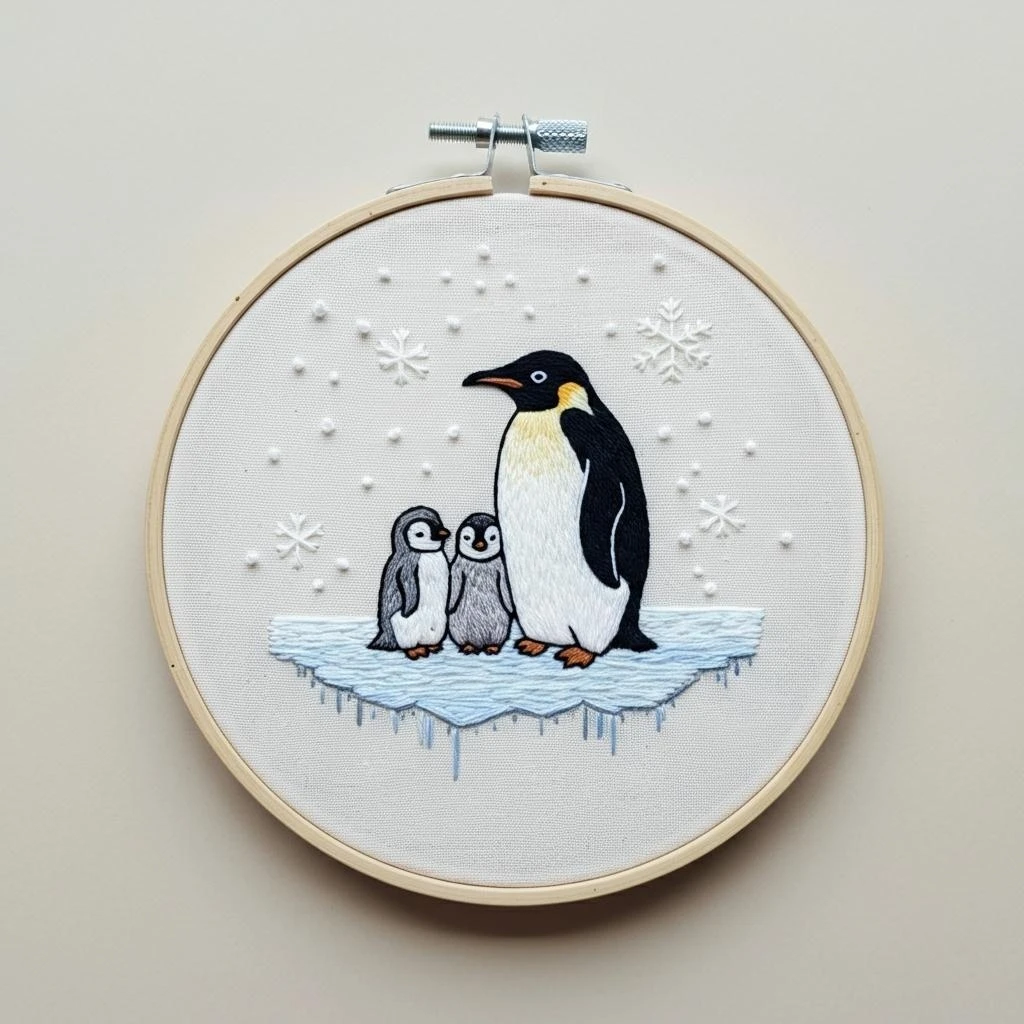
Project snapshot
Plan the stitching from broad snowy forms to small facial details, saving the tiny highlights and falling snow until the end.
Suggested DMC color palette
These floss choices are selected for the classic penguin contrast, soft snow depth, icy winter atmosphere, and small cheerful accent colors.
Recommended stitches by area
- Penguin bodies: Use long and short stitch for rounded black backs and white bellies. Follow the body curve so each penguin looks soft and dimensional.
- Small flippers: Work with satin stitch or short split stitches, keeping the direction angled away from the body for a natural wing shape.
- Faces and eyes: Use one-strand backstitch and tiny French knots. Add a single B5200 highlight in each eye if the scale allows.
- Beaks and feet: Use short satin stitches in 742 and 741, with the darker shade at the base for tiny dimensional warmth.
- Snowbanks: Use split stitch, whipped backstitch, or gentle long-and-short shading in whites, grays, and icy blues.
- Snowflakes: Use seed stitch, tiny straight stitches, or French knots in B5200, 762, or 3756 for varied falling snow.
Thread-count guidance
- 1 strand: eyes, mouths, falling snow, fine belly shadows, scarf folds, and tiny foot separations.
- 2 strands: most penguin outlines, beaks, flippers, and small satin-filled details.
- 3 strands: larger body fills, snowbanks, and accessory areas where stronger coverage is needed.
- 4 strands: optional only for plush snow texture or raised French-knot snowfall on a larger hoop.
- Tip: on a small pattern, keep faces to 1 strand; bulky facial stitches can quickly change the penguins’ expressions.
Blending ideas
Most of the design is neutral, so subtle blending makes a big difference. Use light touch shading rather than heavy color blocks.
- For black bodies, soften edges with 310 → 3799 → 317, using gray only where the form curves toward light.
- For bellies, use 3865 as the main white, B5200 only for highlights, and 762 or 318 around lower curves.
- For snow, blend B5200 → 3865 → 762 → 3756 → 3841, concentrating blue shadows beneath the penguins.
- For beaks and feet, use 742 on the light side and 741 at the base or underside.
- If accessories are included, shade red scarves with 817 → 498 and keep highlights small so the red remains festive but not overpowering.
Outlining and definition
Penguins need clean silhouettes, but snow looks better with soft broken lines. Use different outline weights for each material.
- Use DMC 310 for the most important penguin silhouettes, eyes, and facial definition.
- Use DMC 3799 for softer internal body lines so the black areas do not become heavy.
- Use DMC 318 or 3841 for snowbank outlines instead of black.
- Use whipped backstitch around the outer penguin curves for a smooth, illustrated finish.
- Keep falling snow unoutlined. Tiny knots and short straight stitches will look lighter and more natural.
Shading and texture guide
| Area | Color handling | Texture suggestion |
|---|---|---|
| Black penguin backs | Use 310 as the main dark, then add 3799 and 317 only at curved edges or under soft reflected light. | Short, curved long-and-short stitches give a plush feathered effect without making the surface shaggy. |
| White bellies | Use 3865 for the main fill, B5200 for the brightest center, and 762 or 318 near the side shadows. | Keep stitch direction vertical or slightly curved to suggest rounded little bodies. |
| Snowbanks | Layer 3865, 762, 3756, and 3841 under the penguins and near the lower hoop edge. | Whipped backstitch and soft split-stitch rows create a smooth snowdrift look. |
| Beaks and feet | Use 742 as the bright orange, with 741 tucked underneath for small shadows. | Two or three satin stitches are usually enough; avoid overworking these tiny shapes. |
| Winter accessories | Use 817 for bright red accents, 498 for folds, and a tiny B5200 stitch for a snowy highlight. | Stem stitch outlines and small satin blocks keep scarves and hats tidy. |
| Falling snow | Vary B5200, 3865, 762, and 3756 so snowflakes show on both white and dark sections. | Mix French knots, seed stitches, and tiny crosses for natural snowfall variation. |
Suggested stitching order
Beginner-friendly practical tips
- Keep the fabric tightly hooped so white and pale blue stitches do not pucker around the snowbanks.
- Use short lengths of black floss; dark thread can look fuzzy if dragged through fabric too many times.
- Stitch the eyes after the face fill is complete so they sit cleanly on top and remain symmetrical.
- If white stitches disappear on white fabric, use 3865 for fill and reserve B5200 for raised highlights.
- Do not overfill the snow. Leaving some fabric visible makes the hoop feel lighter and more wintery.
- For a cozy family look, vary the size of the penguins slightly and keep their eye placement consistent.
- Test red accessory colors before stitching; a very strong red can dominate the scene if used too widely.