

DMC palette & stitching notes
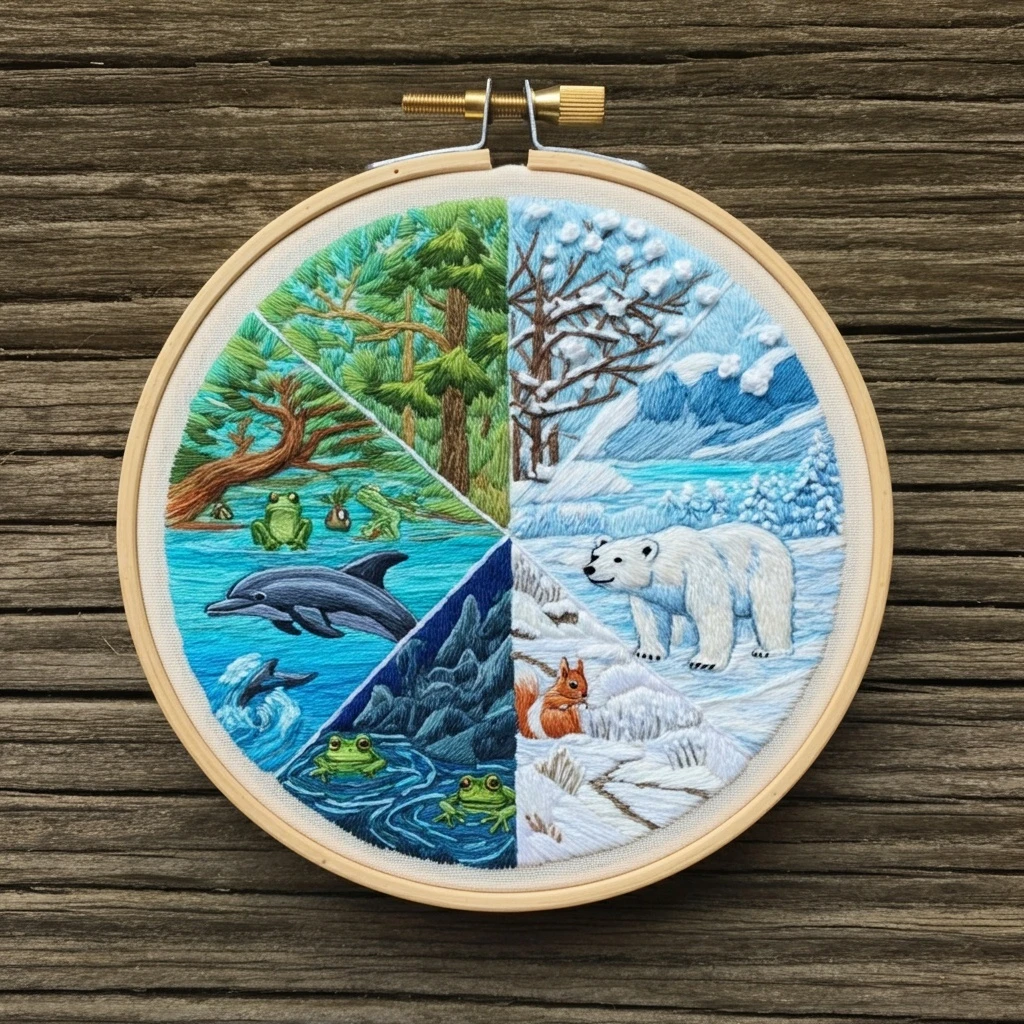
Embroidered Seasons Wildlife Wheel
A circular hoop design divided like a compass of seasons: green woodland spring, bright blue summer water, deep autumn night-water, and crystalline winter snow. Use this guide to translate the illustrated sample into practical floss choices, stitch textures, blending plans, and beginner-friendly embroidery decisions.
Reference focus: radial season panels, wildlife silhouettes, water movement, pine needles, snowbanks, bare branches, and a clean stitched divider line.
Design reading
The artwork is built around a round hoop with four angled landscape sections meeting at the center. The upper-left spring/summer forest area uses lively greens, tan trunks, and turquoise water. The lower-left water panel shifts from aqua to deep navy with frogs, a dolphin, and wave curls. The right half turns cold: icy blues, white snow, a polar bear, bare brown branches, pale grasses, and a small orange squirrel. Keep the central meeting point crisp so every season feels intentional rather than crowded.
Suggested DMC floss palette
This palette balances fresh forest greens, tropical water blues, muted bark browns, frosty winter tints, and wildlife accent colors. The notes explain where each color works best and how to combine it in the hoop.
Season-by-season stitching plan
Green forest panel
Use directional long-and-short stitches for pine clusters, changing angle branch by branch. Blend 895 + 699 for shaded needles, then place 704 and 472 as single-strand surface strokes on the sunlit tips.
Blue water and dolphin
Lay water with horizontal satin or split-fill rows in 3846, 3845, and 3843. The dolphin benefits from smooth long-and-short shading: 317 under the belly, 415 on the back highlight, and a thin 823 shadow under the fin.
Dark pond, frogs, and rocks
Use 823 for the deep wedge and curl in 3843/3845 as wave lines. Frogs look lively with 704 highlights over 699 bodies, with 310 French-knot eyes and tiny backstitch smiles.
Snow, bear, branches, squirrel
Keep snow airy with 3865 and 3756 rather than solid white everywhere. Add polar bear fur using short directional stitches in Blanc, 3756, and 747. Branches need fine 801 backstitch and snow knots in Blanc.
Recommended stitches and thread counts
| Element | Stitch type | Thread count | Practical guidance |
|---|---|---|---|
| Radial dividers | Whipped backstitch or stem stitch | 2 strands base, 1 strand whip | Keep these clean and bright so the seasonal wheel remains readable. Use Blanc or 3756. |
| Background skies and water | Split stitch fill, satin rows, long-and-short | 2 strands | Follow the horizon direction; avoid random angles in flat water areas. |
| Pine needles and foliage | Fly stitch, straight stitch, fishbone clusters | 1-2 strands | Use many short strokes rather than bulky fill; rotate greens for natural texture. |
| Tree trunks and branches | Stem stitch, split stitch, couching for thick limbs | 2 strands trunks, 1 strand twigs | Layer 801 first, then add 975/920 highlights along one side. |
| Animals | Long-and-short shading, tiny backstitch outlines | 1 strand details, 2 strands fill | Stitch bodies before outlines; add eyes, noses, claws, and mouths last. |
| Snow and foam | French knots, colonial knots, detached chain, seed stitch | 1-2 strands | Vary knot size so snow looks soft and irregular instead of dotted in a grid. |
| Rocks and ice ridges | Split stitch, slanted satin, sketchy backstitch | 1-2 strands | Use 317, 415, 747, and 823 sparingly to create angular depth. |
Blending, shading, and texture notes
Water depth blend
Blend 3846 into 3845 for the bright water, then introduce 3843 and 823 toward the dark wedge. For smoother transitions, thread one strand of each neighboring color in the needle.
Winter softness
Do not outline every snowbank heavily. Use 3756 as the main cool tint, 3865 as the warm fill, and Blanc only for ridgelines, bear highlights, and snow caps.
Wildlife definition
Use one strand of 310 only after all body shading is finished. Tiny black details are powerful; too much black will flatten the animals.
Forest texture
Use short, angled straight stitches for pine needles, layered from dark to light. Keep some fabric breathing between strokes so the forest does not become a green block.
Beginner-friendly practical tips
- Transfer the seasonal divider lines first and mark the center point clearly.
- Work one wedge at a time, but reserve final outlines until all wedges are stitched.
- Use shorter thread lengths in the dense green and blue areas to reduce fuzzing.
- For broad fill areas, keep stitches under 1 cm where possible to prevent snagging.
- Step back often; the wheel is viewed as a whole, so color balance matters more than perfect individual stitches.
- Use one strand for eyes, tiny toes, branch tips, foam lines, and small grasses.
- Use two strands for most fills; three strands only for bold tree trunks or heavy divider accents.
- Blend by mixing two colors in the needle when moving from sky to snow or aqua to navy.
- Anchor thread tails carefully behind filled areas, not behind open pale snow where they may show through.
- Press finished work face-down on a towel so raised knots and textured fur stay dimensional.