Embroidered Baobab Tree in Hoop - DMC Palette & Stitching Tips
DMC palette & embroidery guide
Embroidered Baobab Tree in Hoop
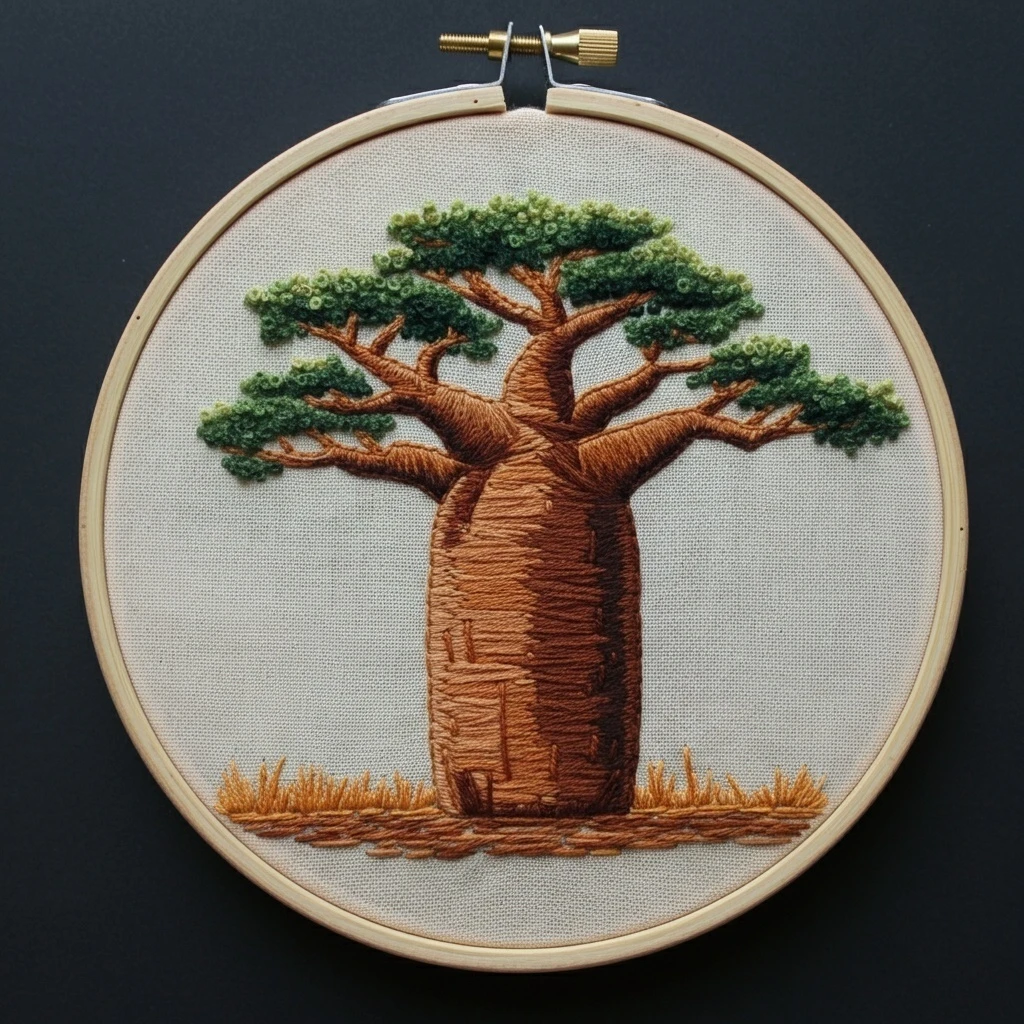
A grounded hoop-style embroidery guide for a sculptural baobab: broad bottle trunk, exposed roots, twisting branches, airy rounded foliage, sun-warmed earth, and natural safari-inspired greens and browns. The palette keeps the tree dimensional while staying practical for hand embroidery.
The design centers on the baobab’s distinctive silhouette: a thick, warm brown trunk, spreading roots, delicate branching, and a rounded broken canopy. The palette should feel natural and sunlit rather than overly bright, with golden tan ground, deep bark shadows, mossy green leaves, olive highlights, and just enough cream to separate small details from the fabric.
Use the darkest browns for structure only. The baobab should look ancient and textured, but not heavy; soft mid-browns and small highlight stitches will make the trunk feel rounded.
DMC 3865Winter White
Tiny bark highlights, knot glints, and the lightest edges on exposed roots. Use 1 strand so it reads as sun catching the texture.
DMC 3822Straw, Light
Warm sky glow, dry grass highlights, and subtle light on the upper trunk. Good for soft, sunlit accents.
DMC 977Golden Brown, Light
Main dry ground, sandy hoop landscape base, and lighter bark planes on the swollen trunk.
DMC 783Topaz, Medium
Ochre shading in the ground and warm transition stitches between tan soil and darker roots.
DMC 435Brown, Very Light
Primary trunk midtone. Use long vertical stitches to suggest the baobab’s broad, ridged bark.
DMC 801Coffee Brown, Dark
Trunk side shadows, root undersides, branch forks, and deeper bark grooves.
DMC 3371Black Brown
Finest branch tips, deepest root lines, and final silhouette accents. Use sparingly with 1 strand.
DMC 3012Khaki Green, Medium
Muted canopy base, distant leaves, and olive-toned shadow clusters. Keeps foliage natural and not neon.
DMC 3011Khaki Green, Dark
Main leaf masses and darker underside of the canopy. Useful for fly stitches and seed stitch clusters.
DMC 936Avocado Green, Very Dark
Deep foliage shadows near branch junctions and behind lighter leaves. Adds depth without black outlines.
DMC 733Olive Green, Medium
Leaf highlights at the outer canopy, small fresh shoots, and scattered top stitches for sunlit texture.
DMC 927Grey Green, Light
Pale background haze or optional sky-tint stitches around the tree, especially if the fabric is cream or linen.
DMC 842Beige Brown, Very Light
Soft branch highlights, dry grass stems, and blending between trunk brown and sandy ground.
DMC 839Beige Brown, Dark
Subtle outline alternative for roots, trunk edges, and bark cracks when 3371 feels too strong.
Stitch plan by design element
Swollen baobab trunkUse long-and-short stitch or vertical satin columns in 435 and 801. Curve the stitches slightly to show the trunk’s rounded bottle shape.
Bark ridgesAdd stem stitch, split stitch, and tiny straight stitches in 839 and 3371. Keep bark lines broken and uneven for an aged-tree look.
Exposed rootsWork stem stitch from the trunk outward, then add short couching or straight stitches for root texture. Roots should feel grounded and slightly raised.
Branch structureUse 1 strand for branch tips and 2 strands for thicker limbs. Stem stitch gives a clean, controlled curve.
Leaf clustersBuild airy foliage with seed stitch, lazy daisy, tiny fly stitch, and French knots. Leave small fabric gaps so the canopy stays light.
Ground and horizonUse directional straight stitch, seed stitch, and small running stitches in 977, 783, and 842 for dry grass and warm earth.
Thread-count guidance
For a 5-6 inch hoop
Use 1 strand for branch tips, fine bark cracks, tiny leaf highlights, and delicate ground lines. Use 2 strands for the main trunk, roots, and most canopy stitches. For French knots in the foreground, use 2 strands with one wrap for neat texture.
For a 7-8 inch hoop
Use 2 strands for trunk fills and leaf groups, 1 strand for refined outlines, and 3 strands only for a few raised bark ridges or larger foreground knots. Larger hoops benefit from more visible stitch direction on the trunk.
Texture balance: make the trunk smoother and directional, the roots slightly raised, and the canopy dotted and airy. This contrast makes the baobab instantly recognizable.
Blending and shading ideas
Map the silhouette first. Lightly outline the trunk, main roots, and branch spread with a removable marker or running stitch before filling.
Shade the trunk from one side. Put 977 and 435 on the light side, 801 and 839 on the shaded side, and reserve 3371 for the deepest grooves.
Blend bark with alternating strands. For soft transitions, thread one strand of 435 with one strand of 801 and use short split stitches between the light and dark areas.
Keep leaves irregular. Cluster 3011 and 3012 first, then add small 733 highlights along the top and outer edges. Avoid perfect circles of leaves.
Let branches peek through. Stitch some limbs before the leaf knots, then add only scattered foliage over them so the tree structure remains visible.
Finish with warm ground texture. Short stitches in 977, 783, and 842 around the roots make the tree feel planted inside the hoop.
Beginner-friendly practical tips
Start at the centerBegin with the trunk, then roots, then branches, foliage, and finally ground texture. This keeps the main shape accurate.
Use short fill stitchesLong satin stitches can snag on a wide trunk. Short long-and-short stitches are stronger and make better bark texture.
Vary leaf stitchesMix seed stitch, lazy daisy, and knots in small groups. Variation creates a natural canopy without complicated shading.
Avoid harsh outlinesUse 839 for most outlines and save 3371 for tiny accents. The finished tree will look softer and more hand-drawn.
Check the hoop from afarThe baobab silhouette matters most. Step back before adding too many leaf knots or bark cracks.
Press from the backAfter stitching, place the embroidery face down on a towel and press gently so knots and raised roots are protected.
Suggested stitch menu
Long-and-short stitch: trunk shading and soft rounded fill. Stem stitch: branches, roots, trunk edges, and curved bark grooves. Split stitch: refined outlines and subtle bark divisions. Seed stitch: dry ground, sparse foliage, and small background texture. French knots: raised leaf clusters and foreground texture. Lazy daisy: individual leaves around the canopy edge. Fly stitch: small branch-and-leaf forms and tufts of grass.
For a polished finish, keep the baobab’s trunk bold, the branches delicate, and the foliage broken into small breathable clusters rather than solid filled shapes.