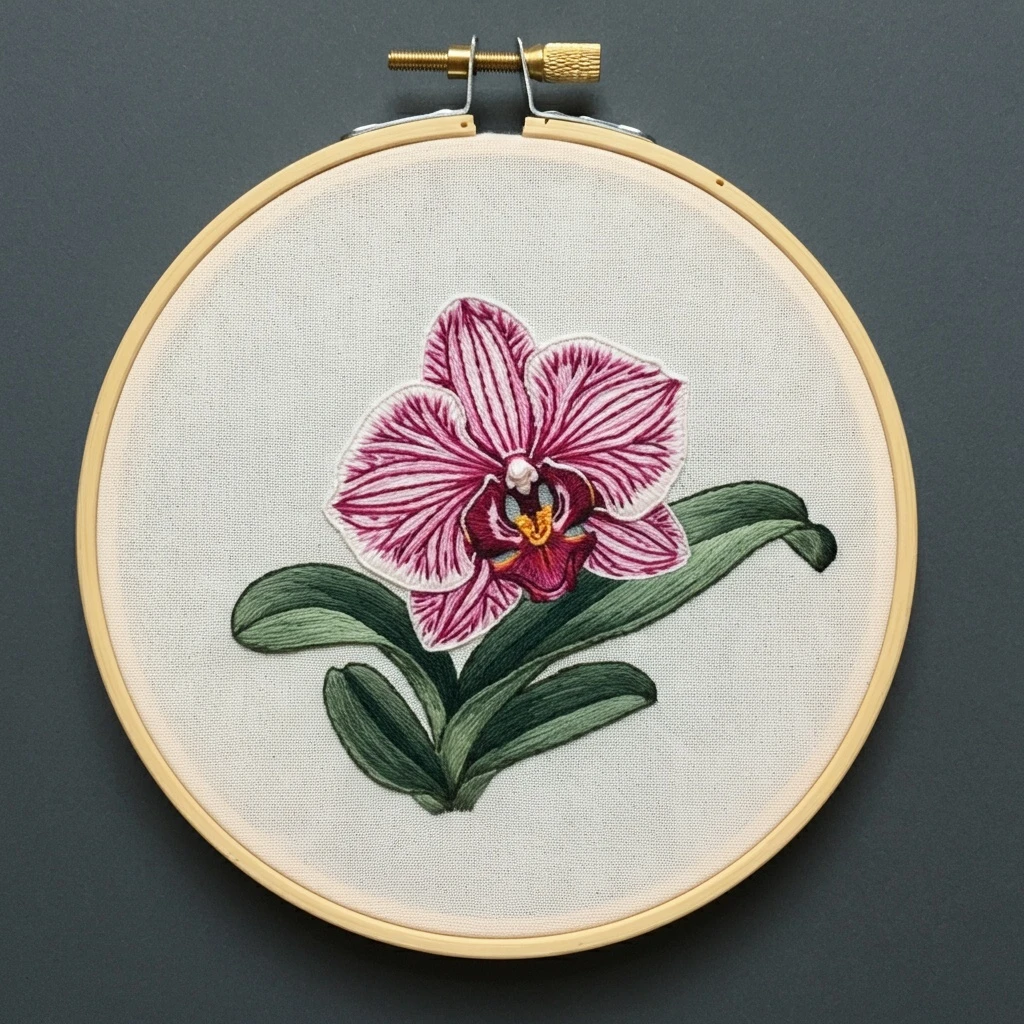

Embroidered Phalaenopsis Orchid In Hoop
This orchid hoop design is delicate and graceful: broad pale Phalaenopsis petals, a richer magenta throat, soft lavender-pink shadows, botanical green stems, and warm hoop accents. The polished result depends on smooth petal shading, fine center details, and restraint. Let the pale petals stay luminous while concentrating the strongest color in the orchid lip and throat.
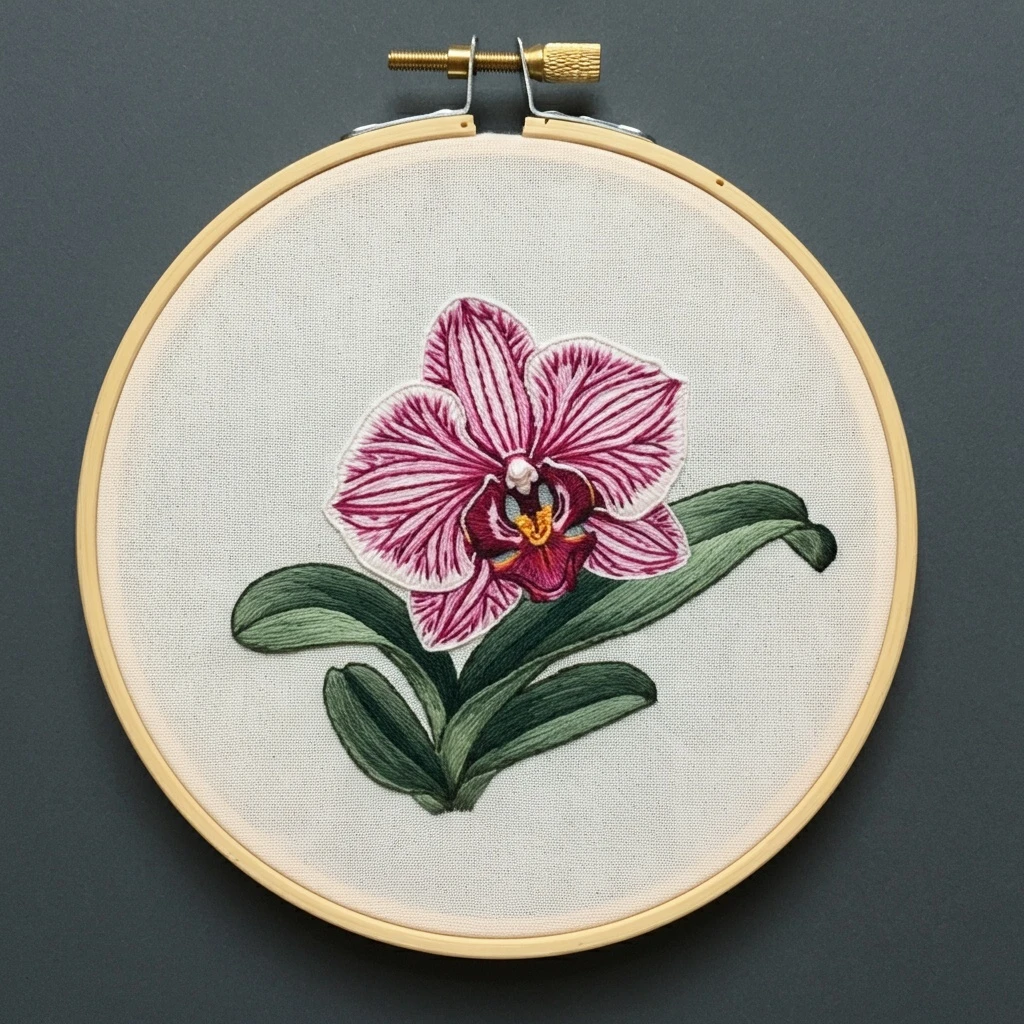
Project snapshot
Approach the orchid as layered translucent petals: pale foundation first, soft shadows second, central throat detail last.
Suggested DMC color palette
These DMC shades support a pale orchid with gentle pink-lavender shading, a rich central lip, natural green stems, and warm hoop details.
Recommended stitches by area
- Large orchid petals: Use long and short stitch in soft curved rows, radiating from the flower center toward the petal edges.
- Petal edges: Use one-strand split stitch or very fine backstitch in 3865, 819, or 153 rather than dark outlining.
- Central lip and throat: Use satin stitch with 3803 and 915, adding tiny French knots or seed stitches in 725 for warm pollen-like detail.
- Veins and folds: Use one-strand straight stitch or split stitch, tapering the lines so they fade into the petal body.
- Leaves and stems: Use stem stitch for stems, fishbone stitch for leaves, and long-and-short shading for larger green areas.
- Hoop accents: Use stem stitch or split stitch following the circular direction, blending 433 with pale neutrals if the hoop is included in the artwork.
Thread-count guidance
- 1 strand: petal veins, inner throat markings, fine edge definition, and small pollen dots.
- 2 strands: most petal fills, soft outlines, stems, and smaller leaves.
- 3 strands: fuller petal areas or leaves on larger hoops where coverage needs to be smooth and opaque.
- 4 strands: use only for optional raised central knots or padded lip texture, not for broad petal shading.
- Tip: if the orchid is small, stay mostly with 1–2 strands so the petals remain graceful instead of bulky.
Blending ideas
The orchid should look soft and luminous. Blend by overlapping irregular stitch lengths, with darker colors concentrated near the center and beneath overlapping petals.
- For pale petals, blend B5200 → 3865 → 819 → 818, keeping the brightest whites near the lifted edges.
- For cool shadows, add 153 or 3743 along lower petal folds and where one petal passes under another.
- For stronger pink depth, transition 3689 → 3688 near the throat or petal base.
- For the central lip, use 3803 → 915 for dark depth, then punctuate with 725 tiny warm stitches.
- For leaves, blend 3348 → 3347 → 3363 → 3051, placing the darkest greens where stems tuck behind petals.
Outlining and definition
Phalaenopsis orchids look best with soft contour lines. Avoid harsh black outlines unless the original pattern uses very graphic line art.
- Use 3865 or 819 for petal-edge definition on pale fabric.
- Use 153 or 3743 to define overlapping petals with cool, natural shadow.
- Use 3803 or 915 only inside the throat and lip, not around the entire bloom.
- Use 3363 or 3051 for leaf and stem outlines, keeping botanical edges crisp but not too heavy.
- For a polished finish, outline after filling so the final line sits cleanly over the edge of the stitched petal.
Shading and texture guide
| Area | Color handling | Texture suggestion |
|---|---|---|
| Upper petals | Use 3865 as the main fill, B5200 on raised edges, and 819 or 153 near the base for subtle shadow. | Long, smooth stitches radiating outward create the broad, silky petal surface. |
| Side petals | Blend 3865, 819, 818, and 3689 where the petal curves inward or overlaps another petal. | Vary stitch length to avoid visible bands and keep the petals soft. |
| Central lip | Use 3803 and 915 for the deepest orchid-magenta areas, with 725 as tiny warm dots or marks. | Satin stitch and tiny French knots add contrast and a natural flower-center texture. |
| Petal veins | Use one strand of 3689, 153, or 3743, fading the lines before they reach the outer edge. | Short straight stitches look more natural than one long uninterrupted vein. |
| Leaves and buds | Use 3348 on light edges, 3347 for the main leaf body, and 3363 or 3051 in lower shadows. | Fishbone stitch follows the leaf shape and creates a clean central vein. |
| Hoop or branch detail | Use 433 with a few lighter stitches if the hoop edge or branch needs a warm wooden note. | Stem stitch along the curve gives a smooth natural line. |
Suggested stitching order
Beginner-friendly practical tips
- Use a water-soluble or very pale transfer method so markings do not show through the light petals.
- Separate each strand before threading. Smooth, separated strands make satin and long-and-short stitches look more polished.
- Keep petal stitches slightly curved rather than perfectly straight; this makes the bloom look more natural.
- Do not overuse dark plum. A few strong throat details are enough to create depth without making the orchid heavy.
- If the white petals disappear on your fabric, outline selectively with 819 or 153 and add a few 762-like cool shadows by using 3743.
- For smoother fills, shorten your stitches near tight curves and lengthen them only in broad open petal areas.
- Pause before adding final veins. Too many vein lines can make a soft orchid look striped, so add only the most important ones.