
Embroidered Water Lilies In Hoop
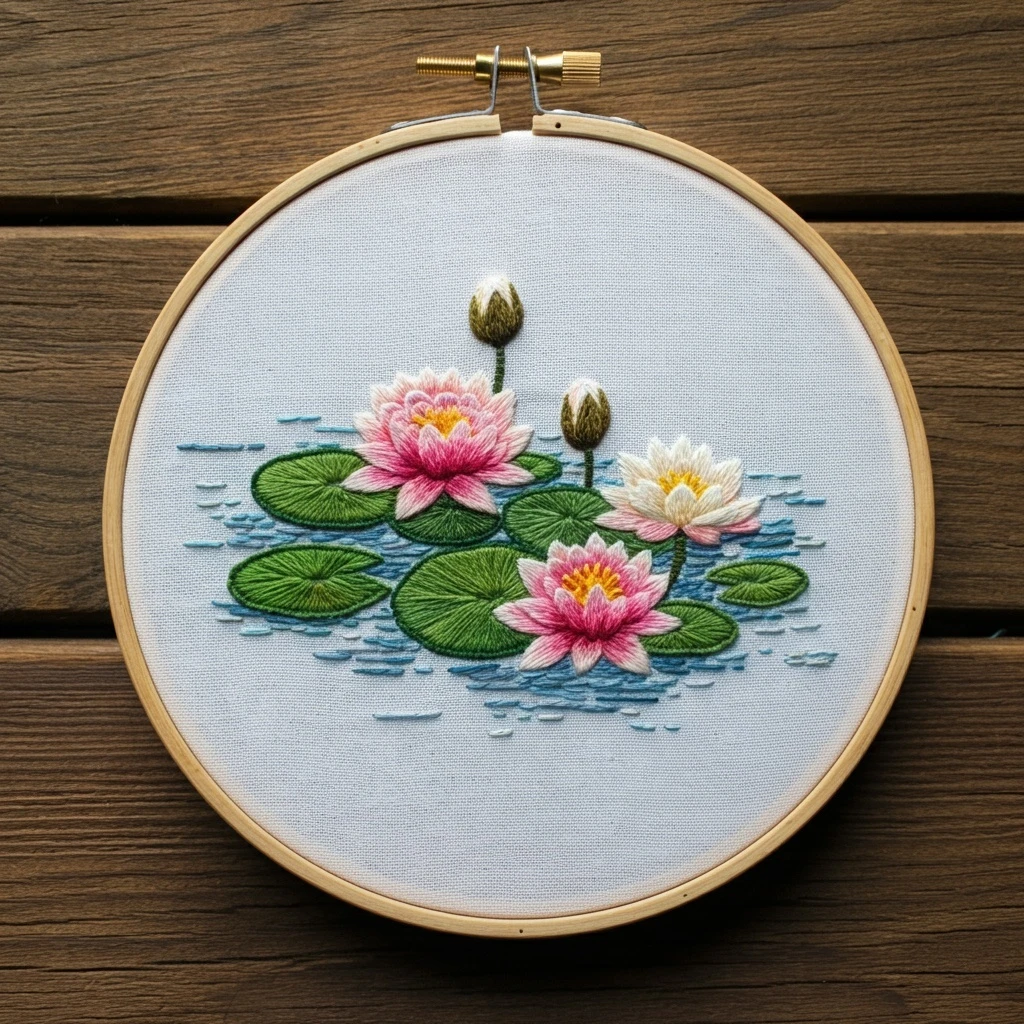
A calm pond-hoop design with rounded lily pads, rippling blue water, soft pink and ivory water-lily petals, ochre-yellow centers, and two upright buds. The overall effect is painterly but beginner-friendly when the design is worked in layers: water first, leaves second, flowers last.
Color read from the reference
The image is built around cool pond blues, layered leaf greens, warm pink blossoms, creamy white petals, golden centers, and dark olive accents for stems and bud shadows. Keep the palette slightly muted so the design feels hand-stitched and botanical rather than neon.
Stitch plan by design area
Lily pads
Outline each pad with split stitch or stem stitch in DMC 895 or a 895/905 blend. Fill from the center outward with long-and-short stitch, changing direction like spokes on a wheel. Add a few single-strand straight stitches in 907 at the outer rim for light-catching veins.
Water ripples
Use uneven running stitch, back stitch, and short straight stitches. Work DMC 3760 in the densest areas beneath the flowers, then scatter 598 and 747 farther out so the water feels reflective rather than heavy.
Pink lilies
Use satin stitch for smaller petals and long-and-short stitch for larger petals. Start each petal with 3685 at the base, feather into 151, and finish the tips with 819 or 3865. Keep stitch direction following the petal curve.
White lily and closed buds
For the ivory flower, alternate 3865 and 822, adding small 819 touches only where the reference shows pink reflected underneath. Closed buds can be built with padded satin stitch: 3011 at the shadowed base, 905 through the body, and 3865 on the little caps.
Centers and pollen
Use French knots, colonial knots, or tiny vertical straight stitches in 726 and 3821. Add knots after the petals are complete so they sit cleanly on top.
Final definition
Reserve the darkest outlines until near the end. A single strand of 895 around selected leaf edges and stem backs is enough; too much outline can flatten the soft pond effect.
Thread-count and blending guidance
Use 1 strand for leaf veins, water glints, petal creases, and final outlines. This keeps the pond surface delicate.
Use 2 strands for satin and long-and-short work on petals and pads. For a bolder beginner version, 3 strands can fill the large leaves faster.
Use 3 strands for French knots, padded bud bodies, and center stamens so the flowers feel dimensional.
| Blend | Where to use it | Effect |
|---|---|---|
| 1 strand 905 + 1 strand 906 | Lily pad fill | Natural mid-green with subtle color movement. |
| 1 strand 3685 + 1 strand 151 | Petal bases | Soft magenta shadow without a hard stripe. |
| 1 strand 598 + 1 strand 747 | Outer ripples | Pale blue shimmer that recedes into the fabric. |
| 1 strand 3865 + 1 strand 822 | White lily shadows | Creamy white petals with visible but gentle dimension. |
Suggested stitching order
Beginner-friendly practical tips
For a soft heirloom finish, press the embroidery face-down on a towel after stitching and mount it taut in a clean wooden hoop. A pale blue-gray linen background will echo the reference image and make the pink lilies and green pads stand out beautifully.