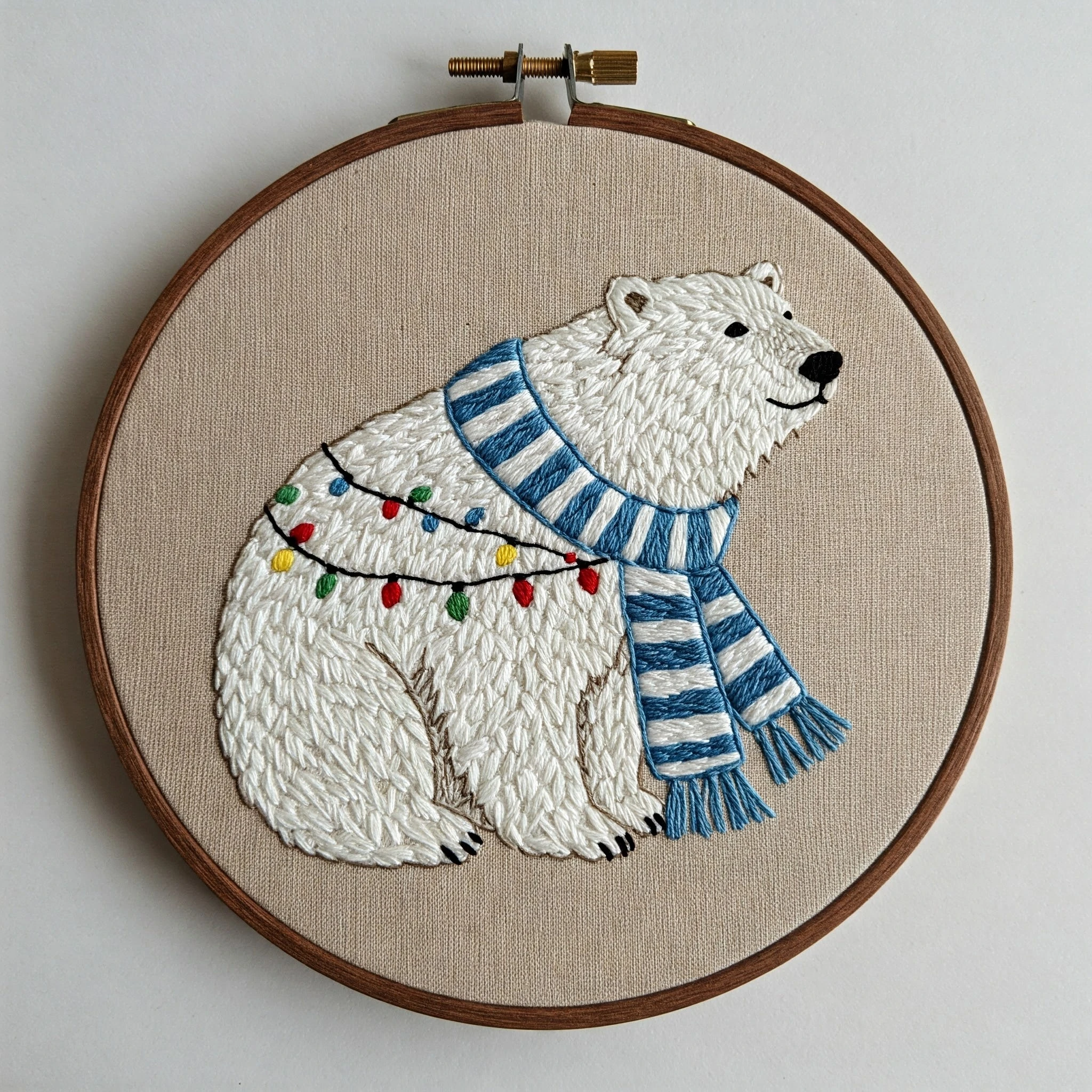

Snowy Bear in Holiday Lights
A cozy polar-bear hoop with shaggy white fur, a striped winter scarf, and cheerful holiday bulb garlands. The palette is cool and snowy, warmed by beige linen, dark wood hoop tones, and small pops of red, green, blue, and golden yellow.
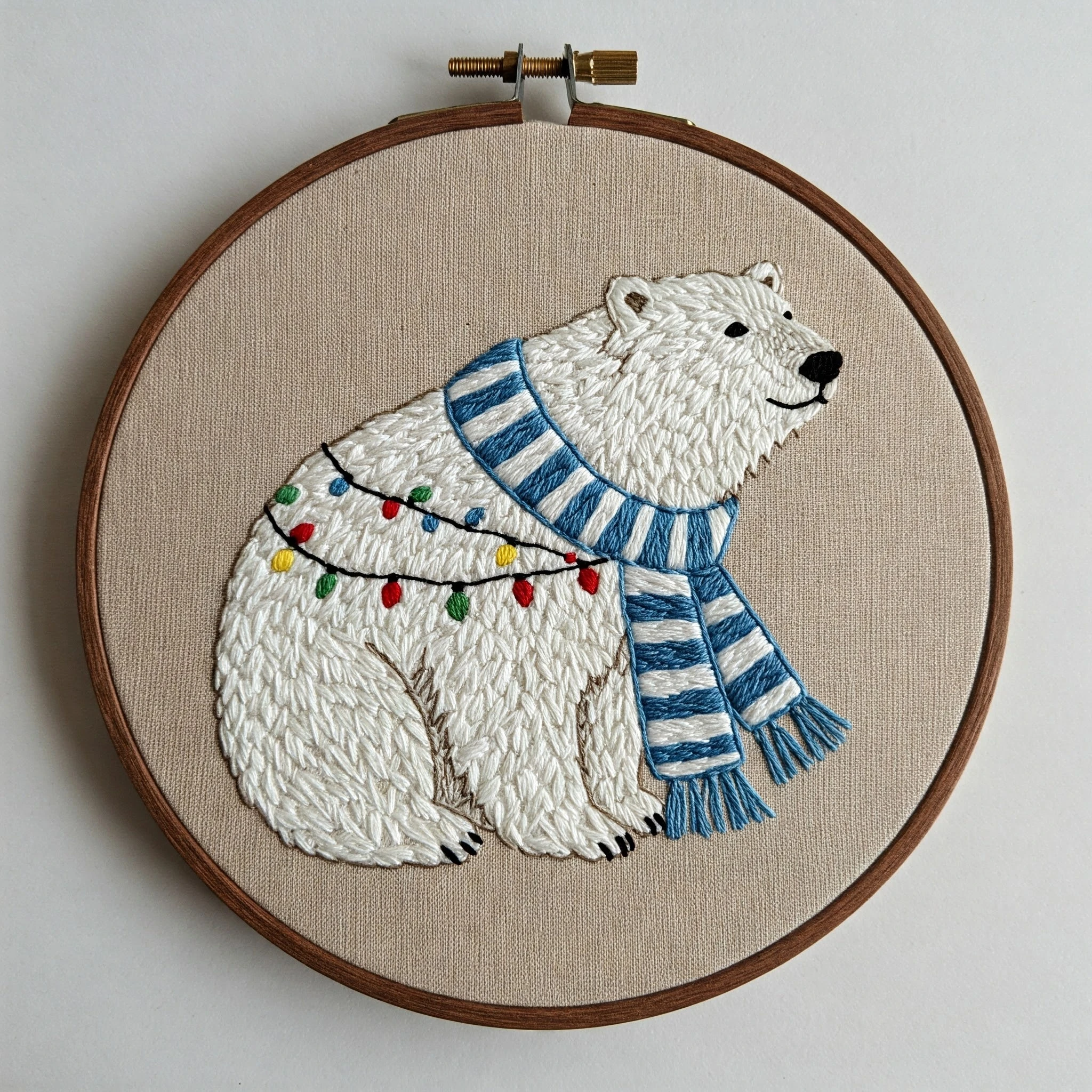
Polished DMC color palette
These DMC suggestions are selected to match the observed off-white bear, cool blue scarf, black linework, warm fabric/hoop notes, and saturated holiday lights.
Stitch plan by design area
| Area | Recommended stitches | Thread count & practical notes |
|---|---|---|
| Bear fur | Long-and-short stitch, fishbone-like fur strokes, scattered straight stitches | Use 3 strands for base coverage, then 2 strands for directional top strokes. Rotate stitch angles around rump, belly, shoulder, muzzle, and neck so the fur follows the animal shape. |
| Fur shadows | Short straight stitch, split stitch underlayers | Blend 3865 + 762 in the needle for soft gray-white transitions. Add 841 sparingly where the original has warm beige-brown contour lines. |
| Scarf | Satin stitch, stem stitch borders, straight-stitch fringe | Use 3 strands for smooth stripes. Keep blue stripes parallel and bold; use 3765 at stripe edges and 807 in the center for dimension. |
| Holiday light cords | Back stitch or whipped back stitch | Use 1 strand of 310 so the cord curves stay delicate and do not overpower the white fur. |
| Bulbs | Satin stitch, padded satin, tiny detached chain | Use 2 strands for small bulbs. Place red, green, blue, and yellow unevenly for a handmade festive look. |
| Face and paws | Satin stitch for nose, French knots or tiny satin stitches for eyes, back stitch for smile, straight stitch claws | Use 1–2 strands of 310. Keep the smile line light and slightly curved; too-heavy black will make the bear look less gentle. |
Blending, shading, and texture suggestions
Layer the whites
Start with 3865 as the main fur layer, add 762 in shadow pockets, then finish with B5200 as loose top strokes. This keeps the bear snowy without looking flat.
Shape with stitch direction
Use curved strokes around the rump, vertical strokes down the legs, shorter strokes around the muzzle, and slightly longer shaggy strokes along the chest and belly.
Make lights pop
After stitching each bulb, add one tiny B5200 straight stitch at the upper edge. For extra glow, place a single loose 444 or 699 stitch beside the bulb on the fur.
Beginner-friendly stitching order
Thread-count guidance
1 strand
Use for mouth curve, delicate cord corrections, tiny eye detail, and the thinnest outline shadows.
2 strands
Use for bulbs, final fur highlights, fine scarf border definition, claws, and shadow strokes.
3–4 strands
Use for most fur fill and scarf satin areas. Six strands can work for extra fluffy white top strokes, but keep them sparse.
Practical finishing tips
- Use a sharp embroidery needle for dense fur so new stitches can slide cleanly between existing threads.
- Do not over-outline the whole bear in black; warm beige and gray contour stitches preserve the soft snowy look.
- For a fluffy edge, let a few white stitches slightly cross the drawn outline, especially along the belly and chest.
- Keep scarf satin stitches short and snug. Long satin stitches across wide stripes can snag or loosen over time.
- Press finished embroidery face-down on a towel so the raised fur and padded bulbs are not flattened.