
Embroidered Lavender Salvia Flower Arrangement
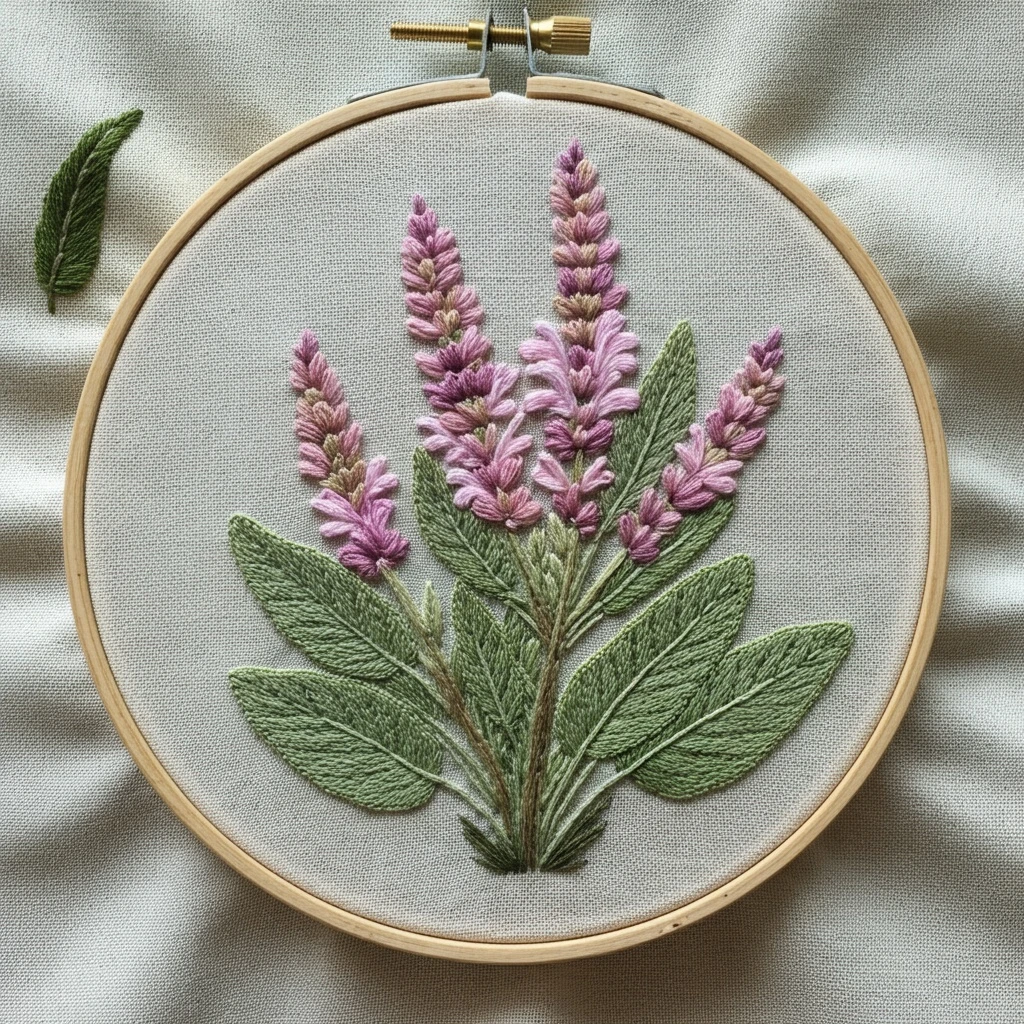
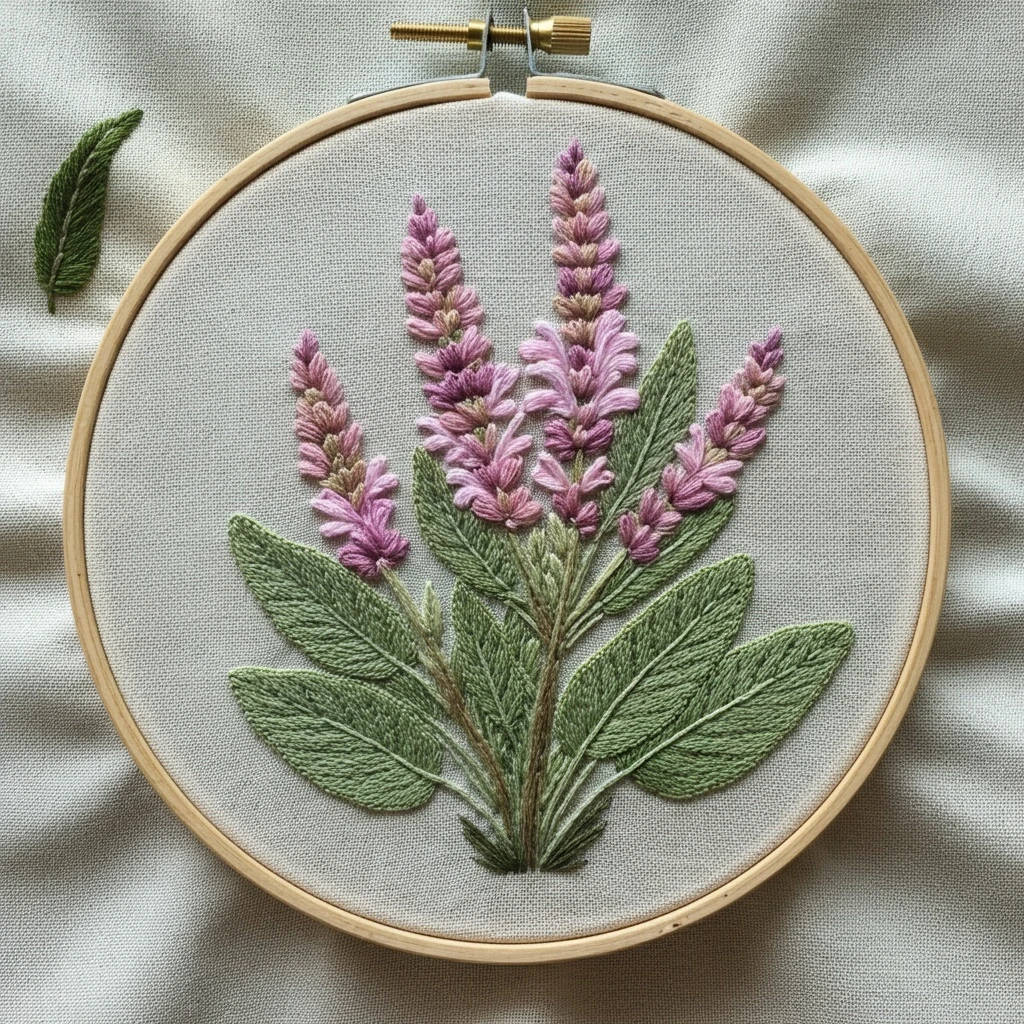
A graceful botanical arrangement with upright lavender and salvia flower spikes, soft violet buds, sage-green leaves, and fine branching stems. The palette below keeps the flowers cool and layered while adding natural green depth so the bouquet feels airy rather than heavy.
Color story from the reference design
The design centers on a loose, upward bouquet of lavender-salvia flower stems. The most important visual notes are the clustered purple flower tips, deeper violet shadows near the base of each spike, dusty blue-lavender midtones, muted sage leaves, and slim olive stems. The arrangement should feel delicate, fragrant, and slightly wild, with small stitch clusters doing most of the work.
Suggested DMC floss palette
Use the darker purples sparingly for shadow pockets and the mid-to-light violet shades for the visible flower mass. Greens are intentionally muted so they support the blooms without competing with them.
Deepest salvia shadow, base of clustered florets, and tiny accent knots.
Main dark purple petals and shaded sides of tall flower spikes.
Primary lavender-salvia bloom color for detached chain and knot clusters.
Soft petal highlights, upper flower tips, and gentle blended transitions.
Very pale bloom glints and airy outer stitches on the tallest spikes.
Cool blue-lavender notes for salvia flowers and shadowed lavender buds.
Dusty background lavender tone, distant buds, and cool transition stitches.
Tiny sparkle stitches on petal tips and optional highlight dots on pale blooms.
Deep leaf creases, stem shadow sides, and the darkest botanical definition.
Main stems and leaf midtones; natural enough for lavender and salvia foliage.
Muted sage leaves, underside shading, and soft transitions in foliage.
Leaf highlights and tender new stems near the top of the bouquet.
Pale sage glints and very light leaf tips without becoming neon.
Dry herb stems, seed-like accents, and warm neutral grounding stitches.
Subtle dried calyx marks and soft neutral highlights at flower bases.
Optional near-black purple detail for the deepest salvia throats, gentler than black.
Thread-count and blending guide
Strands by area
- Main stems: 2 strands for stem stitch; use 1 strand on wispy side stems.
- Flower spikes: 2 strands for detached chain, lazy daisy, or fly-stitch petals; 1 strand for tiny knots near the tips.
- Leaves: 2 strands for fishbone or satin stitch; 1 strand for central veins.
- Final highlights: 1 strand only, especially with Blanc, 210, and 3013.
Blend combinations
- Rich violet bloom: 1 strand 327 + 1 strand 554 for the lower half of each spike.
- Soft lavender tip: 1 strand 554 + 1 strand 211, then add a few single 210 stitches.
- Cool salvia cast: 1 strand 341 + 1 strand 160 for blue-violet side flowers.
- Sage foliage: 1 strand 3052 + 1 strand 3053 for gentle gray-green leaves.
Stitch suggestions by design element
Tall stems
Use stem stitch for the main vertical lines, keeping the twist consistent. For extra-fine branching, switch to one-strand back stitch or split stitch.
Lavender spikes
Use stacked detached chain stitches, fly stitches, or small lazy daisies placed alternately left and right of the stem. Keep the top clusters smaller and lighter.
Salvia florets
Use tiny fishbone stitches or short satin stitches for open petal shapes. Add 333 or 154 only at the throat of the darker flowers.
Bud texture
Scatter French knots and colonial knots in 327, 554, 211, and 341. Vary knot size by wrapping once near the tip and twice near the fuller lower blooms.
Sage leaves
Use fishbone stitch for pointed leaves and long-and-short stitch for wider leaves. Add a one-strand vein in 895 or 469 after the fill is complete.
Fine outlines
Use split stitch in a matching shade instead of black. Purple outlines should be 333 or 154; green outlines should be 895 or 469.
Shading and texture plan
Shade each spike from base to tip
Place the darkest purples at the lower and inner parts of the flower spikes, then transition to 554, 211, and a few 210 stitches near the tops. This creates a natural botanical taper and keeps the bouquet from looking flat.
Leave breathing room
Do not fill every gap between the florets. The reference style relies on small separate stitches, so visible fabric between buds helps the lavender and salvia read as delicate flower clusters.
Make leaves support the blooms
Use muted gray-greens for most leaves, reserving 3013 for tiny highlights along one edge. Too much bright green will pull attention away from the violet flower spikes.
Use raised texture selectively
French knots, colonial knots, and layered detached chains are ideal for the flower heads. Keep stems flatter with stem stitch so the raised blossoms stand forward.
Beginner-friendly stitching order
Transfer the skeleton
Mark the main stem paths, leaf positions, and the outer silhouette of each flower spike. Stitch stems first so every bloom cluster has a clear anchor.
Add leaves and lower blooms
Fill the leaves before the flower heads. Start the purple clusters at the bottom of each spike with darker shades and larger stitches.
Finish with light tips
Work upward into lighter lavender, then add single-strand highlights, tiny knots, and final vein details. Press from the back over a towel to protect raised stitches.
Practical embroidery tips
Fabric and hoop choice
A natural linen, cotton-linen blend, or smooth quilting cotton in ivory, warm white, or pale oatmeal will suit the soft botanical palette. A 6-inch hoop works for a compact arrangement; use a 7- or 8-inch hoop if you want easier detached chain petals.
Tidy back and tension
Avoid carrying dark purple threads behind open pale fabric. Re-anchor frequently, use shorter lengths of floss, and keep knot clusters firm but not tight so they sit like little buds rather than puckering the fabric.
For a softer heirloom finish, skip harsh black outlines and rely on matching dark purple or deep green. For a more decorative finish, add a few metallic or pearl cotton accents only after the cotton stitching is complete.