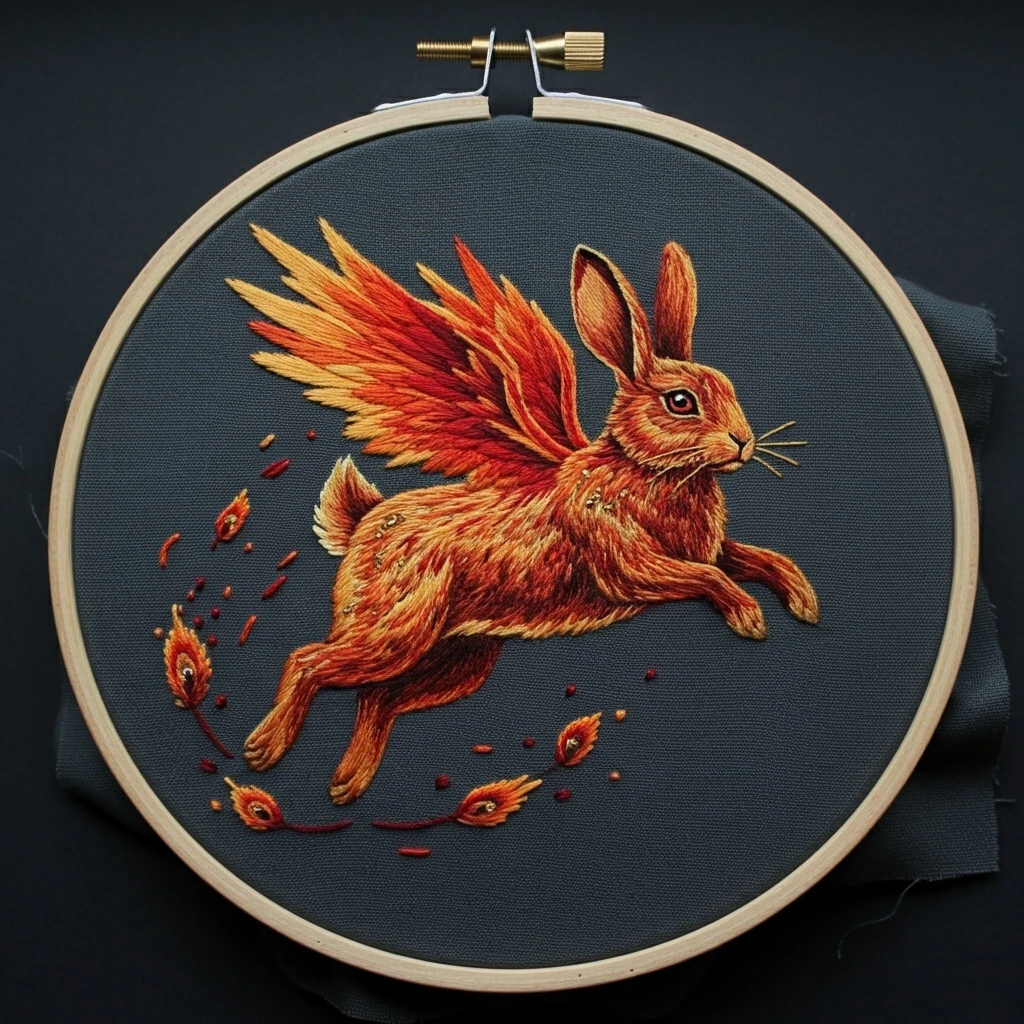

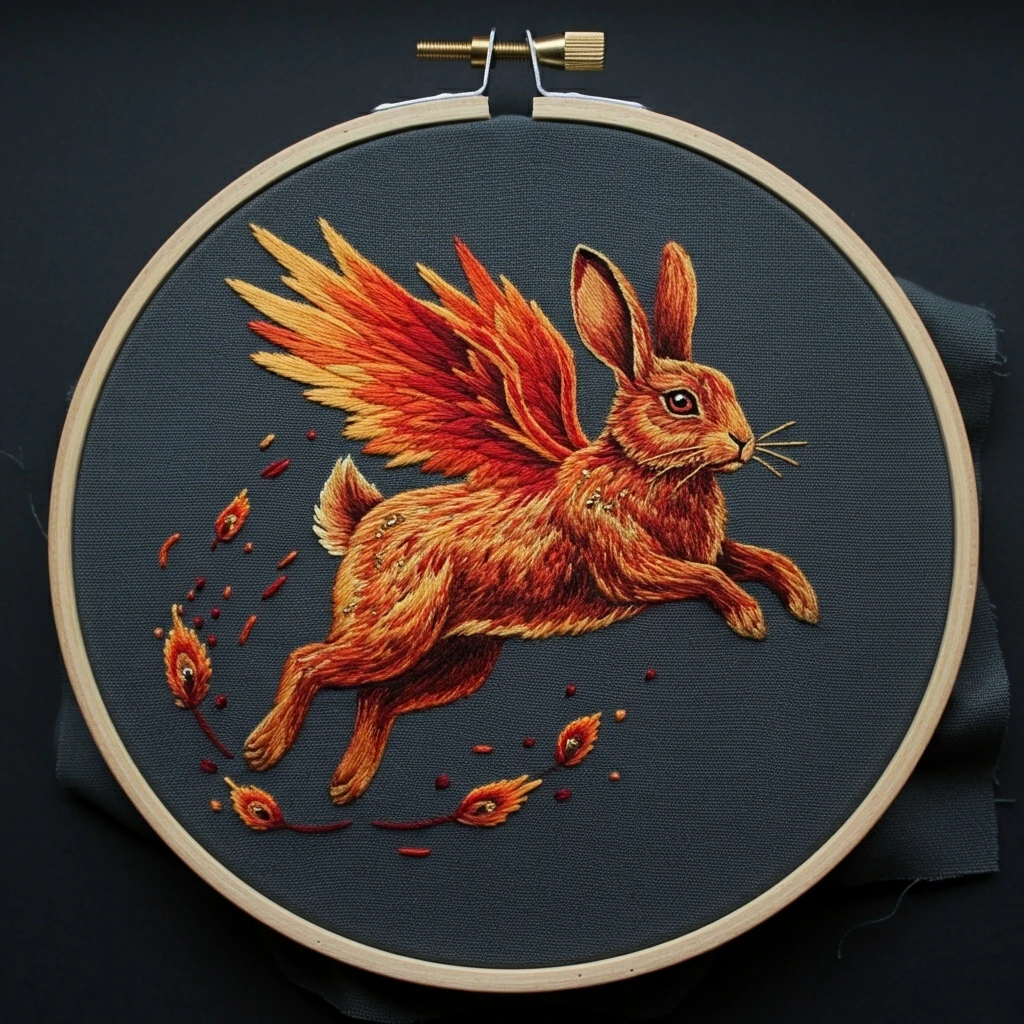
Fiery Winged Jackalope
This design combines a mythical jackalope silhouette with dramatic wings and flame-like accents. Treat it as a warm, high-contrast piece: tawny fur and antlers should feel earthy and natural, while the wings and fiery flourishes can glow with oranges, reds, golds, and deep ember shadows.
Estimated DMC Color Palette
The reference artwork suggests a fantasy woodland creature with warm fur, horn/antler neutrals, and intense flame-feather accents. These DMC choices are selected for practical hand embroidery rather than exact digital color matching.
Stitch Types by Area
Jackalope body and face
- Long-and-short stitch: best for fur gradients on the body, cheeks, legs, and chest.
- Split stitch: use for a neat edge before filling the face and body.
- Tiny satin stitch: good for nose, inner ear shapes, and small paw pads.
Wings and flames
- Fishbone stitch: gives feather sections a central vein and layered texture.
- Long-and-short stitch: creates smooth fire gradients from garnet to yellow.
- Satin stitch: use for clean flame tongues and bold decorative shapes.
Antlers and magical accents
- Stem stitch: excellent for antler curves and branching lines.
- Back stitch: use for crisp ridges, claw lines, and wing separations.
- French knots: add sparks, glowing dots, and textured ember speckles.
Thread Count Guidance
| Area | Strands | Practical note |
|---|---|---|
| Eyes, nose, antler grooves, fine outline | 1 strand | Keeps the expression sharp and avoids bulky dark lines. |
| Fur fill and body shading | 2 strands | Enough coverage while preserving directional fur texture. |
| Large wing feathers | 2 strands | Use smooth directional stitches that follow feather flow. |
| Flame shapes and bold orange accents | 2–3 strands | Use 3 only for the brightest focal flames or thick satin areas. |
| Sparks and glowing dots | 1–2 strands | One strand for tiny pinpoints; two strands for brighter knots. |
Blending, Shading & Texture Ideas
Warm fur blend
Use 739 + 436 for the lightest fur, 436 as the main body tone, and 433/801 along lower edges, wing overlaps, and leg folds. Short stitches should follow the animal’s contours.
Fire-gradient wings
Start near the body with 816, transition through 666 and 900, then move outward into 970, 728, and small touches of 3823 at the hottest tips.
Antler dimension
Outline branches in 839, fill with 437, and place a few 1-strand darker split stitches on one side of each branch to make the antlers look rounded.
Clean fantasy outlining
Use 938 for most outlines and reserve 3371 for the eye, nose, and deepest shadow breaks. This keeps the design dramatic without cartoon-heavy black borders.
Feather texture
For each feather, stitch from the base outward in directional rows. Add a few split-stitch veins over the top in 900 or 816 to separate fiery feather layers.
Magical sparks
Scatter tiny French knots in 728, 3823, and occasional 3865. Keep clusters uneven so they feel like moving embers rather than polka dots.
Suggested Stitching Order
- Transfer main outlines: mark the body, wings, antlers, facial features, and flame shapes clearly.
- Work the jackalope body: fill the light and mid-brown fur before adding any strong dark outlines.
- Add face and antlers: keep facial details delicate with 1 strand and stitch antlers with fine ridged lines.
- Build wing shadows: start wing roots in garnet and dark orange so the fiery areas have depth.
- Layer bright flames: add orange, topaz, and pale yellow highlights toward wing edges and flame tips.
- Finish with definition: outline select edges, add feather veins, sparks, and final catchlights last.
Quick Reference: Best Techniques
| Design element | Recommended stitch | Helpful note |
|---|---|---|
| Fur and body | Long-and-short, split stitch | Follow the direction of fur growth to avoid a flat filled shape. |
| Wings | Fishbone, long-and-short, satin | Blend color bands within each feather rather than outlining every feather heavily. |
| Flames | Satin, straight stitch, long-and-short | Keep the brightest yellows at tips and narrow highlight ridges. |
| Antlers | Stem stitch, split stitch, back stitch | Use 1 strand for grooves and 2 strands for the main branch line. |
| Eye and nose | Tiny satin, French knot, back stitch | One small catchlight can make the creature feel alive. |
| Sparks and ember dots | French knots, seed stitch | Add last so they sit brightly on top of the design. |