Hand Embroidered Hibiscus Flower Hoop

Hand Embroidered Hibiscus Flower Hoop — DMC Palette & Stitch Guide
DMC Color Palette & Stitching Suggestions

Hand Embroidered Hibiscus Flower Hoop

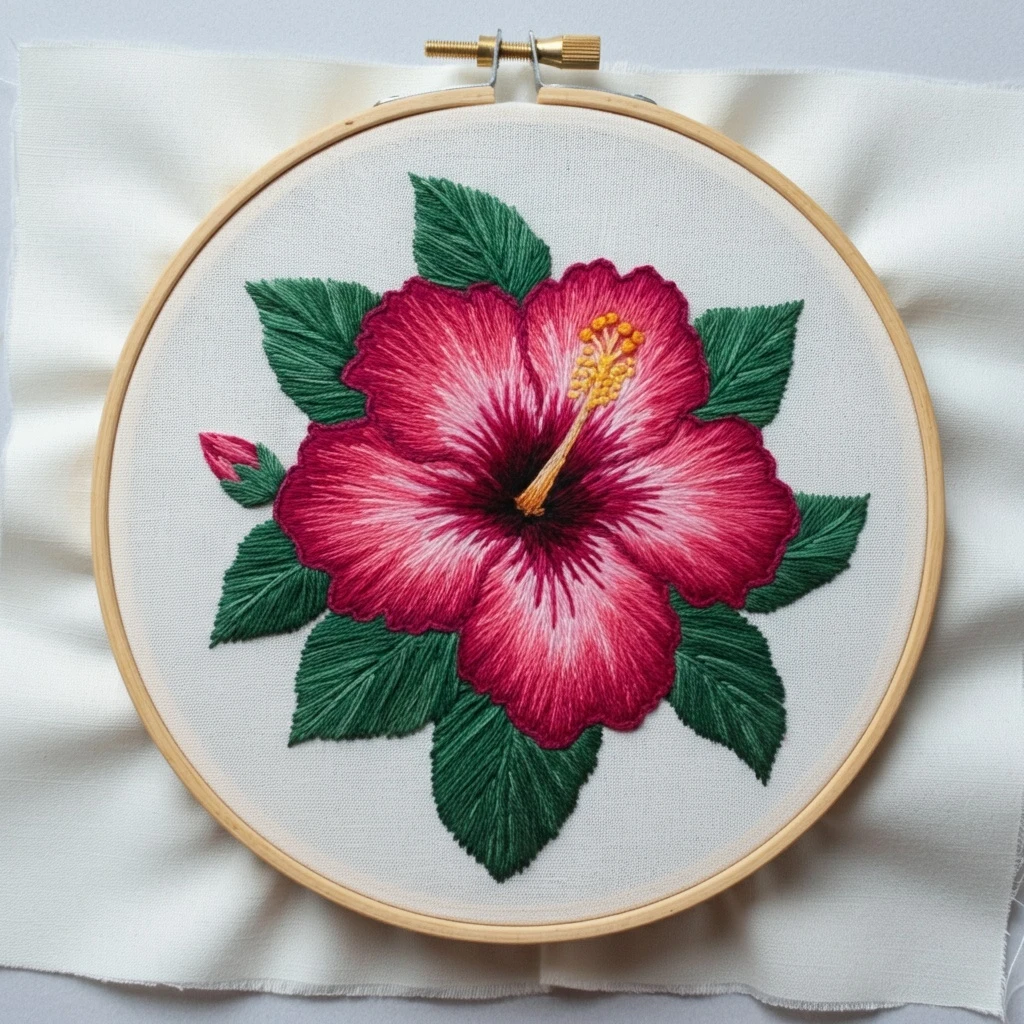
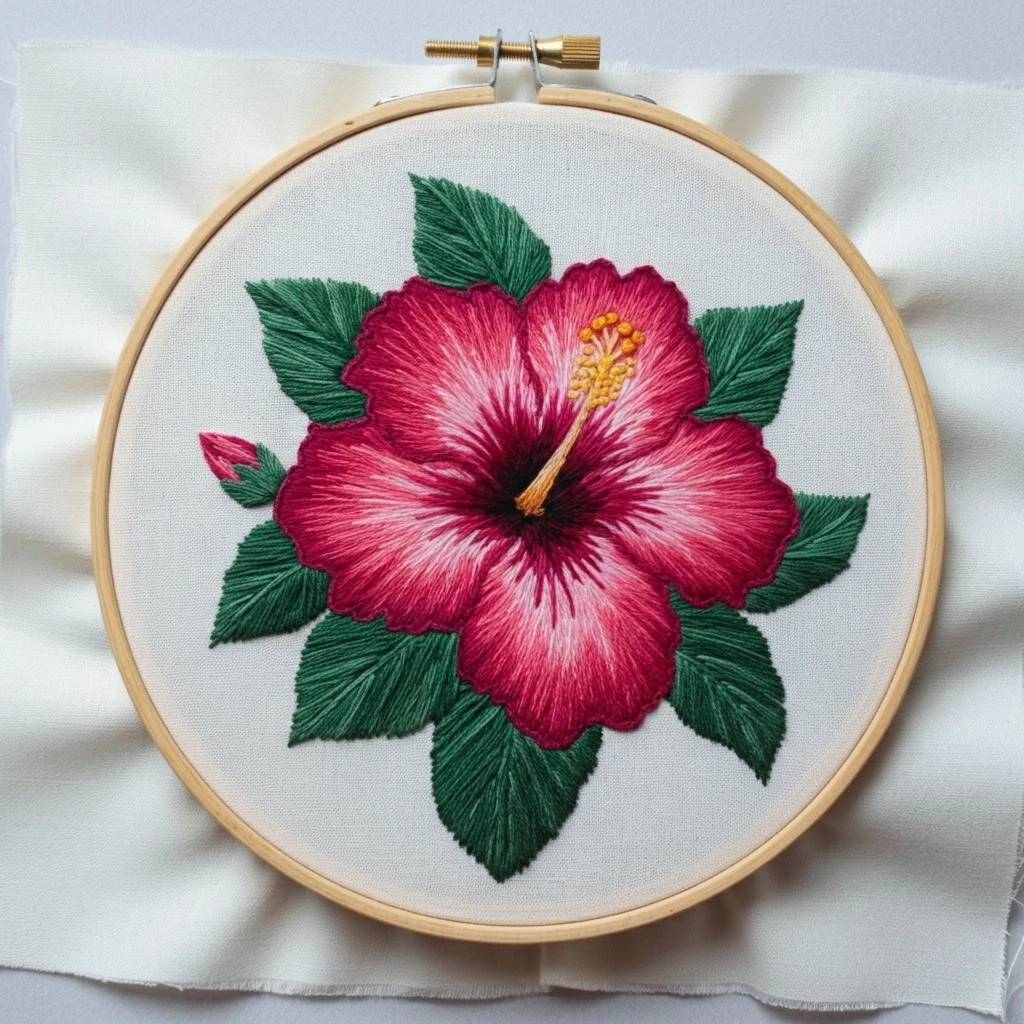
A lush tropical hibiscus with deep raspberry petals, bright cream-pink highlights, golden stamens, and structured emerald leaves. The design works best when the flower is stitched directionally from the dark throat outward, letting long-and-short shading create the soft, painterly glow seen in the reference.
Petal shading focusLeaf vein textureBeginner friendly layers6-inch hoop ready
Hand Embroidered Hibiscus Flower Hoop

Observed Design Colors

The reference shows a white or warm ivory fabric ground in a wooden hoop. The hibiscus uses a dramatic magenta-to-burgundy petal range with pale blush streaks radiating from the center. Leaves are deep green with lighter vein ridges, while the pistil and pollen dots are yellow-gold.

DMC 814
Garnet, Dark
Dark flower throat, petal folds, deepest scalloped edges.
DMC 816
Garnet
Main outline and saturated lower-petal shadows.
DMC 3685
Mauve, Very Dark
Rich raspberry petal body; blend outward from 814.
DMC 3687
Mauve
Mid-pink transitions and soft petal ridges.
DMC 3689
Mauve, Light
Pale blush highlights near petal centers.
DMC 967
Apricot, Very Light
Warm white streaks; use sparingly to avoid chalky petals.
DMC 500
Blue Green, Very Dark
Leaf shadow bases and dark central veins.
DMC 895
Hunter Green, Very Dark
Main leaf fill and crisp serrated leaf edges.
DMC 911
Emerald Green, Medium
Leaf highlights, vein ridges, and small bud leaves.
DMC 3820
Straw, Dark
Pistil stem and warm golden pollen accents.
DMC 743
Yellow, Medium
Raised pollen knots and brightest stamen tips.
DMC 3828
Hazelnut Brown
Optional hoop/wood accent if adding a stitched border.

Stitch Map

Petals

Use long-and-short stitch in radiating rows. Start with 814 at the throat, blend through 816 and 3685, then feather 3687/3689 into the pale streaks.

Leaves

Use fishbone stitch for each leaf half. Work from the center vein outward so the stitches form natural ridges and pointed tips.

Stamens

Use stem stitch for the filament, satin stitch for the larger anther, and French knots for pollen dots.

Edges

Back stitch the scalloped hibiscus edge in 816, then add tiny split-stitch touches in 814 where petals overlap.

Bud

Fill the small bud with satin stitches in 3685/3687 and wrap the base with 895 and 911.

Fabric

Leave the ivory fabric open around the bloom; negative space keeps the tropical flower crisp and gallery-like.

Thread Count Guide

Petal shading: 1 strand for realistic long-and-short blending; 2 strands if the design is enlarged above 7 inches.
Petal outline: 1 strand split stitch for neat curves; use 2 strands only on the outermost silhouette.
Leaves: 2 strands for fishbone stitch, switching to 1 strand for fine side veins and leaf tips.
Stamens: 1 strand stem stitch for the filament; 2 strands or double-wrapped French knots for pollen.
Hoop size: Best in a 5–6 inch hoop on cotton, linen, or cotton-linen blend with medium tension.

Blending, Shading & Texture Plan

Anchor the dark center first. Stitch the hibiscus throat with short irregular strokes in 814, then soften the edge with a 50/50 needle blend of 814 + 816.
Build petal glow in wedges. Follow the natural direction of each petal from center to outer rim. Alternate 3685 and 3687 in staggered lengths so the color shift does not form stripes.
Reserve the pale streaks. Add 3689 and 967 as thin, broken strokes rather than solid blocks. This keeps the flower luminous and prevents the highlights from looking flat.
Deepen the scalloped rim. Outline with 816, then tuck occasional 814 stitches into dips and folds. A darker rim helps the petal shape read clearly from a distance.
Give leaves a ribbed surface. Work fishbone stitch in 895, then add center veins with 500 and small highlight strokes of 911 along the upper ridges.

Practical Embroidery Tips

  • Use a sharp embroidery needle so long petal stitches sit cleanly without snagging neighboring threads.
  • Keep stitches slightly varied in length; hibiscus petals look more natural with feathered, uneven transitions.
  • Turn the hoop as you stitch so each petal is worked comfortably in the direction of growth.
  • Do not overfill the center with knots; leave room for the dark throat to remain dramatic.
  • For a beginner version, simplify each petal to three zones: dark center, pink body, pale highlight.
  • Use a washable or heat-erasable fine-tip pen and test it on the fabric first.
  • Press from the back on a towel when finished to protect the raised pollen knots.
  • Back the hoop with felt if gifting; it hides traveling threads behind pale fabric.

Optional Finishing Ideas

For extra polish, add a single row of tiny seed stitches in 967 around the flower as a subtle glow, or stitch a slim wooden-hoop echo border in 3828. If you want more dimension, pad the large central stamen with one base stitch before covering it in 3820 satin stitch.
Best beginner shortcut: Use satin stitch for the smallest petal tips and long-and-short only on the large central petals. This preserves the shaded look while keeping the project manageable.

Leave a Reply

Your email address will not be published. Required fields are marked *