
Embroidered Autumn Landscape With River And Mountains
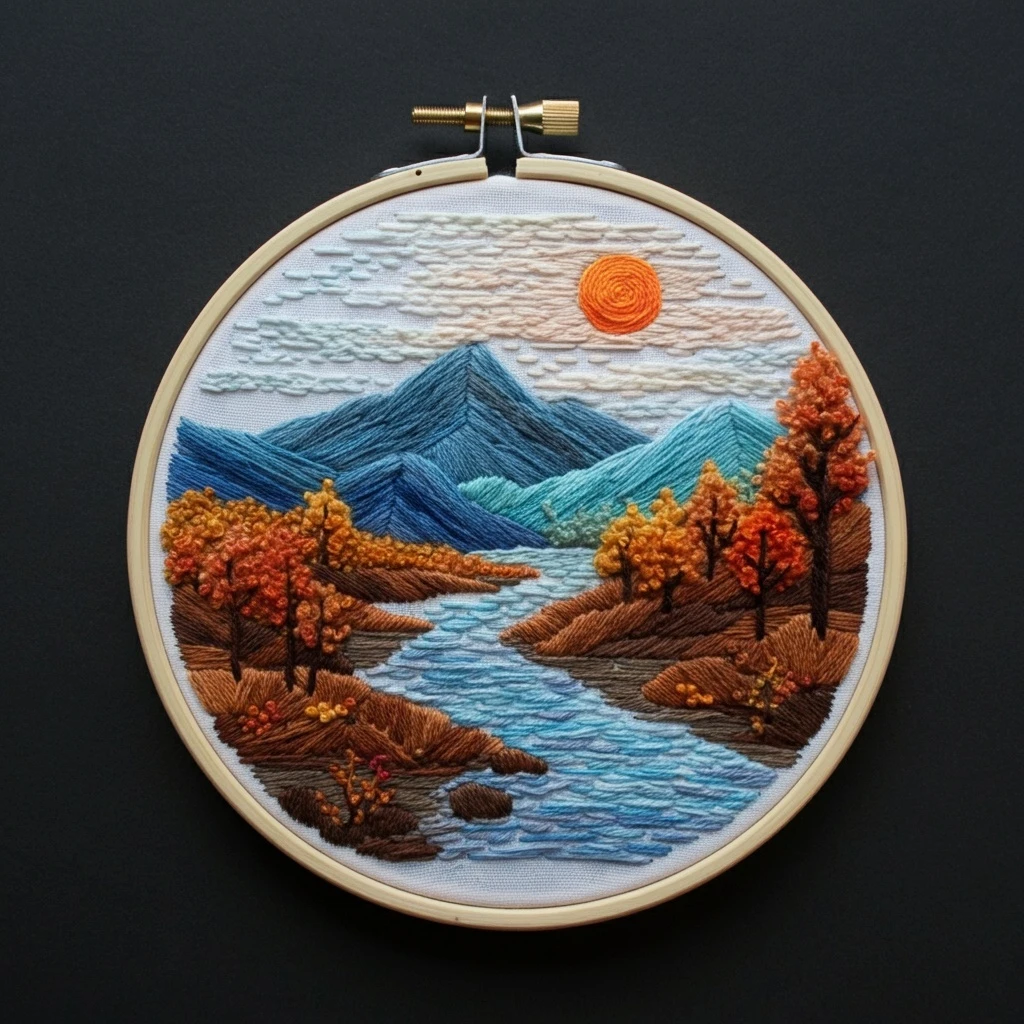
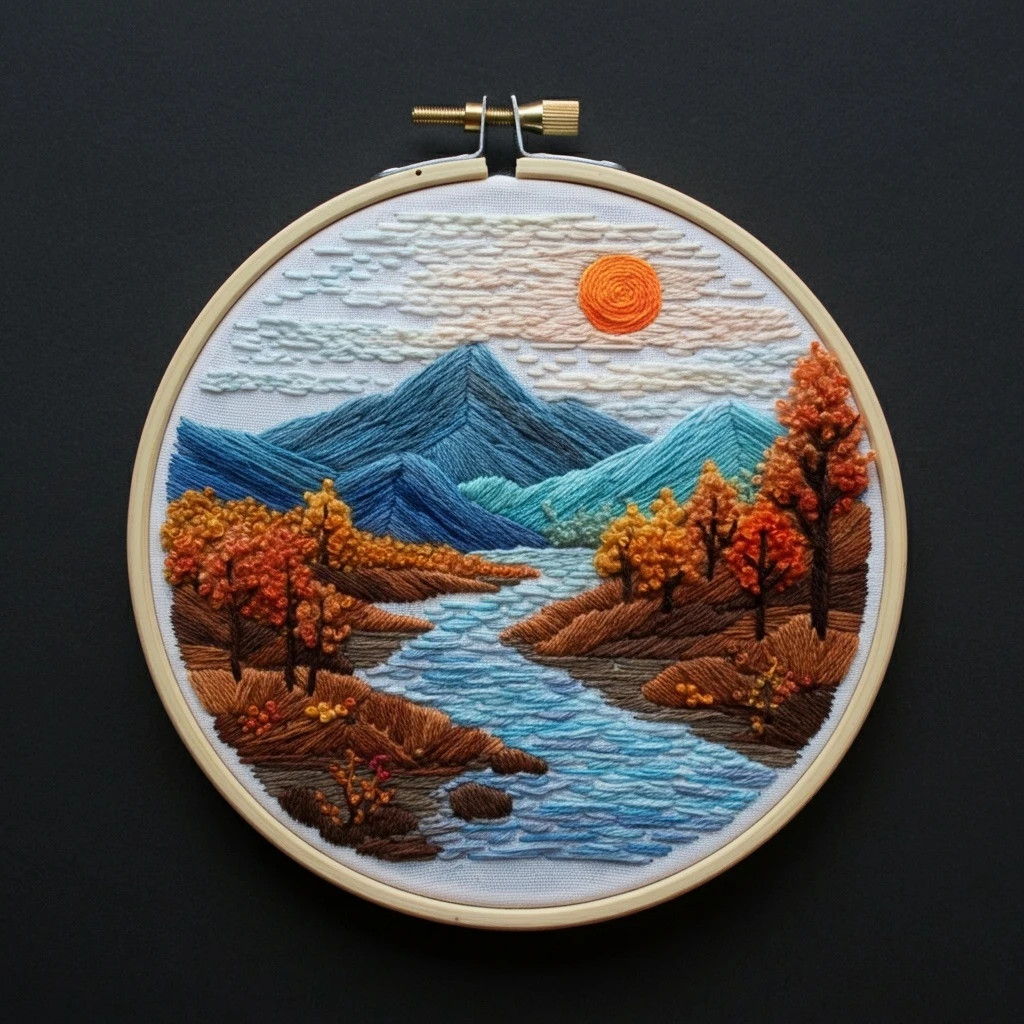
A painterly hoop scene with cool blue mountain planes, a winding turquoise river, warm brown banks, ochre and copper autumn trees, and a bright tangerine sun. This guide translates those design elements into a practical DMC floss palette with stitch direction, strand counts, blending suggestions, and beginner-friendly order of work.
Suggested DMC Color Palette
Use the blues and aquas for depth and distance, then let the rust, copper, gold, and walnut browns carry the autumn foreground. The palette is intentionally layered so the landscape feels dimensional without becoming hard to stitch.
Base highlights for cloud gaps, pale sky breaks, and tiny foam accents on the river.
Soft cloud shadows and the palest mist over distant mountain ridges.
Bright river glints, shallow water strokes, and cool haze near the horizon.
Main light river color and the sunlit side of distant teal slopes.
Mid-tone water ripples, middle mountain highlights, and softened transitions.
Deeper river bends and cool shadow planes in the nearer mountain faces.
Primary mountain stitching, especially diagonal fills that define slopes.
Mountain shadow sides, valley separations, and darker water edges.
Tiny deepest accents under mountain folds; use sparingly for contrast.
Bright sun center and the hottest orange leaves on the right-hand trees.
Golden foliage highlights and a warm glow around the sun if desired.
Ochre tree clusters, mid-ground grasses, and warm path-like bank textures.
Rust leaves, autumn shrubs, and warm hillside strokes in the foreground.
Deeper leaf shadows and the most saturated orange-red foliage knots.
Riverbank ridges, tree trunks, and the darker sides of sloped earth.
Tree branch silhouettes, rock shadows, and the bold foreground outline accents.
Stitch Types By Design Element
Angle every stroke down the slope so the mountains read as folded planes. Blend 931 into 930, then add a few 823 strokes only in the deepest creases.
Follow the river curve horizontally with broken lines. Alternate 747, 598, 597, and 3810 so the water looks rippled instead of flat.
Cluster gold, tangerine, copper, and red-copper knots irregularly. Keep the tops airy and the lower clusters denser for a natural canopy.
Use slanted straight stitches in 976, 975, 920, and 898. Change direction slightly between patches to create terraced earth and rocky texture.
Use 3865 and 762 in soft broken rows. Leave fabric gaps so the sky feels light and hand-drawn.
Work from the center outward in 740, or pad lightly first for a raised sunset focal point.
Blending & Shading Plan
Cool distance
Blend one strand 931 with one strand 597 for transitional blue-green ridges. For the most distant teal mountain, mix 598 + 597, then add a few 747 touches along the top edge.
Water movement
Use irregular ripple bands rather than solid fill. Place pale 747 highlights in the center of the river, 598 and 597 as the body color, and 3810/930 near the banks where the water appears deeper.
Autumn warmth
For leaf clusters, rotate 742, 976, 920, 919, and 740. Keep the brightest 740 knots on the sunlit tree crowns and reserve 919 for lower shadows.
Earth and trunks
Blend 975 + 920 for warm bank ridges, 975 + 898 for shaded ground, and a single strand of 898 for clean branch silhouettes. Avoid outlining every bank; let stitch direction create the edge.
Practical Stitching Sequence
- Transfer lightly. Mark only the main mountain ridges, river edges, sun circle, and tree trunks. Too many tiny foliage marks can make knot placement stiff.
- Stitch the sky and clouds first. Use loose horizontal rows in 3865 and 762. Keep them airy so the textured clouds do not overpower the landscape.
- Build the mountain layers. Start with the far teal ridge, then stitch the darker blue peaks. Keep the direction consistent on each slope for a carved, embroidered look.
- Add the river before the banks. Work pale center highlights first, then darker side ripples. This helps the banks sit naturally on top of the water edge.
- Fill foreground banks with slanted texture. Use short grouped stitches in browns and copper tones, changing direction to separate land masses.
- Add trees last. Stitch trunks and main branches, then build leaf knots around them. Finish with a few dark branch tips peeking through the foliage.
- Final polish. Add tiny 3865 water glints, dark 898 rock shadows, and a neat spiral sun in 740 for the focal point.
Outlining Details
Use 1 strand for most outlines so the design stays painterly. Backstitch the tree trunks in 898, split stitch the river edges in 3810, and use broken dark-blue lines only where mountain ridges need definition. Avoid a heavy continuous outline around the full landscape.
Texture Tips
Let texture vary by subject: smooth directional stitches for mountains, broken running stitches for water, knot clusters for leaves, and rough slanted straight stitches for soil. This contrast is what gives the hoop its hand-embroidered depth.
Beginner Tips
Use a smaller needle for 1-strand details, do not pull knots too tightly, and step back often to check color balance. If the foreground feels too dark, add small 742 or 976 stitches before adding more brown.