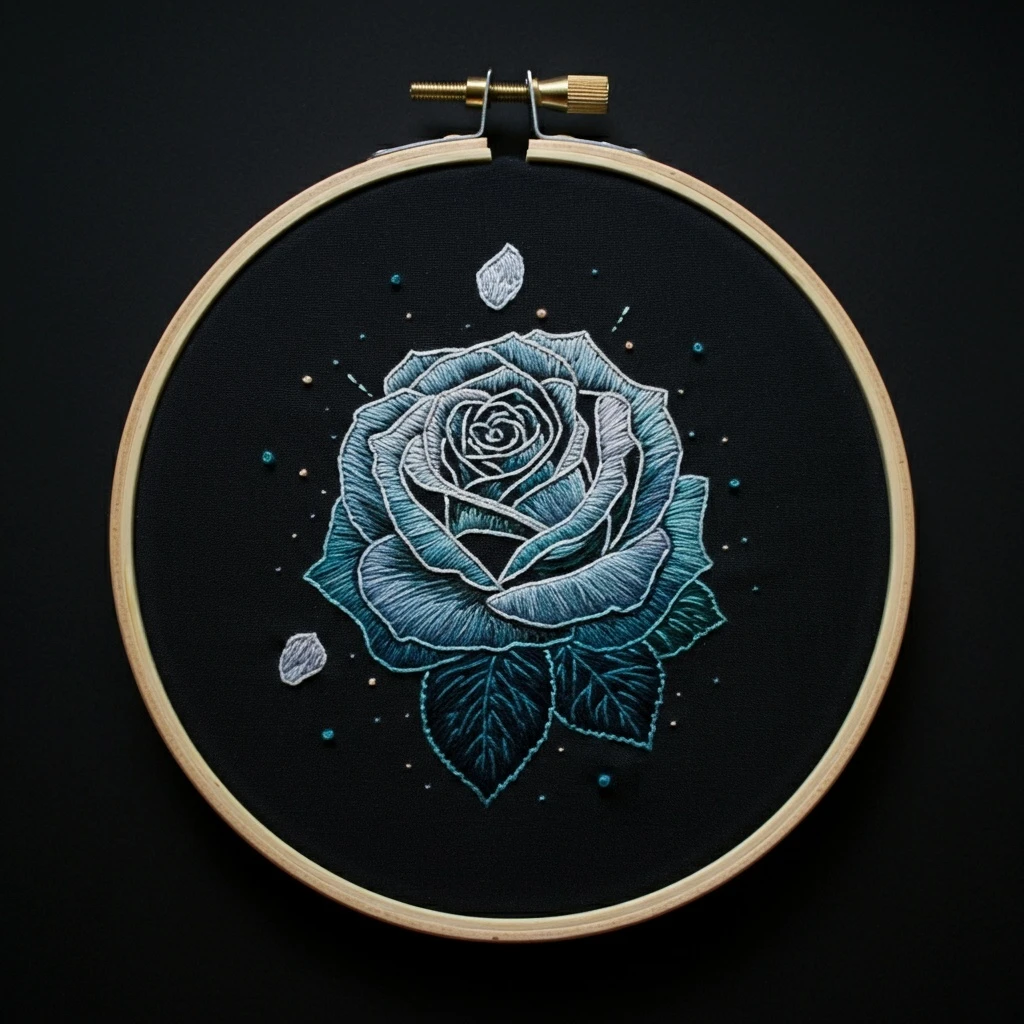

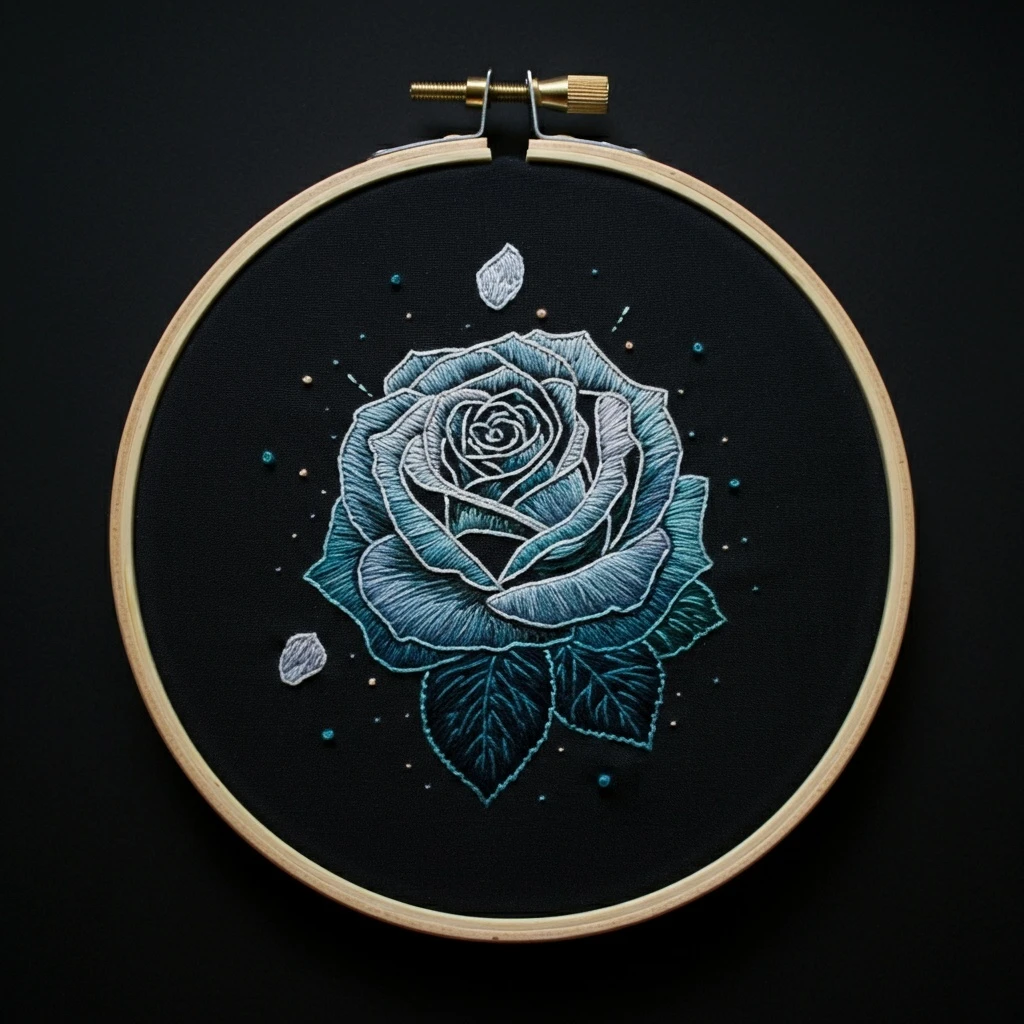
Embroidered Cyan Rose On Black
A dramatic cyan rose stitched on black fabric, with glowing turquoise petals, icy edge highlights, deep teal shadows, and optional cool green foliage. These DMC matches are estimated from the visible hoop preview and chosen to keep the rose bright, dimensional, and clean against a dark ground.
Likely DMC Color Palette
Matched to the black fabric, saturated cyan petals, deep teal folds, icy highlights, glow accents, and optional cool green leaves or stem.
Stitching Suggestions
Build the rose from the dark inner spiral outward, then add petal rims, leaf details, glow stitches, and final crisp highlights.
| Element | Stitch Type | Practical Notes |
|---|---|---|
| Rose center spiral | Long and short stitch | Start with 3765 and 3844 in the deepest inner folds, then blend 3845 and 3846 outward. Keep stitches short and curved around the spiral. |
| Inner folded petals | Split stitch and satin stitch | Outline each fold lightly with 3844, then fill with 3845 and 3766. Add 939 only in the smallest dark creases. |
| Outer petals | Long and short stitch | Use 3846 and 3766 as the main color, feathering 598 and 3811 onto the raised edges. Follow the petal curve rather than stitching straight across. |
| Petal rim highlights | Single-strand straight stitch | Use 3811, 747, or 3756 sparingly along selected rims. On black fabric, a few pale strokes create strong glow. |
| Deep petal shadows | Split stitch | Use 3765, 3844, and tiny touches of 939 beneath overlapping petals. Keep shadow lines narrow so the rose stays luminous. |
| Petal veins | Stem stitch or split stitch | Use one strand of 3845 or 598 to add subtle curved vein lines. Avoid outlining every vein; choose only those that support the petal direction. |
| Black negative spaces | Leave unstitched or reinforce with 310 | Let the black ground show between petals for drama. Use 310 only if a transferred line or fabric scuff needs covering. |
| Leaves, if present | Fishbone stitch | Use 500 at the base, 3815 through the center, and 3816 or 3364 toward the tips for cool green dimension. |
| Stem | Stem stitch | Work with 500 and 3815, then add a single 3816 highlight line on the light-facing side. |
| Dew or sparkle dots | French knots | Use 747, 3756, or 3865 in one-wrap knots. Keep them minimal so they feel like dew rather than polka dots. |
| Soft glow around rose | Seed stitch | Scatter 598 and 3811 very lightly near the bloom edge. Leave plenty of black fabric visible for the cyan glow effect. |
| Final outlines | Single-strand backstitch | Use 3765 or 3844 for selected separations only. Avoid heavy black outlines because the black fabric already provides contrast. |
Thread Count, Blending & Texture
Use strand changes to make the rose glow on black fabric while preserving soft petal layering and clean dark negative space.
Dark fabric control
Use shorter lengths of pale floss so they do not pick up dark lint. Keep the black ground visible between petal folds for natural depth.
Cyan blending
Blend 3844 and 3765 in the shadowed bases, 3845 and 3846 through the mid-petal, and 598 or 3811 along the light-facing rims.
Petal direction
Turn the hoop often and follow each petal’s curve. Directional stitches make the rose look folded instead of flat.
Highlight restraint
Use 747, 3756, or 3865 only on the closest petal tips. Too many pale stitches can flatten the glowing cyan effect.
Selective outlines
Use single-strand teal outlines only in confusing overlaps. The black fabric already supplies strong contrast, so heavy outlines are unnecessary.
Beginner control
Map the rose center carefully before filling. If the center spiral is clear, the outer petal layers are much easier to place confidently.
Recommended Stitching Order
This order keeps the rose structure readable and protects the bright final highlights from dulling.
Helpful Notes for a Polished Finish
A clean dark-fabric finish makes the cyan rose look luminous and elegant.
- Use firm hoop tension; satin and long-and-short stitches stand out strongly on black fabric and reveal puckering.
- Separate and recombine floss before stitching bright cyan areas for smoother coverage.
- Keep thread tails short and avoid carrying pale floss across open black fabric where it could show through.
- Use a lint roller or clean tape around the hoop before final photos; black fabric shows pale fibers easily.
- Do not fill every dark petal gap. Open black space gives the rose its dramatic depth.
- Press the finished hoop face-down on a towel to protect raised highlights and keep the black background smooth.