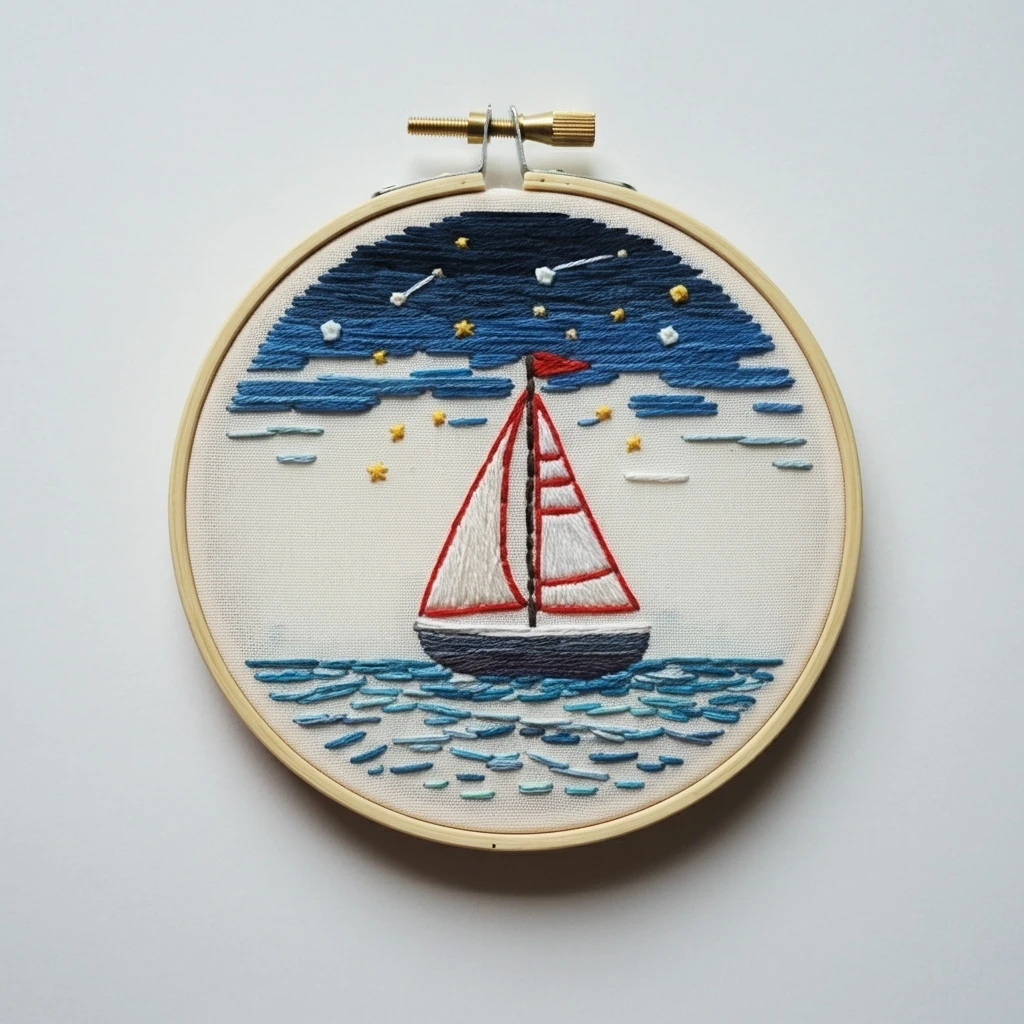

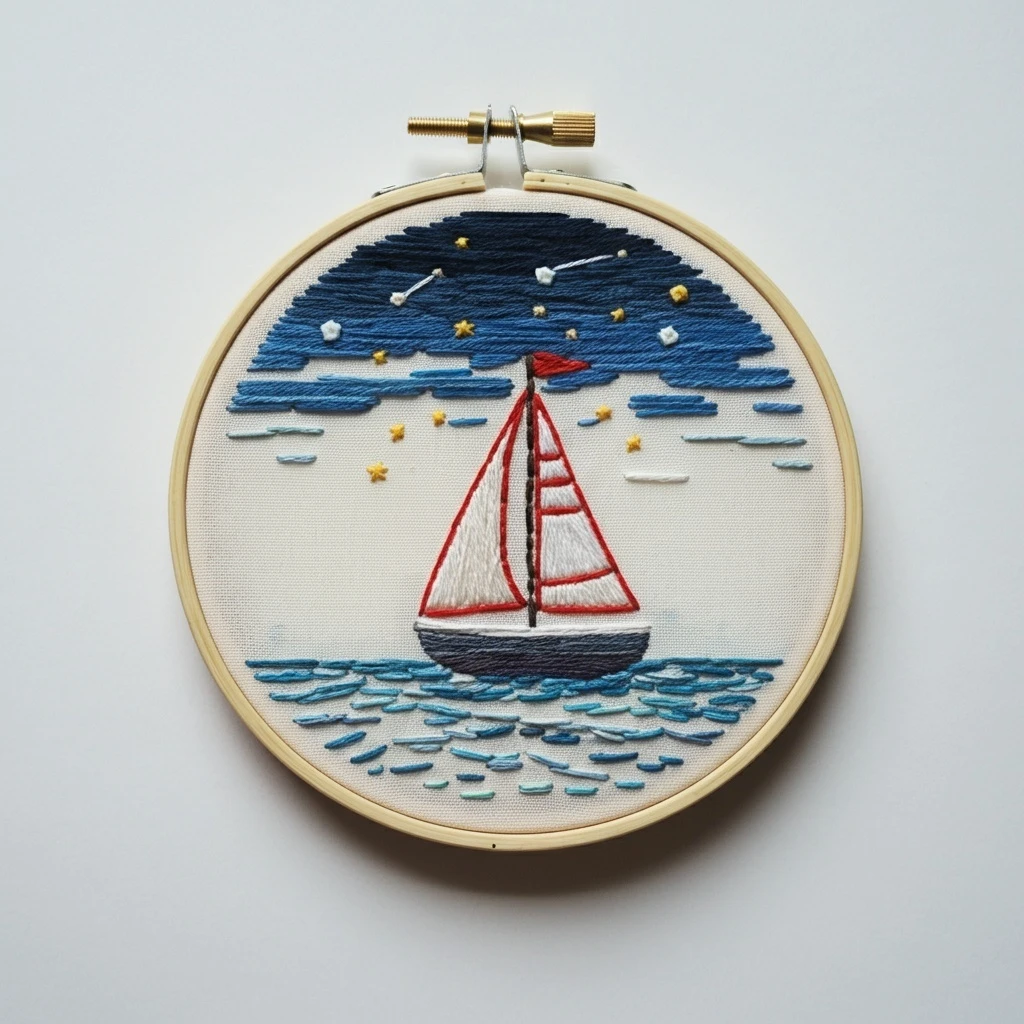
Design #751 · Moonlit nautical scene
Night Sail
Colors are estimated from the visible hoop preview and matched to close DMC embroidery floss shades. This guide focuses on a quiet nighttime sailboat scene with deep blue sky, moonlit water, pale sails, reflected highlights, and warm horizon accents.
Likely DMC Color Palette
Palette based on the night sky, blue water, shadowed boat, cream sails, pale moonlight, and warm reflection accents. Coverage percentages are visual estimates, not exact thread usage.
Stitching Suggestions
Use smooth linework for the boat and broken horizontal stitches for the water. Keep thread counts low in the reflections so the night scene stays airy and atmospheric.
| Element | Stitch Type | Practical Notes |
|---|---|---|
| Night sky | Long and short stitch, split stitch, scattered seed stitch | Use 1-2 strands of 939, 823, and 924. Work in curved or slightly arcing rows rather than rigid blocks to suggest a soft moonlit sky. |
| Moon and glow | Satin stitch, padded satin, tiny straight stitches | Fill the moon with 3865 or 3823. Add a few 1-strand 927 stitches around the edge to blur the glow into the surrounding blue. |
| Stars | Single straight stitch, cross sparkle, French knots | Use 1 strand of 3865 for pinpoints. For brighter stars, make one tiny cross stitch and add a single knot in the center. |
| Sails | Satin stitch, split stitch outline, long and short shading | Use 3865 for the lightest sail planes, then feather in 644 and 927 toward shadowed edges. Keep stitches directional from mast to outer sail edge. |
| Mast and rigging | Backstitch, couching, whipped backstitch | Use 1 strand of 939 or 938. For perfectly straight rigging, couch a laid thread with tiny securing stitches instead of trying to pull one long line tight. |
| Hull silhouette | Satin stitch, split stitch, stem stitch | Anchor the boat with 939 and 938. Add a narrow 422 line along the upper hull if the design shows a warm wooden edge. |
| Water body | Horizontal straight stitch, stem stitch rows, running stitch | Use broken rows of 823, 924, and 926. Vary stitch length so the water looks rippled rather than striped. |
| Moonlit reflection | Short straight stitches, fly stitch, detached chain accents | Place 3865, 3823, and 927 in staggered horizontal dashes below the moon and boat. Keep the brightest marks narrow and separated. |
| Horizon or distant glow | Split stitch, satin stitch, soft couching | Blend 3823 with 927 for a gentle line. Avoid heavy outlining; a broken, thinner horizon feels more distant. |
Thread Count & Blending Guide
Fine details
Use 1 strand for rigging, tiny stars, mast lines, and the thinnest moonlit wave marks. This prevents the boat from looking oversized.
Main shapes
Use 2 strands for sails, hull fill, broad water bands, and the strongest sky outlines. Split stitch first when you need a clean filled edge.
Soft blending
Blend one strand of 926 with one strand of 927 for cool moonlit water, or one strand of 3865 with one strand of 3823 for warm reflected light.
Outlining, Shading & Texture
A night-sailing design works best when contrast is controlled: crisp where the boat meets the sky, soft where light dissolves into water.
Beginner-Friendly Practical Tips
Use a sharp needle
A size 7-9 embroidery needle helps with smooth satin sails and precise rigging. Switch to a finer needle for 1-strand stars.
Shorten metallic alternatives
If adding optional metallic sparkle, use very short lengths and couch them instead of pulling them repeatedly through the fabric.
Mind the tension
Loose tension in water dashes can snag; overly tight tension can pucker the horizon. Aim for stitches that rest flat on the fabric.
Trace lightly
For pale sails and moon areas, use a removable fine-line transfer method so guide marks do not show through light thread.
Separate darks
After stitching 939 or 938, wipe your hands and needle before working cream highlights to avoid lint transfer on pale floss.
Check from a distance
Step back often. Night scenes need clear value grouping, and distant viewing helps you decide where one more highlight is enough.
Finishing Note
For a polished hoop finish, press the work face down on a towel, then lace the backing evenly so the horizon remains level. A dark navy, smoke-blue, or natural linen ground will make the cream sails and moonlit water stand out beautifully.