
DMC palette and practical stitch guide
Embroidered Sea Turtle And Coral Reef
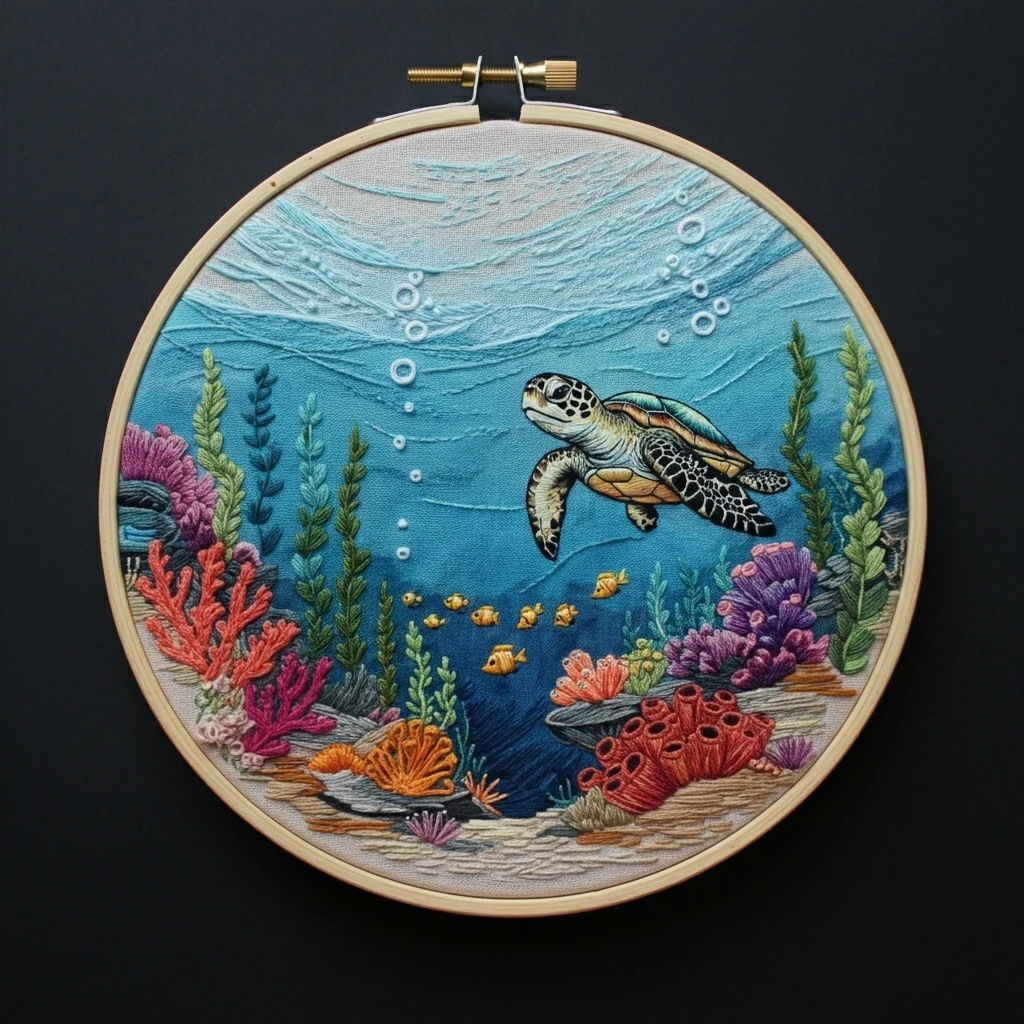
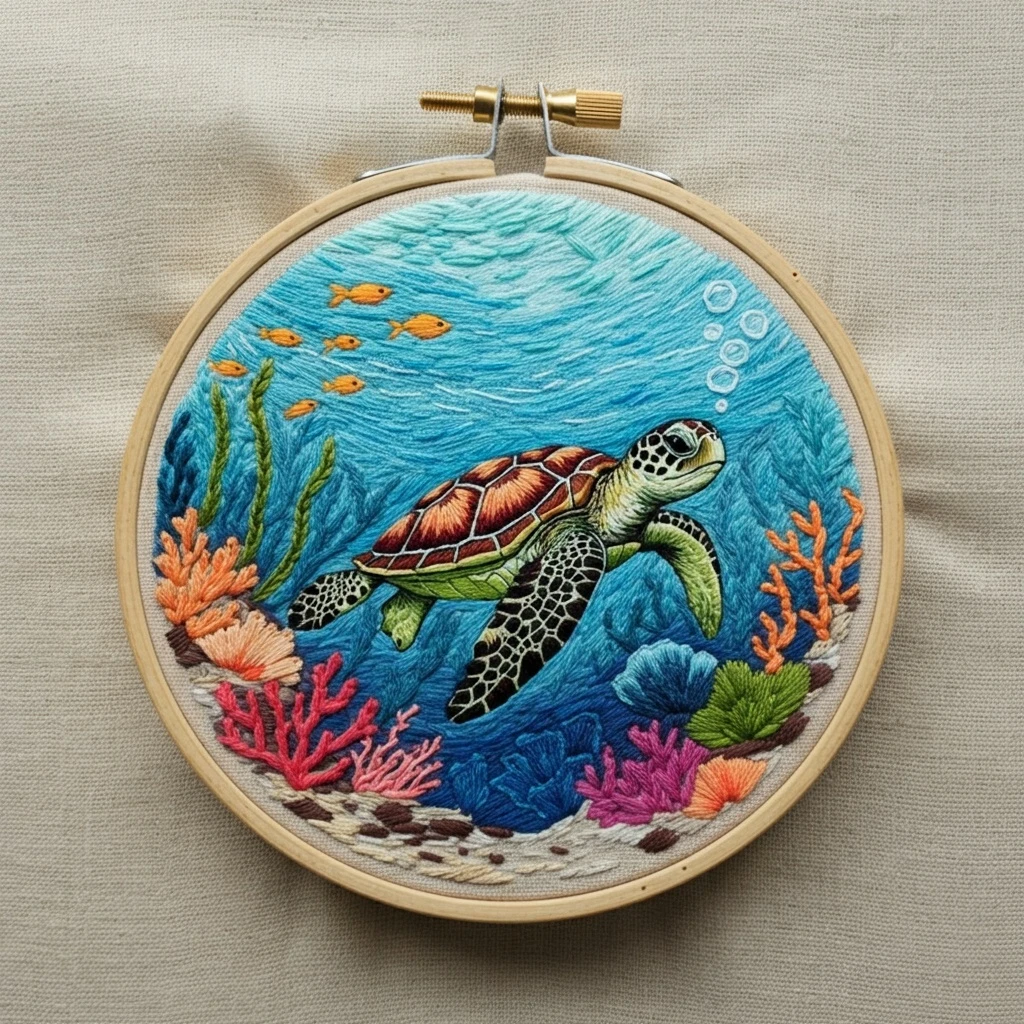
A polished thread plan for a hoop filled with turquoise water movement, a warm brown-and-olive sea turtle, tiny golden fish, bright branching coral, soft sand, sea grasses, bubbles, and deep reef shadows.
Reference image reviewed for the blue water gradient, patterned turtle shell, olive flippers, orange fish, bubbles, sand, and coral reef accents.
Color reading from the design
The piece works because the water is stitched in many directional blue strokes while the turtle is outlined crisply against it. Keep the background airy and blended; save the strongest contrast for the shell plates, black turtle markings, coral branches, and the lower reef edge.
Main mood
Fresh lagoon turquoise at the top, deep teal-blue at the lower reef, and warm peach-coral details around the bottom rim.
Focal contrast
The turtle shell uses red-brown panels with pale golden ridges, while the head and flippers rely on black spots over cream and olive greens.
Texture emphasis
Use thread direction to show current lines, shell plates, fish silhouettes, upright seaweed, round bubbles, and branching coral.
Suggested DMC floss palette
Use these as practical matches rather than rigid rules. Where the design needs depth, blend one strand from two neighboring colors in the needle.
Stitch map by design area
Water background
Work first with 1-2 strands in long-and-short stitch. Follow the sweeping diagonal current seen in the image rather than filling in straight rows. Leave occasional tiny gaps of fabric for a light, handworked texture.
Turtle shell
Outline each shell plate in split stitch with 3777 or 898, then fill with satin or long-and-short using 3777, 921, and 922. Add a final single-strand golden highlight along plate centers.
Head and flippers
Use 1 strand for the black spot pattern so it stays crisp. Fill green areas with short directional stitches in 580, 581, and 3347. Keep the stitches following the curve of each flipper.
Coral branches
Build coral with stem stitch, whipped backstitch, or raised chain. Use 2 strands for the main arms and one strand for tiny twig ends. Add French knots at tips for living reef texture.
Seaweed and grasses
Use stem stitch for upright strands, then add lazy daisy leaves or small straight stitches on one side. Blend 580 and 581 for the shaded base, then touch tips with 3347.
Fish and bubbles
Fish are best in tiny satin stitches with one dark straight stitch for the eye. Bubbles can be split stitch circles in 3865 with a small 747 shadow on one side.
Thread-count guidance
Use 1 strand for detail
- Turtle eye, mouth, facial spots, and black pattern markings.
- Shell plate dividers and the finest water highlight lines.
- Bubble outlines when you want them delicate rather than chunky.
Use 2 strands for most fills
- Water long-and-short, turtle shell color fills, fish bodies, and medium coral.
- Stem stitch seaweed and reef plants where you want visible texture.
- General outlining around the turtle silhouette, but keep pressure light.
Use 3 strands sparingly
- Raised coral at the bottom edge, sandy pebble clusters, and dense reef tufts.
- Short accents only; too many heavy strands can flatten the water movement.
Best order of work
- Background water, distant plants, turtle body, turtle shell, coral foreground, bubbles, final outlines.
- Stitch from back to front so the coral and turtle feel layered over the sea.
Shading, outlining, and texture notes
- Water direction: vary stitch length between 6-18 mm so the sea looks brushed rather than striped.
- Deep reef edge: place 3844 and 898 near the bottom to make the bright coral pop forward.
- Shell glow: keep 922 and 742 near the centers of shell plates, not on every edge.
- Clean outline: use split stitch around the turtle silhouette before filling adjacent background gaps.
- Spot control: make black turtle markings with tiny seed stitches or irregular satin dashes, not perfect dots.
- Coral dimension: whip a stem-stitch base with a lighter shade for raised, rope-like coral arms.
- Sand texture: scatter small seed stitches in 822, 3864, 898, and 3031; avoid filling the sand as a solid block.
- Bubble sparkle: leave the center open and add one small white straight stitch at the upper left of each bubble.
- Color balance: repeat a tiny touch of orange from the fish in the lower coral so the composition feels connected.
- Beginner fix: if a water area looks patchy, add a few thin 3811 highlight strokes on top rather than unstitching.
Beginner-friendly practical tips
Transfer lightly
Mark only the turtle outline, main coral branches, fish, and bubble circles. For the water, draw a few loose current arrows instead of every stitch.
Keep the hoop taut
The dense blue background can pucker fabric. Tighten the hoop often and use shorter thread lengths, about 35-45 cm, to reduce fuzz.
Finish with inspection
After all filling is done, add one-strand outlines and highlights last. This sharpens the turtle and restores detail lost under neighboring stitches.