
Design #760 · Winter Landscape
Embroidered Winter Village Scene
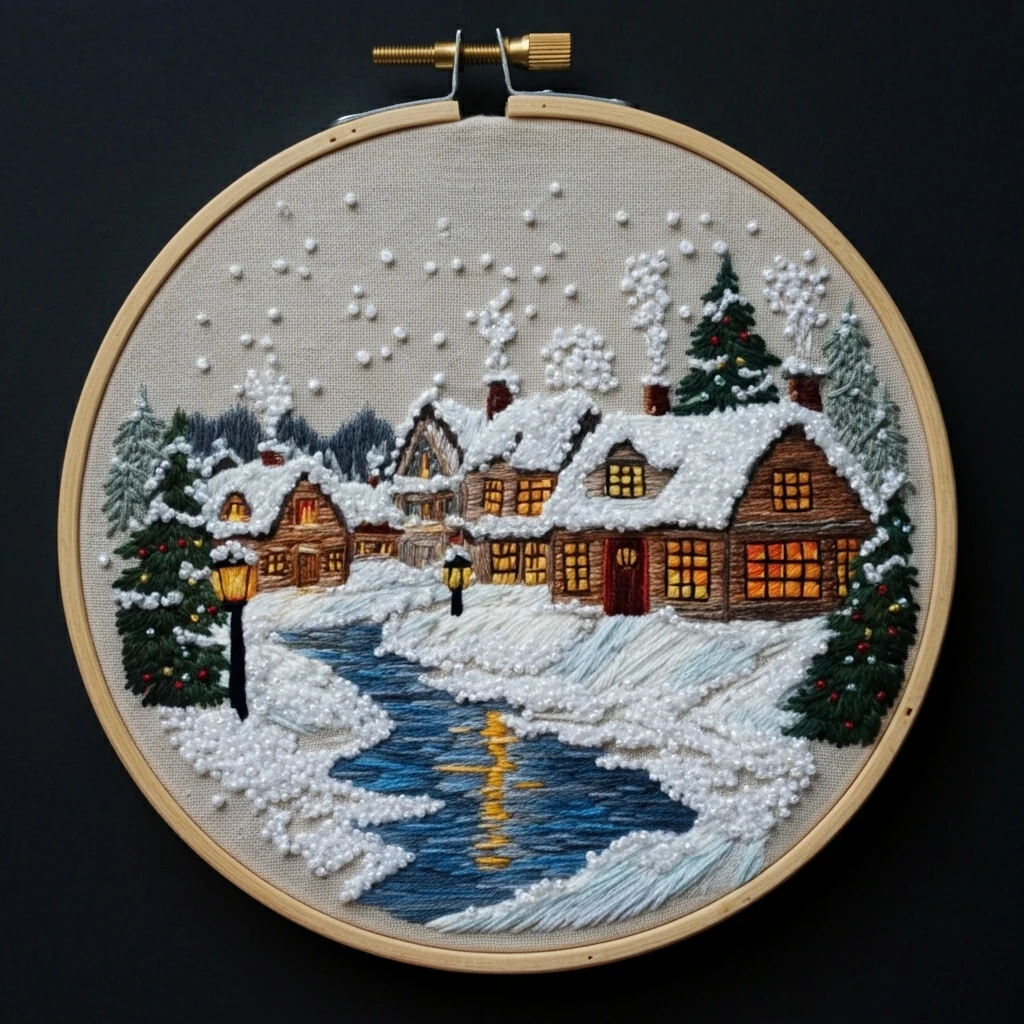
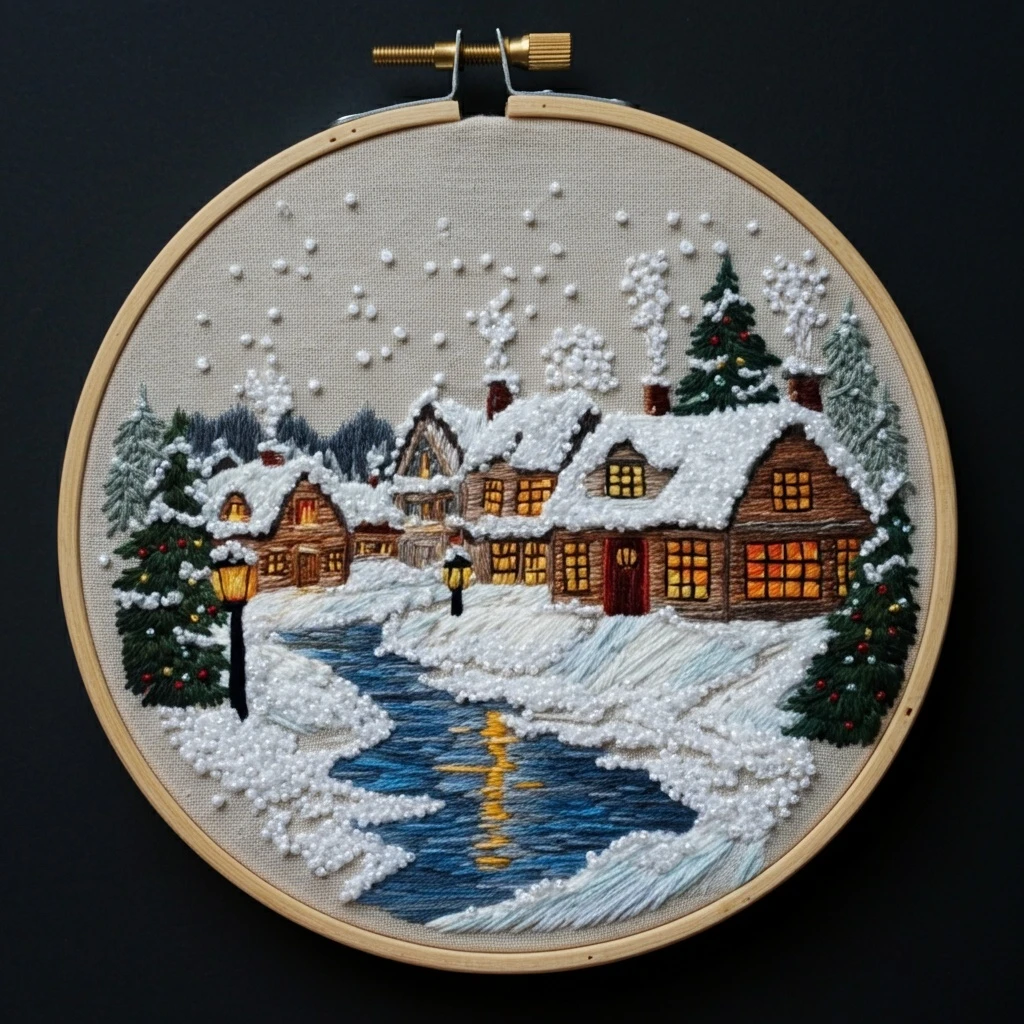
A cozy snow-covered village with glowing windows, evergreen trees, a lamplit path, and an icy blue stream. The palette leans on soft winter whites, warm cabin browns, deep pine greens, cool blue shadows, and small golden-red accents to make the scene feel crisp, dimensional, and welcoming.
Likely DMC Color Palette
Colors are matched to the visible snow, cabins, roofs, trees, stream, windows, lamps, and tiny holiday details. Coverage percentages are visual estimates, not exact thread-yardage calculations.
Main snow blankets on roofs, banks, falling snow, and raised snowy highlights. Use as the brightest final layer.
23% · snow highlightsCool snow shadows, distant icy slopes, and soft blue-gray shading where white needs shape without looking dirty.
12% · cool snow shadePale reflections on snowbanks and the lighter strokes along the frozen stream edges.
7% · icy highlightsMedium stream water, ripples, and shaded blue strokes beneath the snowy banks.
8% · stream bodyDeep water shadows, narrow bank outlines, and distant dark tree silhouettes behind the village.
6% · deep blue shadowEvergreen masses, lowest branch shadows, and the darkest needles on the large side trees.
9% · pine treesMuted fir needles, background trees, and soft branches that recede into the snowy village scene.
5% · muted foliageCabin walls, roof undersides, window frames, wood texture, and the strongest architectural outlines.
10% · cabin woodWarm log highlights, lighter siding, door trim, and midtone roof texture before darker outlines go on.
6% · warm timberGlowing windows, lamp centers, and reflected golden streaks on the stream.
4% · window glowWarmest window panes and tiny firelit accents that make the houses feel occupied and cozy.
3% · warm light accentFront door, chimney accents, ornaments, berries, and small red notes on the evergreens.
3% · red village accentsLamp posts, deepest window divisions, chimney shadows, and selective outlines where definition is needed.
3% · crisp outlinesHoop-like warmth in wood highlights, pale cabin trim, and softened snow-to-wall transitions.
1% · soft warm highlightStitching Suggestions
Work from the background forward: distant trees and roof masses first, then houses, stream, snow texture, and final raised accents. This keeps the village readable and prevents bright snow knots from being flattened while you stitch nearby areas.
| Element | Recommended Stitch | Practical Notes |
|---|---|---|
| Snowy rooftops | Long and short stitch, then French knots | Fill the roof shape with 3865 and a touch of 927. Add small knots along roof ridges and eaves after cabin outlines are complete. |
| Snowbanks and foreground drifts | Split stitch contours plus seed stitch | Follow the curve of each bank with 1–2 strands. Scatter seed stitches and knots unevenly so the snow looks natural rather than gridded. |
| Cabin walls | Horizontal satin stitch or brick-like straight stitches | Use 975 for warm wall fill, 801 for darker log lines, and 3371 only at corners or deep gaps so the houses do not become too heavy. |
| Window glow | Satin stitch with backstitch muntins | Lay 725 first, blend a few 741 stitches near the lower panes, then add thin 3371 or 801 window divisions with 1 strand. |
| Front door and chimneys | Satin stitch with split-stitch edge | Use 815 for red architectural accents and sharpen one side with 3371 for a shadowed winter-evening look. |
| Evergreen trees | Layered straight stitch, fly stitch, or fern stitch | Build branches from trunk outward. Put 3362 in the deepest branch layers, then touch the tips with 3051 and small white snow caps. |
| Distant tree line | Loose vertical straight stitches | Use 924 and 3768 with 1 strand, varying stitch height. Keep it sketchier than the foreground trees so the village stays in focus. |
| Icy stream | Horizontal long and short stitch | Blend 924 in the deepest center, 3768 in mid-water, and 3753 near edges. Keep stitches flowing with the bend of the stream. |
| Water reflections | Short straight stitches | Add broken dashes of 725 and a few 741 touches vertically under lit windows. Leave gaps so the reflection sparkles rather than becomes a stripe. |
| Lampposts | Backstitch stem with satin glow | Use 3371 for the post and 725 for the lamp center. A tiny halo in 738 or 3865 can soften the light against snow. |
| Falling snow | French knots and colonial knots | Use 1 strand for small flakes and 2 strands for closer flakes. Vary knot size; avoid placing them in perfectly even rows. |
| Tree ornaments and berries | Single-wrap French knots | Use tiny 815 red knots with occasional 725 gold knots. Keep accents sparse so they remain charming rather than crowded. |
Thread Count, Blending & Texture Plan
Snow that feels raised
Use 2 strands for roof and ground fills, then add final French knots with 2 strands only where snow should sit forward: eaves, banks, tree tips, and foreground clumps.
Soft winter shading
Blend 3865 with 927 by alternating short stitches rather than twisting them together. This keeps the snow bright while still giving the drifts shape.
Readable tiny houses
Use 1 strand for window frames, log lines, and roof edges. Small village details look cleaner when the outlines are thin and selectively placed.
Water depth
Work the stream in horizontal bands: darkest 924 in the middle, 3768 along the curves, 3753 near snow edges, and gold reflection dashes as the last smooth layer.
Tree dimension
Start evergreen branches with dark green, layer lighter muted green on top, then add snow with short white stitches only on the upper edges of branches.
Warm glow contrast
Keep yellows and oranges concentrated in windows and lamp areas. Their small size is what makes them glow against the cool snow and blue water.
Beginner-Friendly Working Order
- 1. Transfer lightly. Mark cabin outlines, stream edges, tree silhouettes, and main snowbank curves. Do not overdraw every snowflake.
- 2. Stitch the background. Add distant trees and pale snow shadows before the cabins so background stitches sit behind the village.
- 3. Build cabins before snow texture. Finish walls, windows, doors, and roof outlines, then add fluffy white roof snow over their edges.
- 4. Keep strands controlled. Use 2 strands for most fills, 1 strand for outlines and distant details, and 2–3 strands only for raised knot clusters.
- 5. Save knots for last. Falling snow, roof-edge snowballs, foreground clumps, berries, and ornaments should be final so they stay dimensional.
- 6. Step back often. A winter landscape depends on contrast. Check that the warm windows, dark trees, blue stream, and white snow each remain distinct.
Outlining & Shading Guidance
Use outlines sparingly. The reference design has strong dark accents in the cabins, lampposts, and water, but the snow should remain soft. A thin split stitch in 801 works well for rooflines and cabin edges; reserve 3371 for the lamppost, darkest window divisions, and a few deep tree or chimney shadows. For shading, let stitch direction describe form: roof snow slopes downward, stream stitches flow horizontally, evergreen branches angle outward, and snowbank stitches follow the curve of the bank.
Encouraging Finish
This hoop will look best when the texture is layered: smooth cabin walls, crisp window grids, directional blue water, feathery pine branches, and raised snowy knots. Keep the palette cool overall, then let the tiny gold windows and red accents do the storytelling. The finished piece should feel like a quiet village glowing warmly under fresh winter snow.