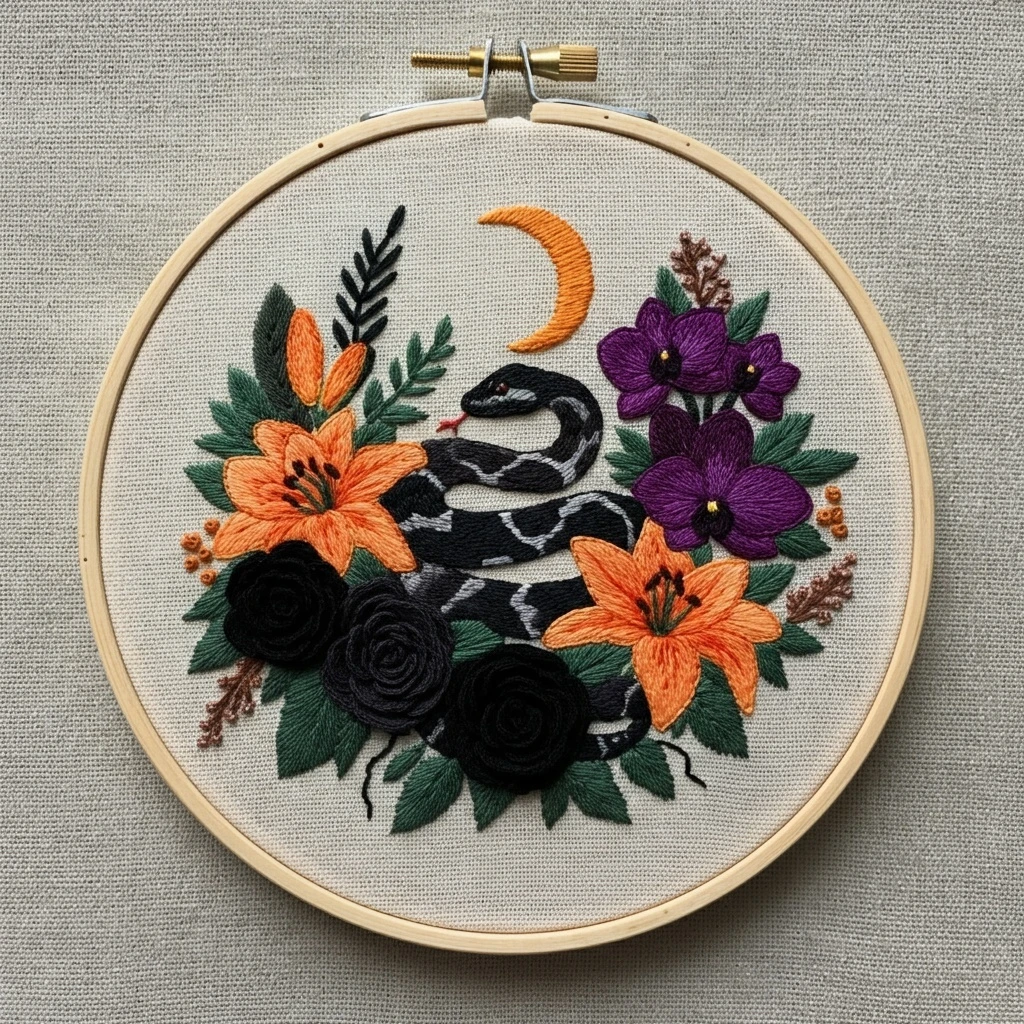

Mystical Serpent and Floral Crescent
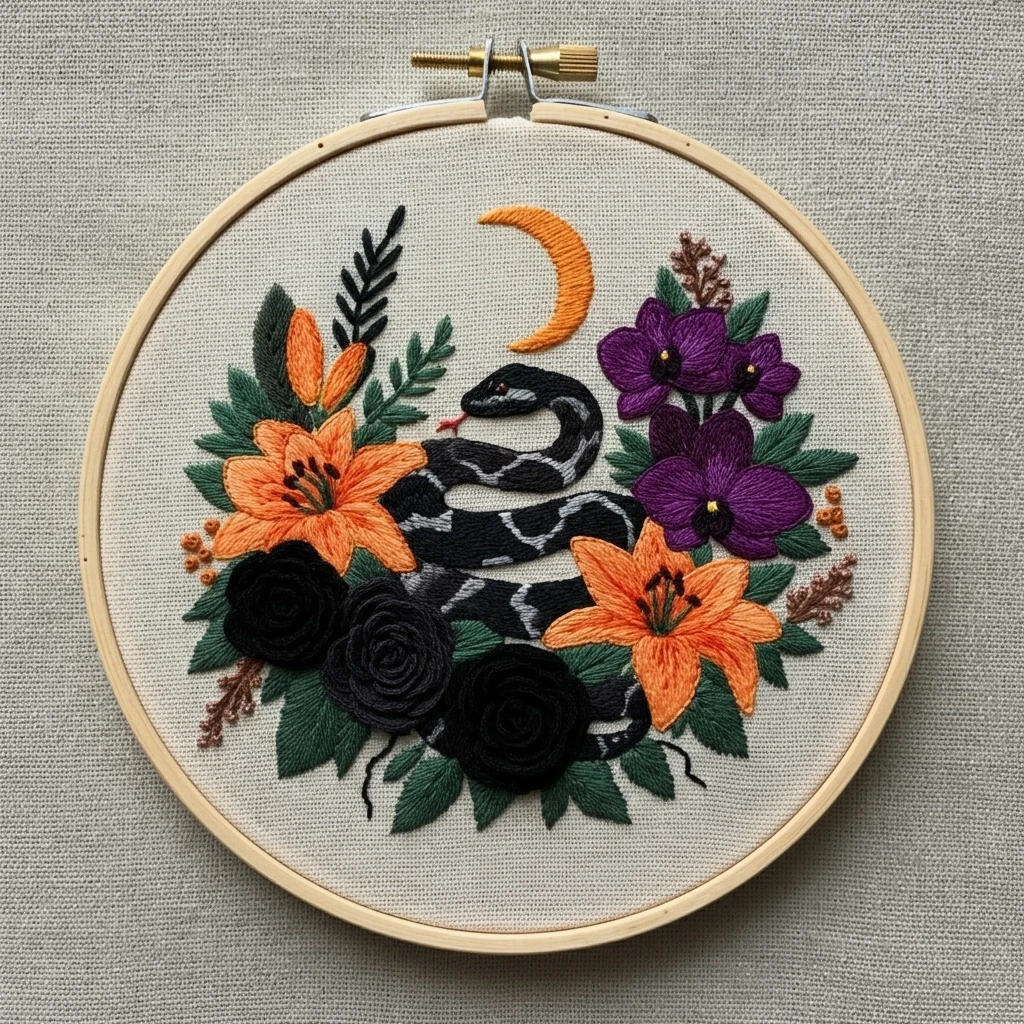
A dramatic botanical moon design with a black-and-charcoal serpent weaving through orange lilies, deep violet blossoms, dense emerald leaves, black roses, warm berry sprigs, and a glowing crescent moon. The palette below keeps the embroidery rich and enchanted while remaining practical for hand stitching on natural linen or light neutral fabric.
Core DMC Palette
Use these colors as a working palette for the serpent, flowers, foliage, moon, and small accent details. Where possible, blend adjacent tones in the needle for softer transitions.
Stitching Suggestions by Design Element
- Serpent body: Use split stitch or stem stitch for the outer contour in DMC 310, then fill wider body sections with short-and-long stitch in 310. Add broken highlights with 3799 and 414, following the snake’s curves rather than stitching straight across.
- Snake markings: Work the pale gray bands with 1 strand of DMC 414 or a blended needle of 414 + 3799. Keep the marks irregular and slightly curved so they read as natural scale patterning.
- Orange lilies: Fill each petal with long-and-short stitch from base to tip. Start shadows with 721 near the center, graduate into 741, then flick 742 along the petal tips and upper ridges. Use 938 for stamens and tiny knots.
- Purple blossoms: Use directional satin stitch or long-and-short stitch. Place 550 at the inner petal base, 552 through the center, and 553 as single-strand highlight veins. Finish flower centers with a black French knot and one tiny 743 knot.
- Black roses: Build spirals with padded satin stitch, whipped backstitch, or layered stem stitch in DMC 310. Add subtle outer petal edges in 3799 so the roses stay readable against the serpent.
- Foliage and ferns: Use fishbone stitch for broad leaves, fly stitch for fern sprays, and straight stitch clusters for small fronds. Blend 500 + 501 for deep leaves and 501 + 502 for brighter tips.
- Crescent moon: Use smooth satin stitch in DMC 741, switching to 742 on the outer bright edge and 721 along the lower inner curve. For a luminous effect, lay the stitches all in one direction around the crescent arc.
- Berries and twig sprigs: Use French knots or colonial knots in 976 with a tiny 743 top stitch for shine. Twig stems work well in backstitch or whipped backstitch with 938.
Blending Ideas
For soft transitions, thread the needle with one strand of each adjacent color: 721 + 741 for petal shadows, 741 + 742 for bright orange ridges, 550 + 552 for violet depth, and 500 + 501 for dark foliage.
Outlining Details
Outline the serpent and major petals with 1 strand first, then fill. After filling, add a final fine stem-stitch pass only where the shape needs sharpening. Avoid outlining every leaf; selective outlines look more natural.
Texture Guidance
Contrast smooth satin areas with textured knots and raised rose spirals. The moon and snake should look sleek, while roses, berries, and fern sprays can be more dimensional.
Practical Embroidery Tips
- Use a sharp embroidery needle for dense satin stitching and switch to a slightly smaller needle for 1-strand facial details, eye, and tongue.
- Keep satin stitches shorter than 1/2 inch where possible. For longer areas, use long-and-short stitch instead to prevent snagging.
- Rotate the hoop as you stitch the serpent so each stitch follows the body curve comfortably.
- When working black floss, use shorter thread lengths, about 12–14 inches, to reduce fuzz and dullness.
- Press the finished embroidery face down on a folded towel so raised knots, roses, and satin petals keep their shape.