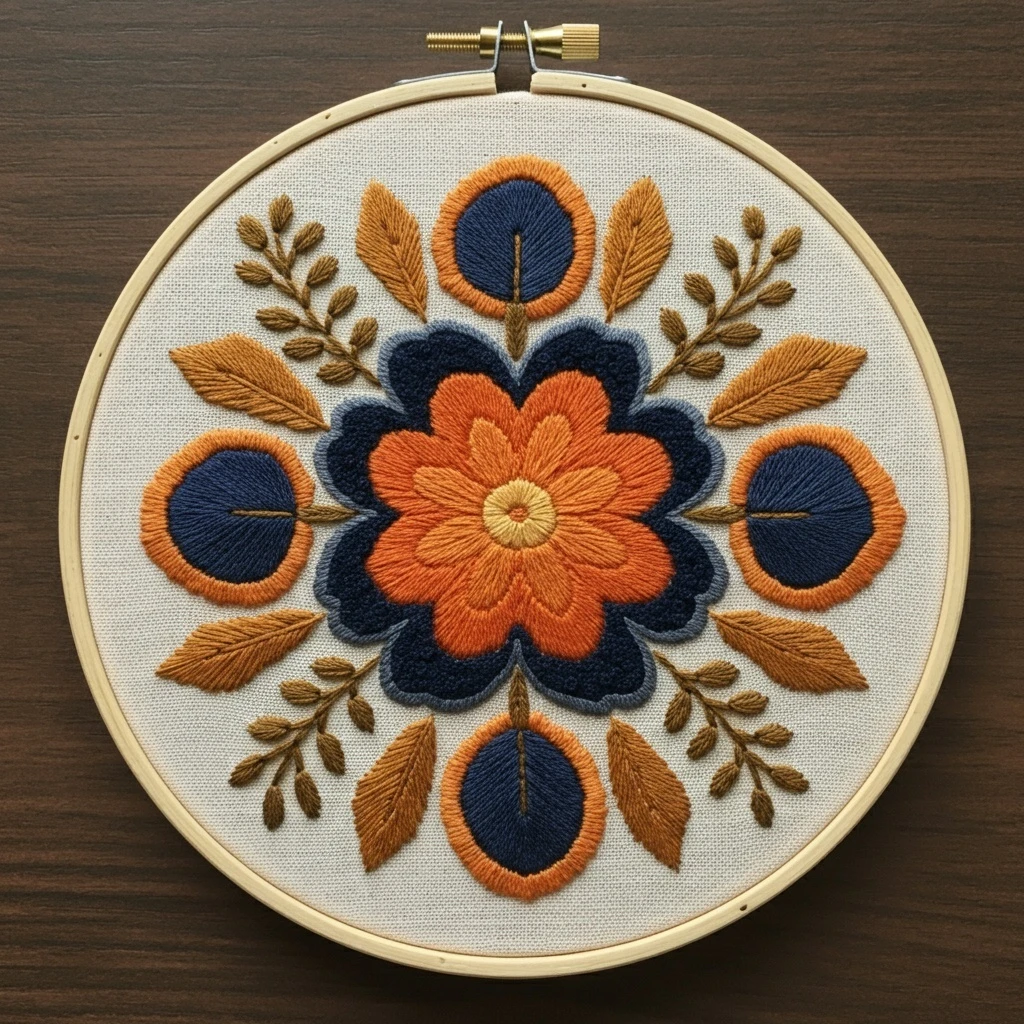

Simple Folk Inspired Floral
A warm, symmetrical folk floral built around a bold orange center bloom, deep navy circular motifs, ochre leaves and stems, and a natural linen ground. Keep the color story simple and saturated: crisp navy outlines, glowing pumpkin petals, golden wheat foliage, and a small butter-yellow center for charm.
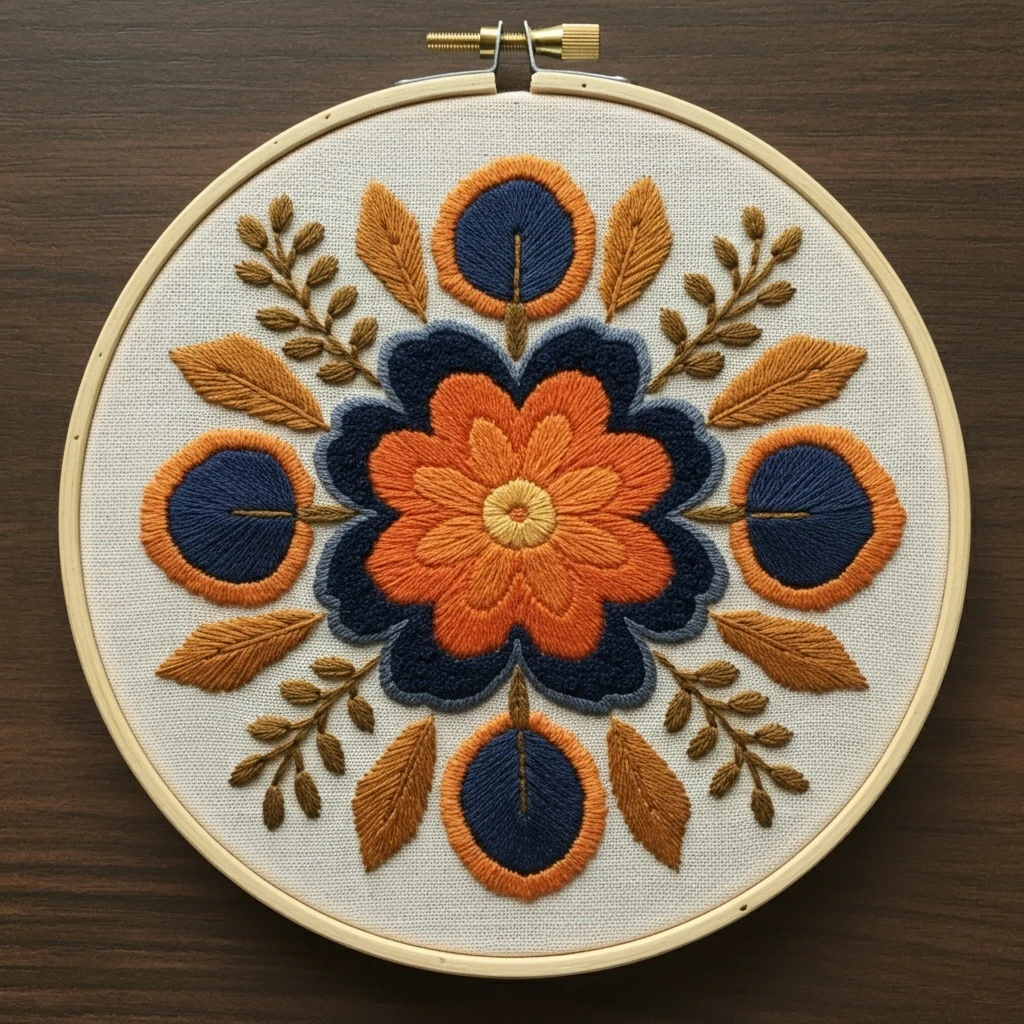
Design color read
The reference design uses a classic folk-art balance: a large central flower with orange petals, a deep navy scalloped outer layer, and a pale yellow circular center. Around it, four navy round buds are framed by raised orange rings. The surrounding leaves and small sprigs are stitched in golden ochre and warm brown, all sitting on an unstitched oatmeal linen background.
The strongest visual contrast is orange against navy. Treat navy as the grounding color, orange as the main decorative color, and ochre as the supporting botanical texture.
Polished DMC floss palette
These DMC selections match the visible stitched tones: burnished orange, dark indigo-navy, warm ochre foliage, butter-yellow highlights, and neutral linen shadows. Use fewer colors than a realistic floral; the charm comes from flat, confident folk shapes with small shaded accents.
Thread-count guidance
- Central flower fill: 2 strands for broad satin or long-and-short petals; 1 strand for inner petal veins.
- Navy motifs: 2 strands for full coverage, especially on linen; use 1 strand for fine outlines.
- Leaves and sprigs: 2 strands for large leaves, 1 strand for small oval buds and stem veins.
- Flower center: 2 strands for woven wheel or satin fill; 1 strand for the tiny copper dot.
Best stitch choices
- Satin stitch: cleanest choice for round navy buds, large orange petals, and small leaf shapes.
- Long-and-short stitch: useful in the central flower to add gentle petal direction without realism.
- Stem stitch: smooth lines for stems, leaf midribs, and the horizontal lines crossing the blue circles.
- Fishbone stitch: ideal for the larger ochre leaves because it forms a natural center vein.
Blending ideas
- Blend 970 + 947 in alternating rows for dimensional orange petals.
- Blend 823 + 336 in large navy shapes to avoid a flat dark patch.
- Use 782 + 783 together on leaves for golden variation.
- Add 3820 + 744 only at the flower center so the eye lands there first.
Suggested stitching order
Area-by-area notes
| Area | Recommended colors | Technique notes |
|---|---|---|
| Central orange flower | 970, 947, 741, 920 | Work petal stitches from the outer curve toward the center. Keep the stitch direction consistent within each petal for a tidy folk-art finish. |
| Navy scalloped backing | 823, 336, 924 | Use 823 at the deepest edges and 336 toward the center. A few 924 stitches along the outside create the blue-gray halo seen in the reference. |
| Round blue buds | 823, 336, 970, 947 | Fill the inner circle first, then pad or satin the orange ring so it sits slightly raised around the navy center. |
| Large leaves | 782, 783, 975, 869 | Fishbone stitch gives an instant central vein. Add one darker straight stitch along the vein only if the leaf needs definition. |
| Small sprigs | 975, 782, 869 | Stem stitch the branch, then use detached chain or tiny satin ovals for leaves. Keep each leaf plump and evenly spaced. |
| Flower center | 3820, 744, 920 | Try a small woven wheel, padded satin circle, or tight spiral stem stitch. Place a copper dot at the center for the folk-floral focal point. |
Beginner-friendly practical tips
Start from the middle
Because the design is symmetrical, stitch the center flower first and check placement before moving to the four surrounding blue circles.
Use short satin stitches on curves
For round buds and scalloped petals, shorter satin stitches sit smoother and are less likely to snag than long stitches stretched across the whole shape.
Pad the orange rings lightly
A single base layer of split stitch under the rings gives the raised, cozy look visible in the sample without making the circles bulky.
Keep the linen visible
Do not fill the background. The unstitched fabric is part of the folk style and makes the navy, orange, and ochre palette feel fresh.
Texture and finishing suggestions
For the plush, hand-stitched texture seen in the reference, let the flower and bud rings sit slightly raised while keeping stems and veins fine. A small amount of padding under the orange rings and center circle creates dimension; the surrounding leaves can stay flatter and more graphic. Use a laying tool or spare needle to keep satin stitches parallel, especially in the navy circles where uneven thread direction is more visible.
When finished, press from the back over a thick towel so the raised areas do not flatten. If the design will stay in a hoop, trim the fabric evenly, lace the back neatly, and leave the natural linen face clean and unembellished.