
DMC palette & hand embroidery notes
Winter Forest Path
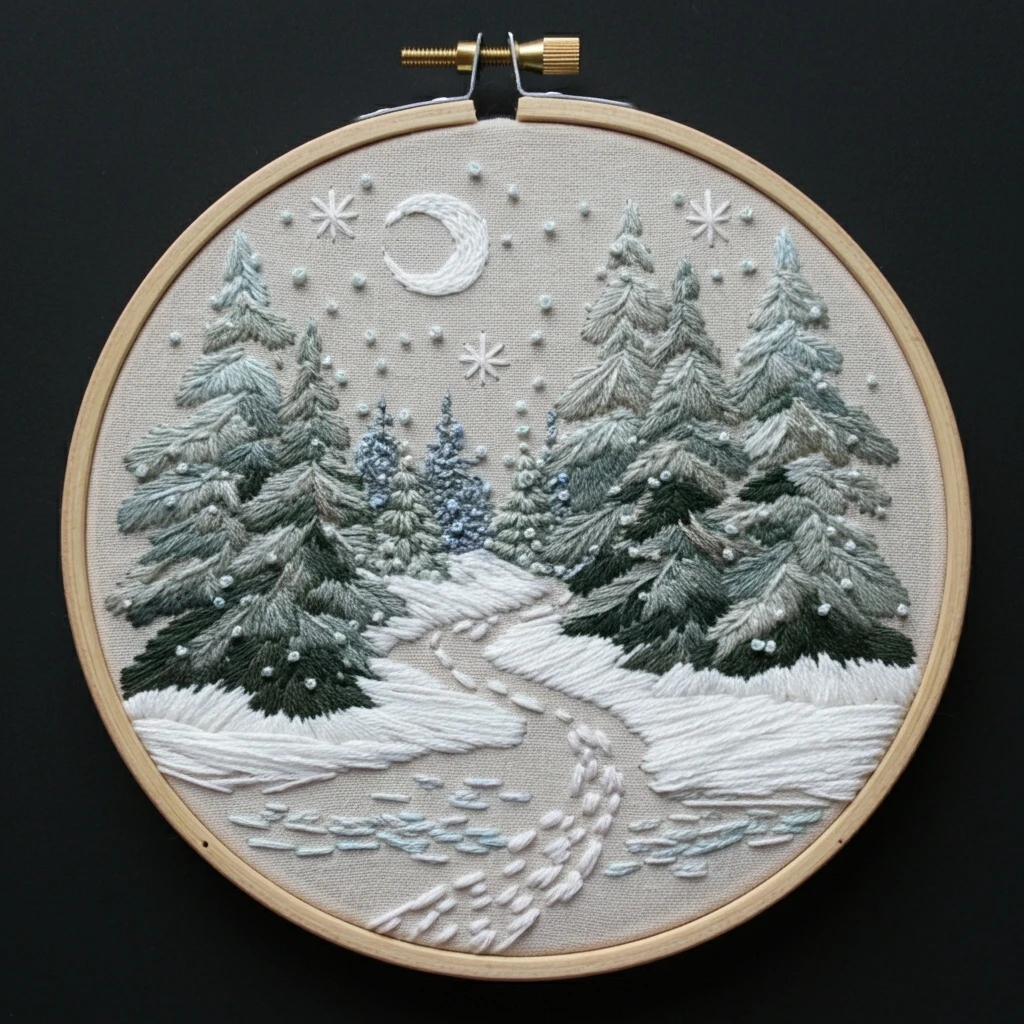
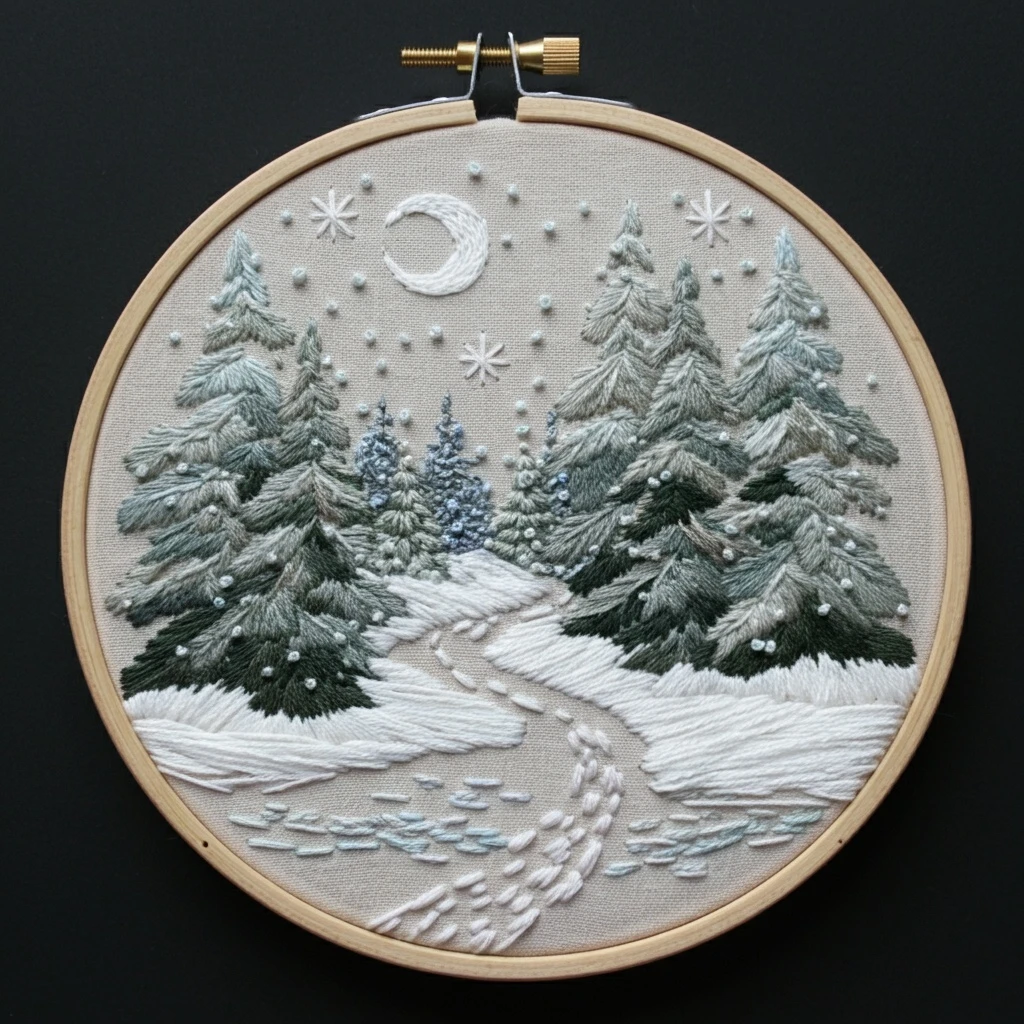
A calm woodland scene with a pale snow-covered path winding into dark evergreens. The design relies on cool blue-gray shadows, soft white highlights, muted bark browns, and dense green-black tree texture to create depth.
snowy landscape
evergreen texture
beginner friendly layers
soft perspective
Design read
Main impression:
quiet winter path framed by tall trees, with the brightest values reserved for snowbanks and the central trail.
quiet winter path framed by tall trees, with the brightest values reserved for snowbanks and the central trail.
Color mood:
cool whites, pale blue shadows, charcoal evergreen masses, and restrained brown-gray trunks.
cool whites, pale blue shadows, charcoal evergreen masses, and restrained brown-gray trunks.
Stitch priority:
preserve the path shape first, then add tree silhouettes, branch texture, and small snow accents last.
preserve the path shape first, then add tree silhouettes, branch texture, and small snow accents last.
For a polished finish, avoid filling every snowy area solidly. Let the fabric show through in the lightest sections, then stitch only the shaded edges, ruts, and tree-cast shadows.
Suggested DMC floss palette
This palette balances bright snow, blue winter shade, dark pine structure, and understated bark. Use fewer strands in the distance and heavier texture in the foreground.
DMC B5200
Snow White
Cleanest sparkle on snow caps, path highlights, and tiny branch snow.
DMC 3865
Winter White
Softer snow fill where pure white would look too stark.
DMC 762
Pearl Gray
Subtle snow shadows and distant mist between trees.
DMC 415
Pearl Gray
Cooler blue-gray ruts along the path and shaded snowbanks.
DMC 932
Antique Blue Light
Icy blue cast for deeper snow shade, especially near tree bases.
DMC 931
Antique Blue Medium
Use sparingly for the strongest cold-shadow accents.
DMC 3052
Green Gray Medium
Muted evergreen midtone; ideal for layered pine needles.
DMC 3363
Pine Green Medium
Deep tree boughs, shaded foliage clumps, and forest depth.
DMC 3371
Black Brown
Deepest tree interiors, trunk creases, and tiny high-contrast details.
DMC 844
Beaver Gray Ultra Dark
Neutral trunk outlines that stay softer than black.
DMC 3782
Mocha Brown Light
Exposed bark, path earth peeking through snow, and warm balance.
DMC 613
Drab Brown Very Light
Soft beige trail warmth and dry grass hints under snow.
Stitch map & texture plan
| Area | Suggested stitches | Thread count | Practical notes |
|---|---|---|---|
| Snowy path | long-and-short, split stitch, scattered straight stitch | 1–2 strands | Follow the curve of the path. Keep center strokes lighter and place blue-gray stitches along the edges to show perspective. |
| Snowbanks | satin stitch accents, seed stitch, tiny couching | 1 strand for shade, 2 for foreground | Use B5200 only at crests; blend 3865 + 762 for soft snowy volume. |
| Evergreens | fishbone, fly stitch, fern stitch, irregular straight stitches | 2 strands foreground, 1 strand distance | Layer 3052 over 3363, then add a few 3371 marks inside the densest boughs. |
| Tree trunks | stem stitch, split back stitch, couching | 1–2 strands | Outline with 844 rather than black. Add narrow 3782 highlights on the side facing the path. |
| Distant forest | single-strand running stitch, tiny vertical straight stitch | 1 strand | Reduce contrast in the background; distant trees should look misted and slightly broken. |
| Falling snow / sparkles | French knots, colonial knots, tiny detached chain | 1 strand | Add after all shading is complete. Keep knots unevenly spaced for a natural snow effect. |
Blending, outlining & shading guidance
Blended needles
- For soft snow shadows, thread one strand 3865 with one strand 762.
- For colder path dips, blend 762 + 415, then add a few single 932 strokes only where the shade is deepest.
- For pine boughs, combine 3052 + 3363 in two-strand stitches to avoid a flat block of green.
- For bark, blend 844 + 3782 for warmer trunks near the foreground.
Outlining details
- Use split back stitch for the path edges so the curves remain clean but not harsh.
- Reserve 3371 for selective dark accents under branches and inside tree bases.
- Break trunk outlines into short segments; continuous lines can make the forest look cartoon-like.
- Add final B5200 stitches on upper branch edges to suggest snow resting on limbs.
Depth trick: make foreground stitches longer, darker, and more textured; make distant stitches shorter, paler, and more vertical. This keeps the winding path readable.
Beginner-friendly working order
- Transfer the main path, tree trunks, and horizon line lightly; avoid overmarking snowy spaces.
- Stitch the palest snow shadows first with 3865, 762, and 415 using one strand.
- Add tree trunks with stem or split stitch, keeping distant trunks thin.
- Build evergreen clusters from dark to light: 3363, then 3052, then tiny white snow highlights.
- Define the path edges with soft broken stitches rather than a heavy outline.
- Finish with knots and bright white accents only after the scene feels balanced.
Hoop, fabric & finishing notes
Fabric:
natural linen, pale cream cotton, or light gray-blue fabric. A slightly tinted ground makes white snow easier to see.
natural linen, pale cream cotton, or light gray-blue fabric. A slightly tinted ground makes white snow easier to see.
Needle:
size 7–9 embroidery needle for 1–2 strand work. Switch to a sharper needle for dense evergreen texture.
size 7–9 embroidery needle for 1–2 strand work. Switch to a sharper needle for dense evergreen texture.
Hoop tension:
keep the fabric drum-tight before stitching long snow strokes so the path does not pucker.
keep the fabric drum-tight before stitching long snow strokes so the path does not pucker.
Press from the back on a folded towel to protect French knots and textured pine boughs. Trim traveling threads behind the snow areas because pale sections can reveal dark carry threads.