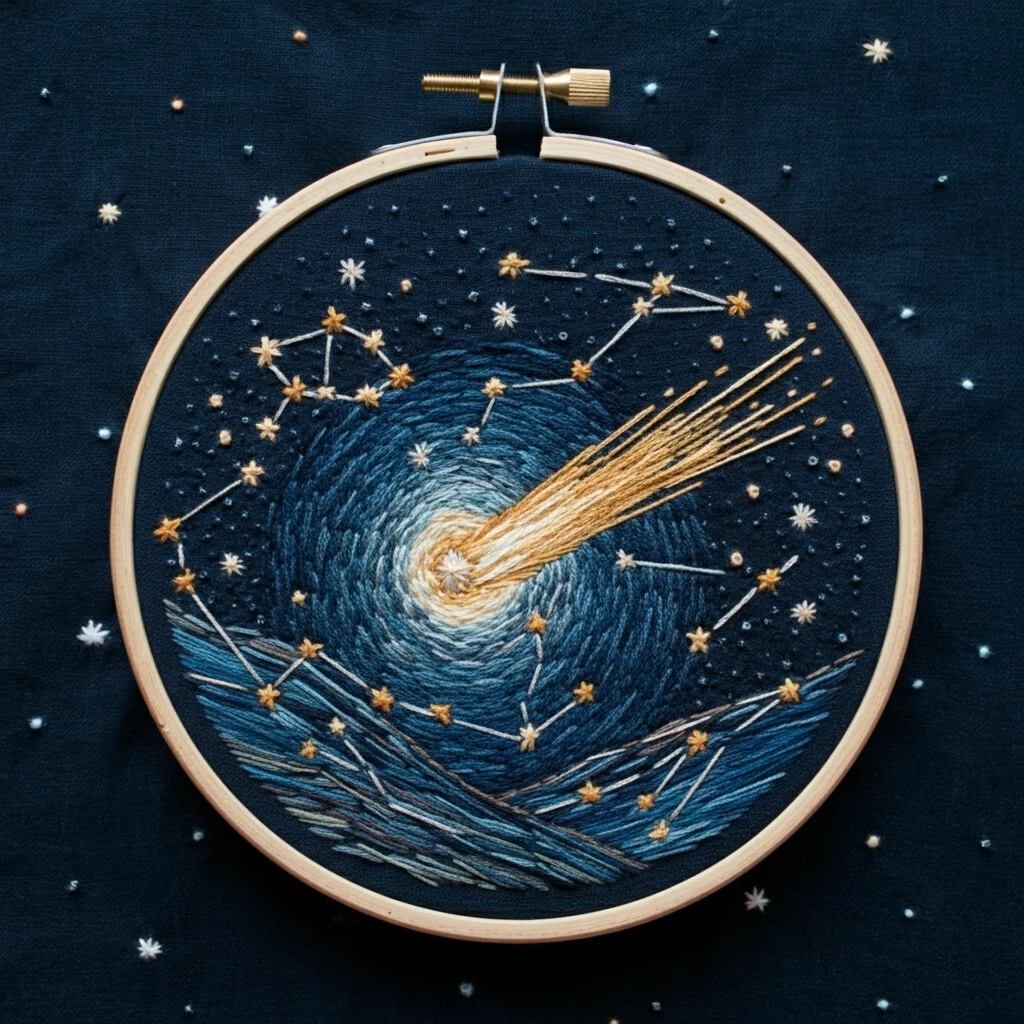


Celestial Comet
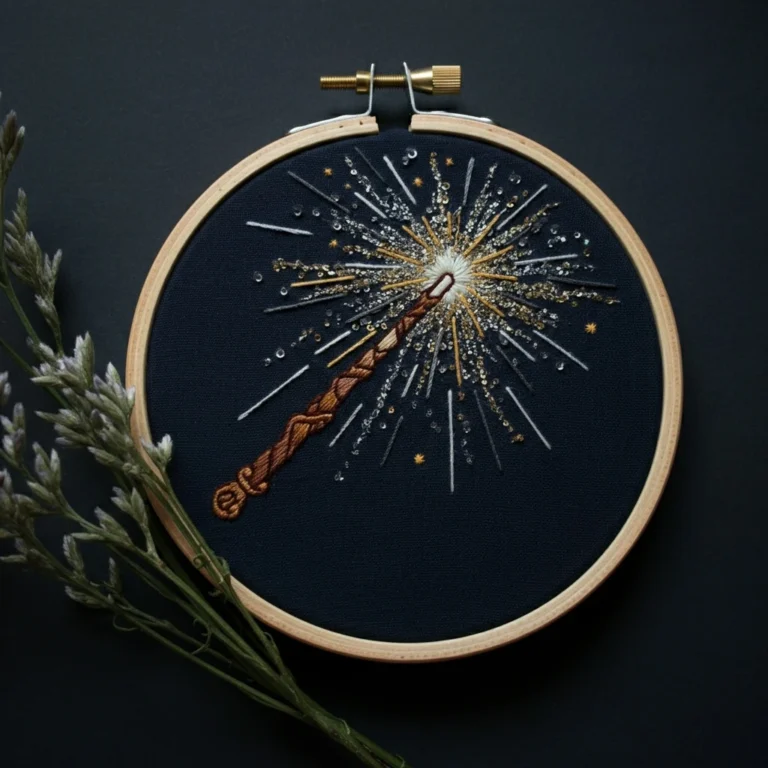
This design captures the feeling of a bright comet traveling through a starry sky, with a glowing head, a tapered luminous tail, and delicate constellation-like accents. The strongest stitched version keeps the comet trail graceful and directional, uses a warm-to-cool color shift for movement, and adds tiny star details sparingly so the main comet remains the focal point.
Polished DMC Color Palette
This palette is designed for a gentle cosmic look: warm gold and cream for the comet core, lavender and blue for the cooler edge glow, and deeper plum-gray tones for subtle definition. It works especially well on light fabric, where the colors stay airy and luminous.
Stitch Map by Design Element
Thread Count & Blending Guide
Fine details
Use 1 strand for constellation lines, tiny stars, trail-edge sparkles, outline corrections, and delicate finishing stitches. One strand keeps the celestial details elegant.
Main fills
Use 2 strands for the comet head, the main tail bands, and any prominent star motifs. Two strands give enough coverage while still allowing soft color transitions.
Raised sparkle
Use 2–3 strands for French knots and the brightest focal stars. Three strands works best only for selected stars close to the comet head.
Shading, Outlining & Texture Suggestions
Creating comet movement
- Follow the same sweeping direction with nearly all tail stitches.
- Keep the densest stitches near the comet head and lighten the tail as it extends.
- Break the tail into grouped streaks instead of one solid block.
- Let a few tiny star stitches drift just beyond the tail edge for motion.
Building celestial glow
- Place 3865 at the brightest point only; it will stand out more when used sparingly.
- Use 822 or 928 beside pale highlights to soften the transition.
- Keep blue and lavender on the outer edge of the glow for a cool cosmic feel.
- Use small gaps of fabric as negative space to keep the comet airy.
Starfield balance
- Cluster more stars near the comet head and fewer farther away.
- Mix knot stars with straight-stitch stars for a varied texture.
- Use gold and cream as the main star colors, with lavender and blue as supporting accents.
- Avoid filling every open area; the emptier spaces help the comet glow feel stronger.
Outlining approach
- Outline only the comet head or selected star motifs if they need extra definition.
- Use 154 or 3799 sparingly to avoid a harsh graphic look.
- Split stitch is excellent for curves, while back stitch works well for tiny straight details.
- Finish outlines last so they sit neatly above fills and sparkle stitches.
Beginner-Friendly Stitching Order
- Transfer the main arc: mark the comet head, tail curve, and the position of only the largest stars or constellation points. Add tiny star dots later as you stitch.
- Work the comet head first: build the focal glow so you can judge how bright the tail should be.
- Stitch the main tail bands: move outward from the head, keeping stitch direction consistent and gradually fading the density.
- Add soft haze: place lighter lavender and blue edge stitches around the main tail.
- Stitch stars and constellation marks: add the larger stars, then the smaller seed stitches and knot accents.
- Finish with detail work: add tiny cream highlights, selective outlines, and any final balancing stitches.
Practical Tips for a Clean Finish
Fabric & hoop
Warm cream cotton, linen, or cotton-linen complements this palette beautifully. A smooth, tightly hooped surface helps the long comet stitches stay graceful and prevents wobbly curves.
Needle choice
Use a sharp embroidery needle size 7–9 for one- and two-strand work. If you add many French knots, keep a slightly larger needle nearby for easier wraps and smoother pull-through.
Keep the tail elegant
If the tail begins to look too thick, stop adding full rows and switch to broken highlight stitches or soft seed stitches. That keeps the comet light and flowing.
Check the glow from a distance
Step back after stitching the comet head and first part of the tail. It is easier to see whether the warm-to-cool transition is balanced before all the star details are added.