

DMC color palette · stitch planning · finishing notes
Tree of Life with Rosette Flowers
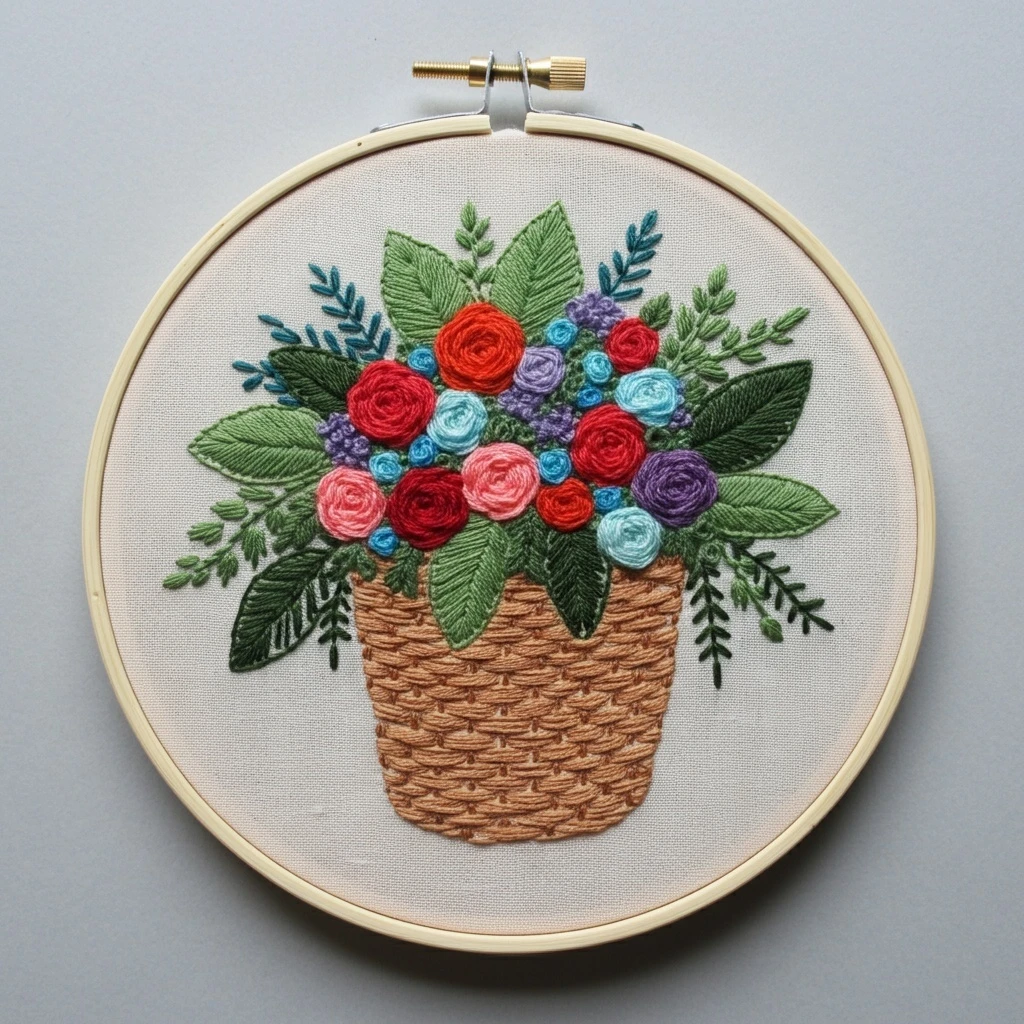
A lush botanical embroidery guide inspired by the reference image: layered leafy branches, dimensional rosette flowers in scarlet, coral, aqua, and violet, deep evergreen shadows, and warm bark-like brown texture. The design works beautifully as a compact hoop centerpiece with strong color contrast and raised floral detail.
Design Read: What to Capture
Visual mood
The reference feels abundant and celebratory: dark green foliage forms a generous canopy, while bright red, coral, aqua, and violet rosettes sit like jewels across the center. A warm brown base or trunk texture grounds the piece and gives the flowers a handcrafted folk-art charm.
Embroidery priorities
Prioritize dimensional flowers, directional leaf veins, and strong contrast between pale blue highlights and deep green shadows. Keep the center dense, then let small sprigs and narrow leaves extend outward to create the Tree of Life silhouette.
Suggested DMC Palette
These DMC colors are selected to match the visible garden greens, deep leaf shadows, scarlet and coral rosettes, turquoise buds, lavender-violet flowers, and warm brown bark texture in the design reference.
Motif-by-Motif Stitch Suggestions
| Area | Recommended stitches | Threads | Color handling |
|---|---|---|---|
| Large red rosettes | Woven wheel, whipped spider-web rose, or tight stem-stitch spiral. | 4–6 strands for raised roses; 2 strands for inner spiral accents. | Begin centers with 816, build petal body with 321, and add tiny 350 accents where petals catch light. |
| Coral-pink flowers | Loose woven wheel, padded satin petals, or small spiral backstitch. | 3–5 strands depending on desired height. | Use 350 as the main shade, 352 on the outer turns, and a single touch of 321 near the center for warmth. |
| Aqua rosettes and buds | Small woven wheels, colonial knots, French knots, detached chain buds. | 2–4 strands for flowers; 2 strands for knots. | Use 3846 for saturated blue centers and 3844 for pale outer wraps. Add 3810 for cool shadowed buds. |
| Violet clusters | French knots, woven wheels, lazy daisy petals, or short satin petals. | 2–3 strands for knots; 4 strands for small rosettes. | Place 550 in the center or lower edge and 340 on raised petal turns. |
| Large leaves | Fishbone stitch, long-and-short stitch, closed fly stitch, or directional satin stitch. | 2–3 strands for leaf fill; 1 strand for veins. | Shade from 890/895 at the base to 989/988 near tips. Keep leaf direction consistent for a ribbed botanical look. |
| Fine side sprigs | Stem stitch branches with detached chain, straight stitch, or fly stitch leaflets. | 1–2 strands. | Use 3810 for blue-green sprigs and 895/989 for natural green sprigs. Alternate colors so the foliage does not look flat. |
| Tree trunk or woven base | Stem stitch rows, split stitch, couching, seed stitch, and short horizontal straight stitches. | 2–3 strands for texture; 1 strand for grooves. | Lay 434 as the base, add 433 for grooves, then finish only the deepest separations with 3371. |
| Final outlines | Back stitch, split stitch, tiny couching, or single straight stitches. | 1 strand for most details; 2 strands only on the lowest trunk edge. | Use color-matched outlines first; reserve 3371 for tiny final definition only. |
Blending & Shading Plan
Rosette dimension
For the red rosettes, work from a dark center outward: 1 strand 816 + 1 strand 321 for the first wraps, pure 321 for the main body, then a few 350 or 352 stitches on the upper petals.
Leaf depth
Use directional shading. Blend 1 strand 895 + 1 strand 989 for mid leaves, and use 890 only where leaves tuck beneath flowers. Add 988 as small highlights near leaf tips and raised veins.
Cool accents
The turquoise and violet details keep the design lively. Pair 3846 + 3844 for blue flowers and 550 + 340 for violet flowers, placing the lighter strand on the upper-left petal arcs.
Thread Count & Texture Map
| Texture goal | Thread count | Where to use it |
|---|---|---|
| Raised, plush flower centers | 5–6 strands | Large woven rosettes and the boldest red blooms. |
| Small round flowers and buds | 3–4 strands | Aqua mini roses, coral rosettes, and violet flower clusters. |
| Clean leaf fill | 2–3 strands | Fishbone leaves, satin leaf sections, and larger greenery. |
| Fine sprigs and veins | 1–2 strands | Side foliage, narrow stems, leaf midribs, and detached chain leaflets. |
| Bark grooves and final definition | 1 strand | Trunk texture, flower overlap lines, and the deepest shadows. |
Outlining Details
Outline by color family
Use 816 around red petals, 350 around coral petals, 3810 around aqua buds, 550 around violet clusters, and 895 or 890 around leaves. This keeps the image dimensional without a heavy cartoon outline.
Reserve the darkest thread
Use 3371 only in the deepest overlaps: between trunk rows, under dense flower clusters, and at a few leaf tips. Too much dark brown will flatten the cheerful rosette palette.
Practical Embroidery Tips
- Fabric: Natural linen, cotton-linen, or evenweave in oatmeal, flax, warm beige, or pale grey will support both the greens and bright rosettes.
- Transfer: Mark flower circles and major leaf shapes clearly, but keep tiny sprigs lightly drawn so they can be adjusted around raised flowers.
- Needles: Use a chenille needle for woven rosettes and a sharp embroidery needle for fine veins, knots, and trunk grooves.
- Layering: Complete background foliage before stitching raised rosettes. Raised flowers should sit on top of leaves, not be squeezed under them.
- Hoop tension: Keep the fabric drum-tight before woven wheels; loose fabric can pucker around thick rose foundations.
- Knot control: For berry-like blue or violet buds, vary French knot size with 2 wraps for tiny dots and 3 wraps for larger buds.
- Finishing: Steam from the back and never press directly on woven roses, knots, or padded leaf sections.
Quick Stitch Recipe
- Transfer the trunk/base, main leaf silhouettes, rosette circles, and outer sprigs with a removable fabric pen.
- Work the trunk or base texture in 434 and 433 using horizontal stem stitch rows and small groove stitches.
- Stitch background leaves with fishbone or long-and-short stitch, shading from dark bases to lighter tips.
- Add side sprigs in 3810, 895, and 989 using stem stitch with detached chain leaflets.
- Create the red and coral rosettes with woven wheel stitch, shifting from darker centers to brighter outer wraps.
- Add aqua and violet mini flowers as small woven wheels or French knot clusters.
- Finish with 1-strand veins, color-matched outlines, and a few 3371 accents only where contrast is needed.