
Blossoming Tree With Roots
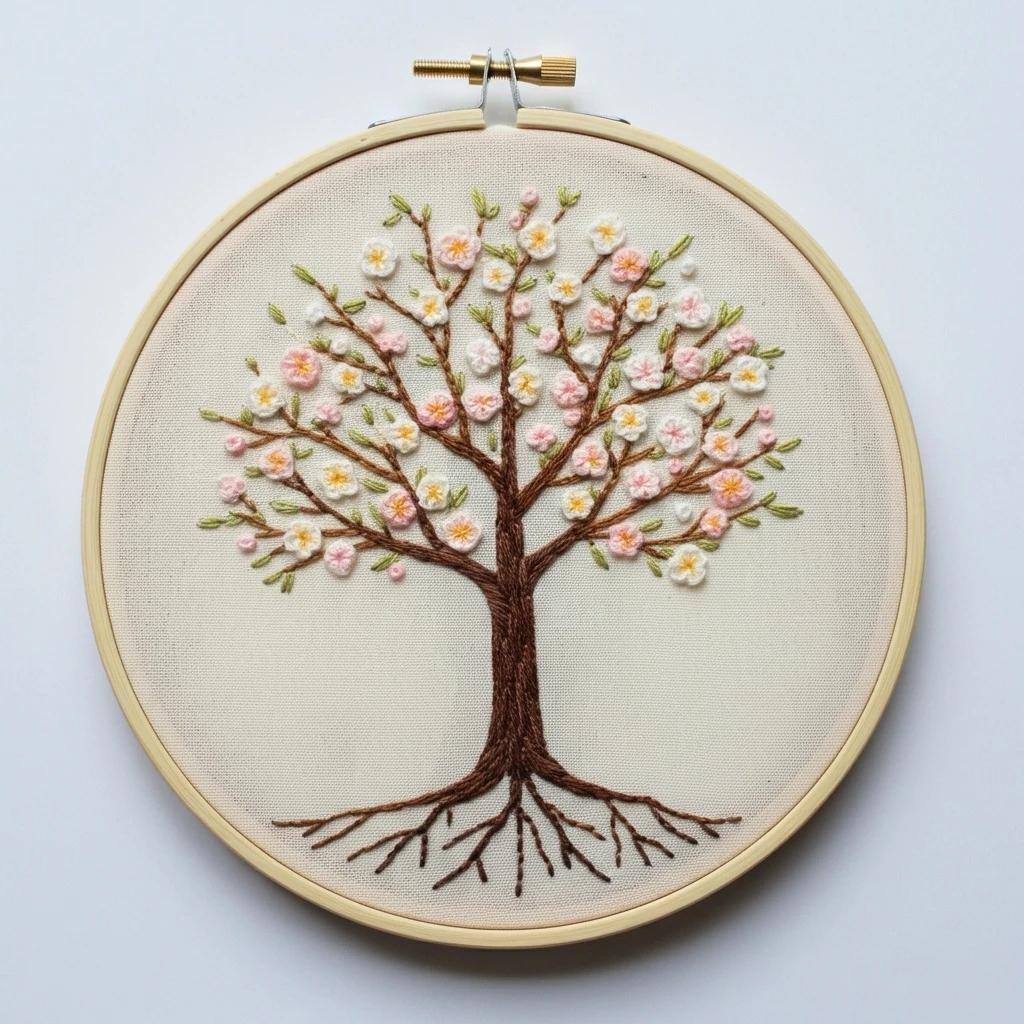
A graceful tree-of-life style design with warm brown roots, textured bark, fresh green leaves, and soft pink blossoms. The stitching approach works best when the trunk is grounded first, then built upward into light, airy flower clusters.
Design color read
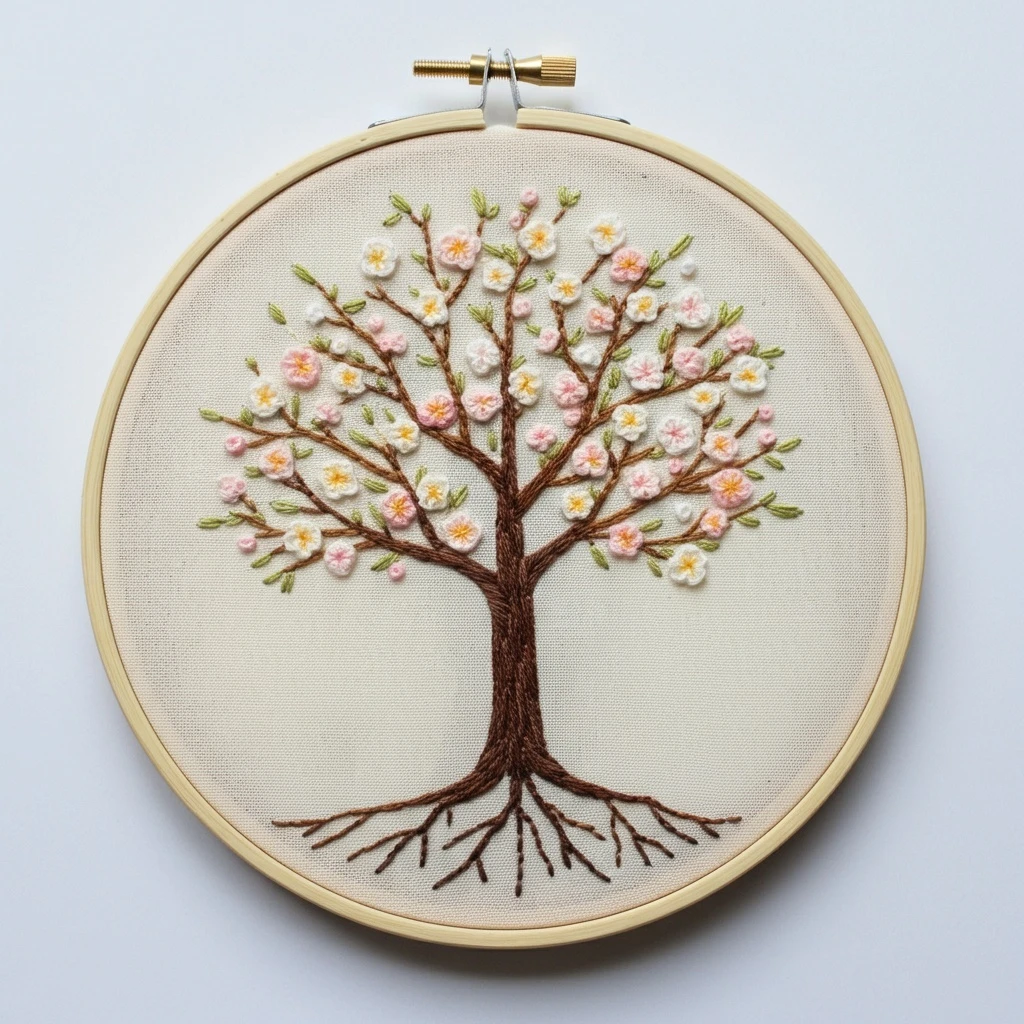
The reference design is built around a strong central tree silhouette: dark curling roots anchor the lower half, a warm brown trunk rises into branching arms, and the canopy is softened by clustered pink blossoms with small green leaves. The palette keeps the roots slightly darker than the trunk, uses rosy petal shades in layered values, and adds enough green to stop the blossoms from looking flat.
Suggested DMC palette
Stitch types by design area
Trunk & main roots
Stem stitch, split stitch, long-and-short shading
Use 2 strands for the outer trunk contour and 1 strand inside narrow root lines. Follow the direction of the bark: vertical on the trunk, sweeping outward along each root.
Fine root tips
Back stitch, whipped back stitch
Use 1 strand of 3371 or 938 so the tips stay delicate. Whip only the thicker visible roots to avoid bulk.
Bark texture
Seed stitch, tiny straight stitches, couching
Add scattered 1-strand marks in 433, 3863, and 3857 after the trunk is outlined. Keep the marks irregular so the tree feels organic.
Blossom clusters
Lazy daisy, detached chain, woven wheel, French knots
Use 2 strands for petals and 1 strand for small background blossoms. Mix 224, 151, and 223 in the same cluster for a soft blooming effect.
Leaves
Fishbone stitch, satin stitch, detached chain
Use 1-2 strands depending on leaf size. Place the darkest green under blossoms and the lightest green on outer tips.
Ground accents
Seed stitch, fly stitch, small straight stitches
Keep the base airy; a few greens and gold dots can suggest moss and fallen petals without crowding the root shape.
Outlines
Back stitch, stem stitch
Outline the most important silhouette lines only: trunk edge, large roots, major branches. Leave some blossom edges unoutlined for softness.
Thread-count guidance
- 1 strand: fine root tips, inner bark cracks, blossom centers, small leaves, and delicate branch ends.
- 2 strands: most trunk outlines, main roots, petals, medium leaves, and visible decorative lines.
- 3 strands: only for the thickest lower trunk or bold root base if the pattern is enlarged; otherwise it can overpower the airy flowers.
- Needle choice: a size 7-9 embroidery needle works well for 1-2 strands on cotton or linen. Use a sharp needle if the fabric is tightly woven.
Blending, shading & texture ideas
Bark blend
Thread one strand of DMC 938 with one strand of DMC 433 for the trunk's main body. Add DMC 3863 as broken highlight stitches along one side of the trunk and upper root ridges.
Root depth
Use DMC 3371 in the under-crossing root sections and switch to 938 or 433 on top surfaces. This simple dark-to-mid shift makes the roots look layered.
Blossom clusters
Place DMC 3350 and 223 first in the densest flower areas, then add 224 and 151 on top as petal highlights. A few DMC 3865 stitches make the blossoms sparkle.
Leaf contrast
Keep DMC 936 close to the branches, DMC 469 for regular leaves, and DMC 471 for tips or new growth. This keeps the green accents lively but not overpowering.
Recommended stitching order
Beginner-friendly practical tips
- Do not satin-stitch the whole trunk in one direction. Curved stitches make bark and roots look much more natural.
- Keep blossom stitches loose enough to sit softly on the fabric; pulling too tightly can pinch the petals.
- For a fuller canopy, repeat small flower stitches in uneven groups of three or five rather than perfect rows.
- When changing from bark to blossoms, finish dark threads neatly at the back so they do not shadow through pale pink petals.
- Use a hoop that keeps the fabric drum-tight. Root lines look cleaner when the fabric does not shift under the needle.
- Step back often. A tree design reads best when the trunk feels balanced against the blossom mass, not when every tiny area is filled.