
Dark Rowan Tree Berry
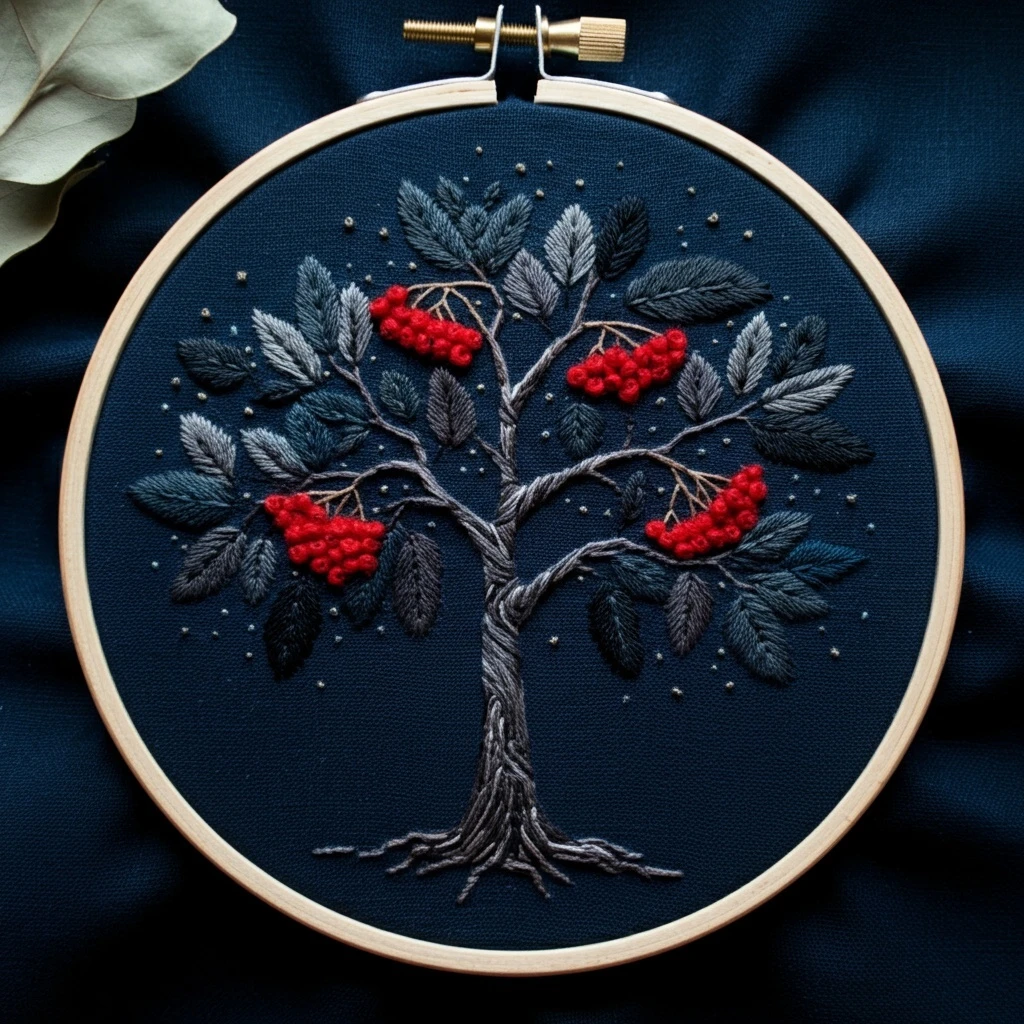
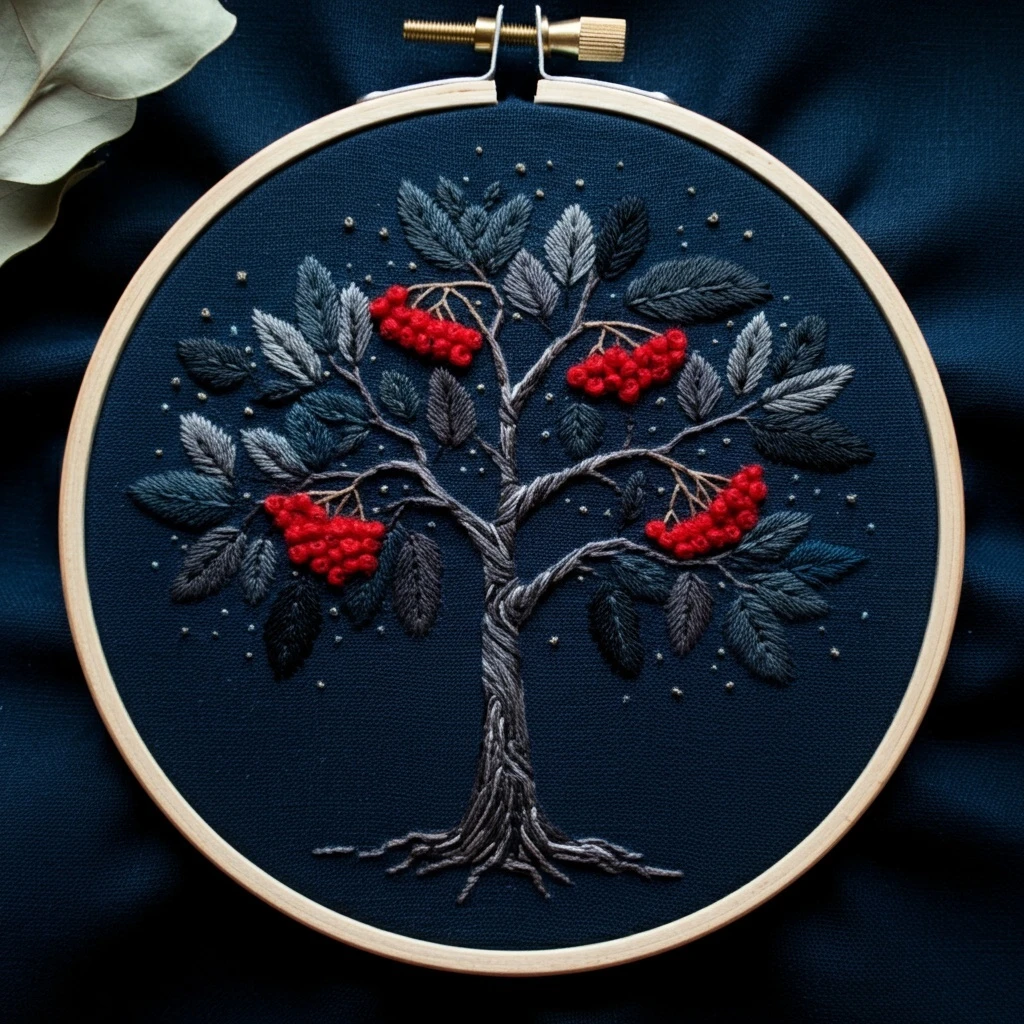
A moody botanical hoop with a charcoal-grey rowan trunk, blue-black foliage, bright raised berry clusters, and scattered winter-sky seed stitches on deep navy fabric. The palette is built for strong contrast: cool greys for bark and leaf veins, smoky blue-greens for leaves, and saturated reds for the berries.
Polished DMC Color Palette
Use the darkest tones sparingly so the design keeps its night-garden softness. The red berries should be the clearest focal point, with the greys and blue-greens supporting the tree structure.
Stitch Map by Design Element
Tree trunk and roots
Work the trunk as twisted, layered bark instead of a flat column.
- Use split stitch or stem stitch for the central trunk lines with 2 strands of DMC 414.
- Add long-and-short stitches in 3799, 414, and 318 to build ridges and grooves.
- For roots, switch to 1 strand and let lines taper naturally; avoid making every root the same length.
- Place a few DMC 415 single-strand highlights on the left-facing ridges only.
Leaves
The leaves are narrow, feathered, and cool-toned, so directional stitch placement matters.
- Outline each leaf with split stitch in 924 or 939 using 1 strand.
- Fill with fishbone stitch for simple leaves; use satin stitch for tiny oval leaves.
- Blend 924 at the base into 926, then add 927 near the upper center vein.
- Keep the stitch direction angled toward the leaf tip for a crisp botanical look.
Berry clusters
The berries should be raised and vivid against the dark fabric.
- Use French knots with 2 strands wrapped twice for medium berries.
- For larger berries, make a colonial knot or a tiny padded satin dot.
- Place 815 knots first in the shaded rear area, then 321 over most of the cluster.
- Add tiny 666 highlights to the upper-left side of selected front berries.
Twigs, stems, and night dots
Fine details keep the composition delicate and prevent the dark palette from feeling heavy.
- Use 1 strand of 3782 for berry stems with back stitch or whipped back stitch.
- Use 318 for pale twig accents where branches cross the berries.
- Scatter seed stitches in 415 and 927 around the canopy, varying length and spacing.
- Do not make all dots identical; use tiny straight stitches, single knots, and occasional beads if desired.
Thread Count, Blending & Shading Guide
| Area | Recommended strands | Color handling | Practical note |
|---|---|---|---|
| Trunk outline | 2 strands | 414 with 3799 in the deepest grooves | Keep the outer contour slightly irregular so the bark looks organic. |
| Bark highlights | 1 strand | 318 and very small touches of 415 | Use fewer highlights near the base to preserve the dramatic dark center. |
| Large leaves | 2 strands | 924 to 926, tipped with 927 | Blend by alternating colors in adjacent long-and-short or fishbone stitches. |
| Small leaves | 1–2 strands | 939 for shadow leaves; 927 for lifted leaves | One-strand work gives the small leaves a refined, fern-like texture. |
| Berries | 2 strands | 815 shadow, 321 body, 666 highlight | Cluster knots close together but leave a few tiny dark gaps for separation. |
| Snow/star speckles | 1 strand | 415, 927, and occasional 318 | Stitch after the tree is finished so the speckles sit around, not under, the branches. |
Texture Suggestions for a Dark Botanical Finish
Raised berries
Add a tiny straight stitch under each berry before the knot if you want extra lift. This makes the red clusters stand forward from the flat leaf stitching.
Feathered foliage
Use fishbone stitch with imperfect edges. Slightly uneven lengths mimic rowan leaves and keep the canopy from looking too graphic.
Dimensional bark
Work trunk lines in layers: first a split-stitch skeleton, then long-and-short shading, then a few whipped lines for raised ridges.
Beginner-Friendly Stitching Order
- Transfer the tree outline lightly using a white or pale blue removable marking pencil suitable for dark fabric.
- Stitch the trunk and main branches first so the leaf and berry placement has a strong structure.
- Add larger leaves next, starting with the darkest leaves in 939 and 924, then build toward lighter 926 and 927 leaves.
- Stitch berry stems in 3782 before adding knots, because stems are harder to place once berries are raised.
- Add berry knots from back to front: 815 first, 321 second, and 666 highlights last.
- Finish with seed stitches and tiny sparkle dots around the canopy, stepping back often to keep the spacing airy.
Finishing Notes
Mount the finished piece taut in a pale wood hoop to echo the sample’s contrast between warm hoop and cool fabric. Press only from the back on a padded towel so the French knots and bark ridges are not flattened. If the navy fabric attracts lint, use a clean lint roller before final framing and keep the raised berry clusters untouched.